
A pump is easier to use when you can press the head, catch the liquid, and leave the bottle standing. Those are design problems, not a ranking of brands. The Arthritis Foundation’s Ease of Use guide for rigid-packaging components, and a preview of ISO 22015:2019, were both read on 15 October 2026. The bottles in the photograph have no labels. This note does not name a price, a score, or a shop.
The ISO preview says the standard does not apply to products regulated for safety, including medicinal products and medical devices. The clauses below are about ordinary consumer packs. They are not instructions for a medicine bottle. If you are deciding when to wash hair, that is the hair note, which is also general information.
What the hand has to do
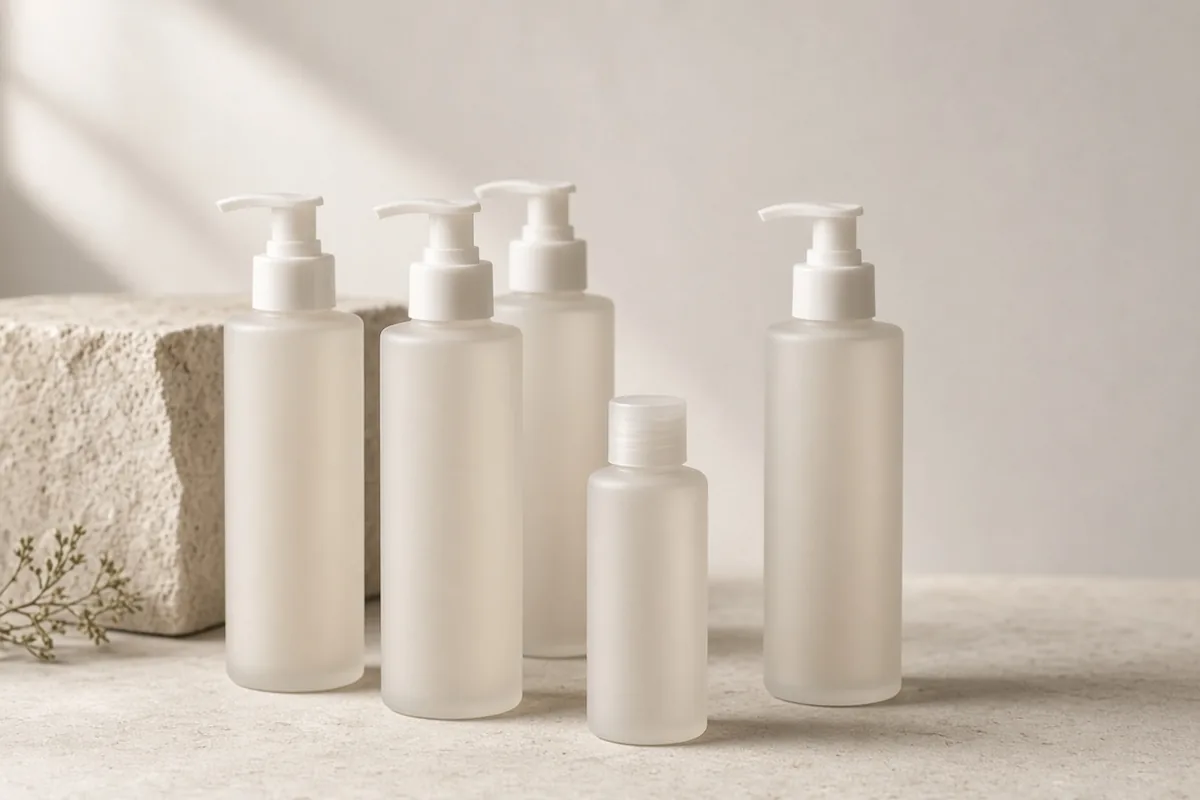
The Arthritis Foundation guide describes a pump as a rigid component that disperses a small, measured amount of product. It is built from dozens of parts. The guide looks only at the parts the user touches. You press the head with one hand while the other hand catches the product. The head travels down, the pump starts, and the liquid lands in the open hand.
The guide’s short list for a pump asks for a comfortable grasp, a clear place to press, a low dispense force, a comfortable depression area, a nozzle that is long enough, a lock you can operate and see, and a nozzle plug that is either absent or easy to remove.
It then says most pump closures designed for one hand will be accessible to people with arthritis. Excessive activation force, or a nozzle plug or seal, may make a pump difficult. A nozzle that is too short may be hard to use with one hand. A nozzle that is small or has sharp edges may be uncomfortable.
On force, the guide is specific. It tells designers to keep the force needed to depress the pump closure below 3.0 pounds through the closure’s range of motion. It also says the top should be large enough to press with the palm, because a palm press can be easier than a press with one finger, and large enough for at least a two-finger press. A shaft that binds when the press is slightly off line can make the pump hard to move.
The nozzle should be long enough for two ways of working: one hand on the head and the other catching the liquid, or one hand with the fingers curled under the nozzle. The liquid should come out without spilling. The guide says people who have trouble metering force may do better if the stream is not too fast.
The bottle should sit still while you press. The guide asks for a large base, a high-friction or rubberized bottom, and a lower centre of gravity so the bottle is less top-heavy. Higher press forces, it says, make a tip more likely. A grasp note earlier in the same guide, written for larger-diameter containers, asks for a grasp that needs no more than 2.5 to 3.0 inches of grip span.
What the standard preview adds
ISO 22015:2019 is titled Packaging, Accessible design, Handling and manipulation. The preview read here is the first edition, July 2019. It covers holding, lifting, carrying, pulling, pushing, grasping, twisting and tearing, for opening, reclosing, taking contents out, storage and disposal. It says the shape should work when only one hand is free. A non-slippery finish helps the hand use its strength. One example is the pinched waist of a PET bottle or a cosmetic bottle. Packages should be balanced so they do not tip on a flat surface.
The preview says you should not have to press and rotate at the same time, except where that double action is there for safety such as child-resistance. Opening actions (grasp, pinch, rotate, twist, tear, push, pull) should be understandable. A reclosing should confirm itself with a mark, a texture, a click, or a force limit. Measured dispensing is useful when the product needs it. Packs should limit splashing and waste. Surfaces shall not have sharp points or harmful edges.
One diameter in the preview is easy to misread. It says 30 mm is commonly used for the diameter of a screw-top on a PET drinking bottle. That sentence is about a drinking bottle, not about the head of a pump.
The personal care section uses these clauses as a checklist you can hold up to a bottle you already own. It does not tell you to buy one.