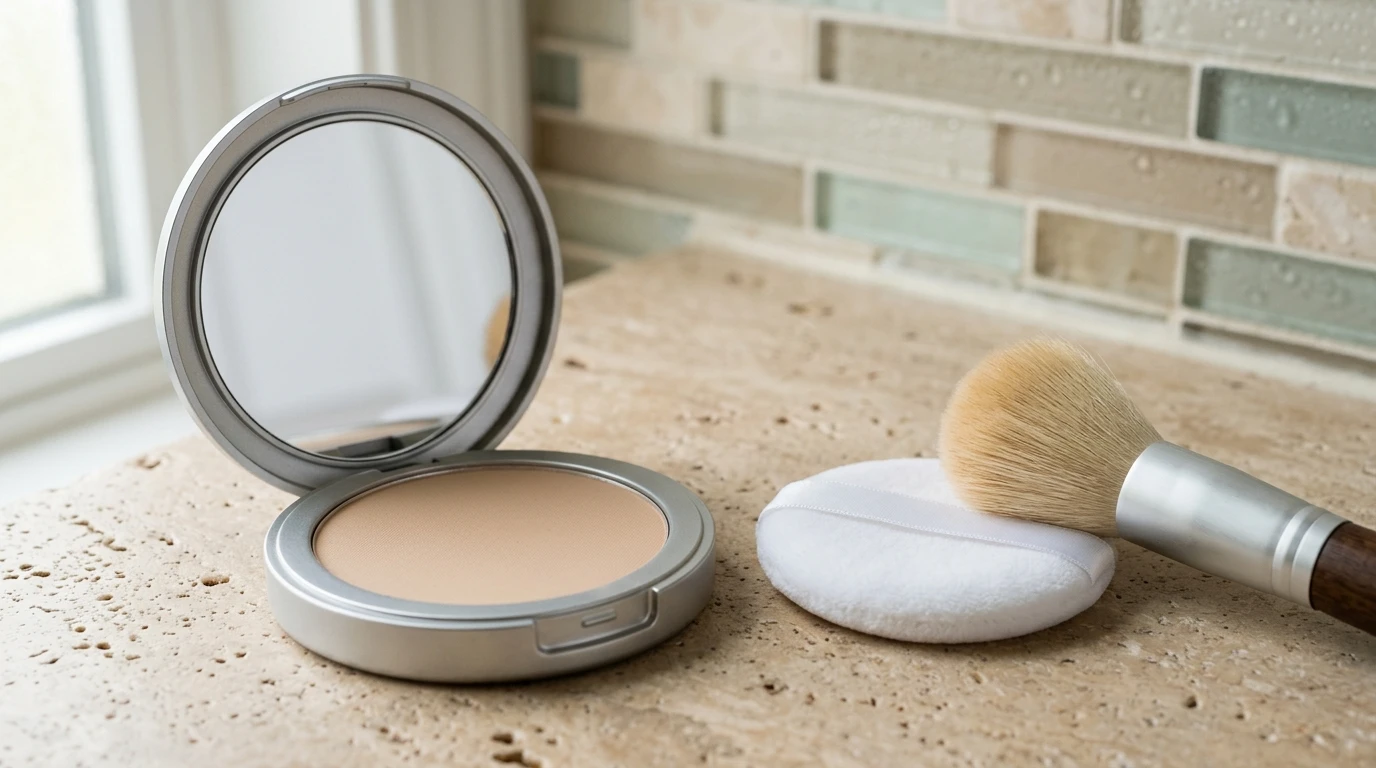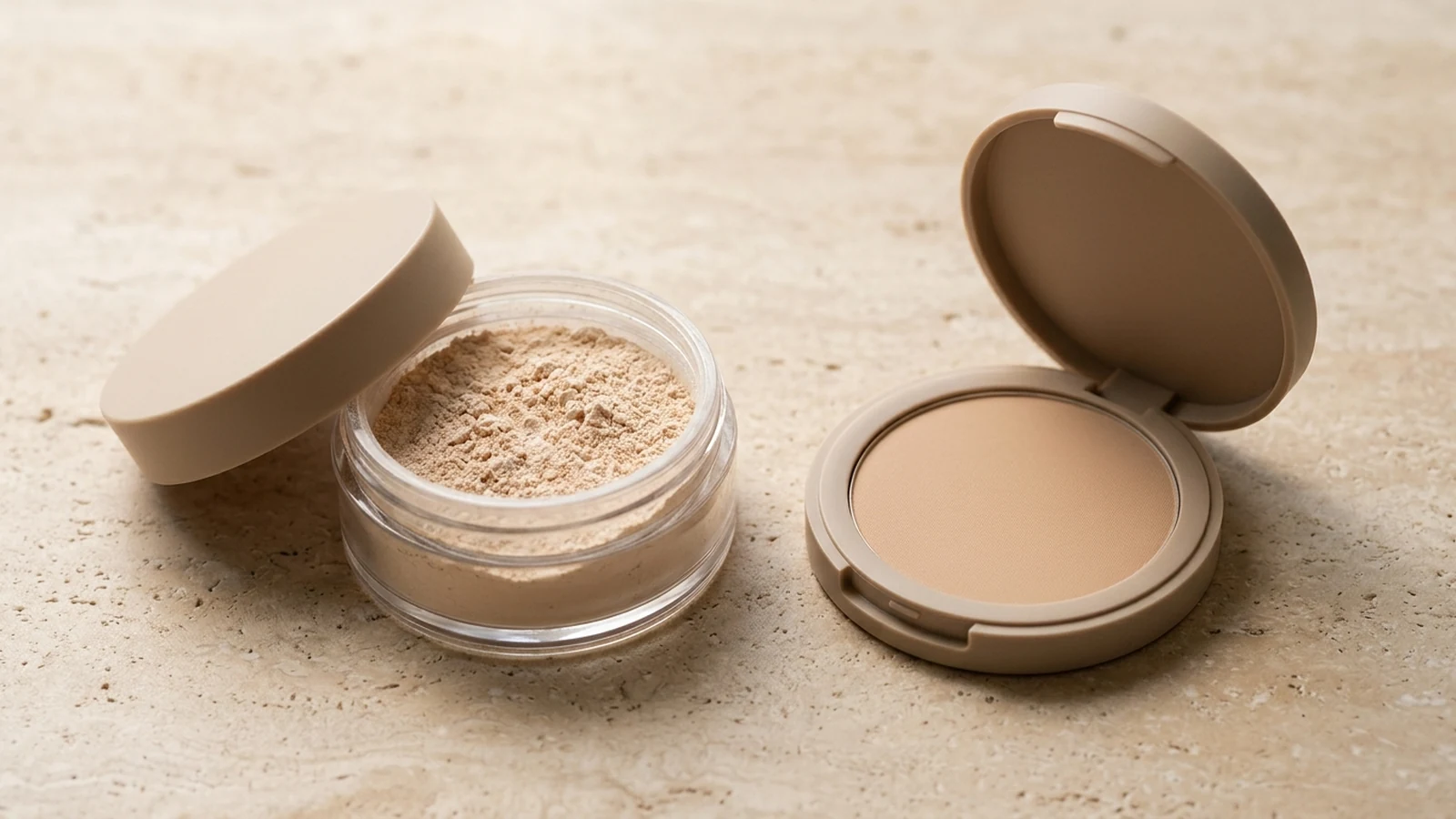
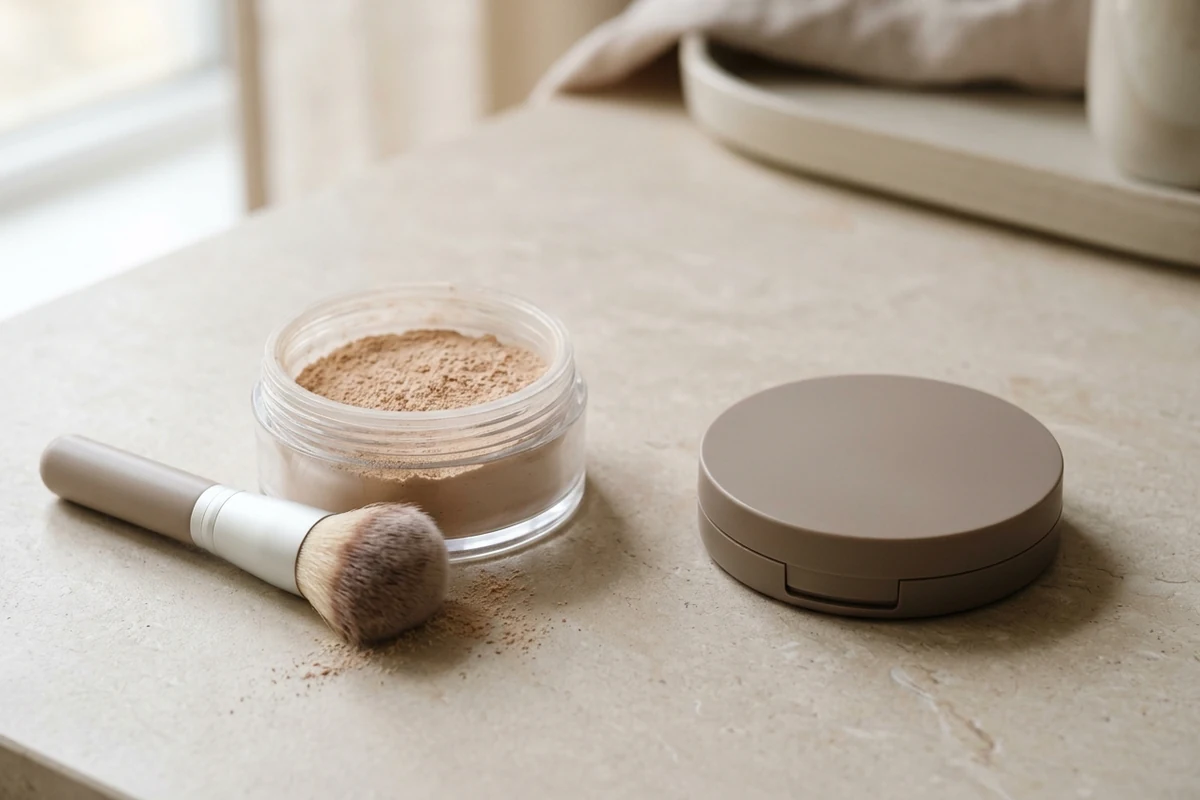
Loose face powder stays free in a jar with small particles that give light coverage, and the face-powder encyclopedia describes it as mattifying shine on oily skin, whereas pressed powder incorporates liquid or solid binders and compression so the cake holds together in a compact for blemish coverage and travel touch-ups. Both forms can set foundation and concealer, and both translucent and finishing powders are made in loose and pressed versions.
Powdered cosmetics span free powders, solids, and freeze-dried items such as body powders, pressed powders, and blushes, relying on binders, slip agents, fillers, and colorants to govern texture, appearance, and wear (PubMed Central powdered-cosmetics review). Within our beauty and hair collection, bathroom moisture, skin-oil surface hardpan, and metal-pan glue sit in the companion note on pressed powder compact humidity and pan adhesion.
| Property or Role | Loose Face Powder | Pressed Face Powder |
|---|---|---|
| Package and physical state | Packaged in a jar as a fine consistency of small particles | Compressed into a cake inside a compact container to resist breaking during transport and consumer use |
| Binder and flow behavior | A benchmark formula with no binder, not sold as a loose face powder, had the lowest Hausner ratio and Carr index | Adding any binder raised the Hausner ratio and Carr index, reducing powder flowability and raising compressibility |
| Coverage and overuse look | Gives light coverage with a smooth, silky texture and absorbs excess moisture on oily skin | Conceals blemishes and discoloration as a light-coverage foundation, while larger particles can look thick and clotted when overused |
| Makeup setting and finishing | Used to set foundation and concealer; translucent and finishing powders include loose forms | Can also set makeup and handles on-the-go touch-ups; translucent and finishing powders include pressed forms |
How Do Binders and Press Force Separate Loose and Pressed Powder?
Binders turn a free-flowing powder bulk into a solid compact cake upon compression by replacing the air between particles and raising particle-to-particle adhesion. In powdered cosmetics, binders combine slip agents, fillers, colorants, and other materials into a cohesive product, while liquid or solid binders in pressed powders replace interstitial air and lower surface tension so intermolecular forces and cake density increase (University of the Arts London binder study).
Liquid binders also wet pigment surfaces by displacing trapped air with liquid, developing full color strength, maintaining color stability, and increasing cohesiveness while reducing powder flow to the target level. Across powdered formulas, oleophilic binders such as liquid paraffin and silicone oils smooth application and stabilize particles, whereas synthetic binders such as polymethyl methacrylate (PMMA) add strong cohesion and a flexible, sleek texture. Slip agents including sorbitan esters, propylene glycol, and PEG-8 optimize dispersion, curb excessive particle cohesion, reduce caking, and leave a silky feel on skin.
Historically, formulators combined gums, sugars, and soaps as binders, whereas nowadays the most common liquid binders are silicone-based or petrochemical hydrocarbon-based, led in pressed powders by cyclopentasiloxane, dimethicone, and dimethicone crosspolymers. Because growing consumer skepticism toward silicones has prompted the use of alternatives, the University of the Arts London study tested three plant-derived liquid emollient binders, including diisooctyl succinate (DOS, an emollient and slip agent with a light cushion and silky after-feel) and castor-oil-derived heptyl undecylenate (HU, a light, dry alternative to cyclomethicone and mineral oils), against medium-weight dimethicone (DM, selected as the most widely used silicone in powder cosmetics) and a no-binder benchmark in a talc bulk preserved with methylparaben and propylparaben and colored with CI 77510 (ferric ferrocyanide, Prussian blue, or iron blue).
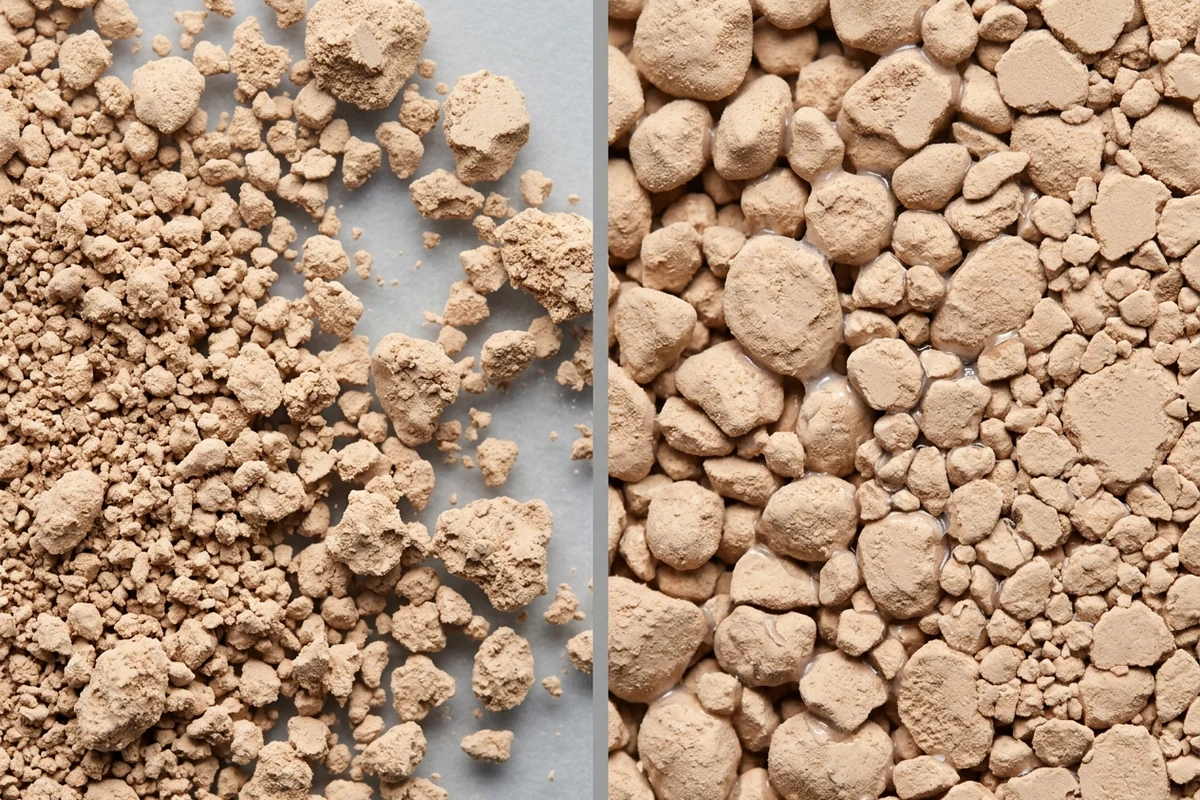
During factory production, binder concentration has to leave the bulk free-flowing enough to blend, travel through hoppers and feeders, and fill pans without inconsistent batches, frequent stoppages, or incomplete filling, yet cohesive enough to form a uniform compact under compression. In the University of the Arts London bulk tests, the no-binder benchmark recorded the lowest Hausner ratio and Carr index, and adding any binder raised both indices, lowering flowability and raising compressibility.
Press pressure usually varies from 300 psi to 2,000 psi depending on composition, binder concentration, press steps, and press duration. Very high compaction pressure produces an overly hard cake with poor payoff and a tendency to glaze from press force, whereas very low pressure yields a soft compact prone to breakage and easy rub-off. Inside the University of the Arts London experiments, cakes pressed at 2,000 psi were harder than cakes pressed at 1,000 psi, probably through greater reduction of interstitial air and stronger intermolecular forces, while the 1,000 psi cakes delivered higher weight reduction, meaning higher payoff. Raising binder concentration reduced payoff as well, requiring formulators to balance cake strength against payoff: medium-weight dimethicone produced the weakest cakes with high payoff, whereas the plant-derived binders gave better cohesion than dimethicone.
How Do Setting Powder, Finishing Powder, and Translucent Powder Differ?
Setting powder and finishing powder name two distinct makeup jobs rather than loose versus pressed physical states, and both jobs exist in loose and pressed forms (Wikipedia Face Powder). Modern face powders are typically used to set makeup, brighten the skin, and contour the face, and the cosmetics encyclopedia groups face powder, setting powder, and setting sprays as products that set foundation or concealer for a matte or consistent finish while concealing small flaws (Wikipedia Cosmetics).
Loose powder comes in translucent or colored versions in a jar, locks in foundation and concealer underneath to smooth out the complexion and limit cracks and lines, and gives light coverage with a fine consistency of small particles. Pressed powder comes in shaded compacts for blemish coverage and travel touch-ups, and it can also be used for setting makeup. Unlike setting sprays, which are generally untinted, setting powder and face powder come in translucent or tinted varieties and can be used to bake foundation so it stays longer on the face.
Translucent powder is not a third physical state: it comes in both pressed and loose forms, and its role is mattifying the skin to cut oiliness and shine. Finishing powder is likewise sold in both pressed and loose forms, where it serves as a final step to minimize fine lines and pores, even out skin texture, and blur imperfections.
How Do Loose and Pressed Powders Differ for Oily and Dry Skin?
On oily skin, the face-powder encyclopedia describes loose powder as assisting in absorbing excess moisture and mattifying the face to reduce shininess, while translucent powder in either pressed or loose form also mattifies oiliness and shine. In the PubMed Central formulation review, oil absorption for longer wear belongs to the fillers named in that review across powdered cosmetics, including mica, kaolin, calcium carbonate, talc, silica, pearl, and nylon, which also contribute sheen, silkiness, and soft-focus effects rather than isolating loose powder in a clinical oil-control trial.
For dry skin, none of the cited formulation papers or encyclopedia entries tests or designates either loose powder or pressed powder as the better choice. Reversing the encyclopedia’s oily-skin lead into a claim that pressed powder suits dry skin is unsupported by those texts; instead, the pressed-powder section notes that pressed powder particles are larger than loose powder particles and can produce a thick, clotted appearance when overused. Separate formulation work focuses on slip agents such as sorbitan esters, propylene glycol, and PEG-8 to reduce caking and keep powder dispersion smooth, while the baking entry’s caution addresses ageing skin rather than dry skin.
Which Formula Works for Under-Eye Concealer and Baking?
Public references describe under-eye setting through the baking technique and particle-build limits without crowning either loose powder or pressed powder as superior for under-eye concealer. On Wikipedia’s Baking (make-up) entry, baking means applying a heavy amount of translucent powder under the eyes and across high points of the face, including the T-zone, to set base makeup and extract facial oils without specifying whether that translucent powder is loose or pressed.
In that technique, the heavy translucent layer soaks up facial oils and helps foundation melt into the skin, preventing creasing in baked areas while maximizing coverage and longevity and leaving a matte finish, although many makeup artists argue that baking is not a good technique for ageing skin. Outside heavy baking, loose powder is described as locking in foundation and concealer with fine particles, whereas overusing the larger particles of pressed powder can leave a thick, clotted look. Eye-area permissions on the FDA color-additive table indicate only which colorants are legally listed for eye-area cosmetics, not whether loose or pressed powder performs better over concealer.
Can You Wear Loose Powder Daily or Pair Both Forms?
Neither federal cosmetic definitions nor the pressed-powder binder study issue a medical verdict on daily wear of loose powder, and no cited source prescribes a fixed sequence for using loose and pressed powder in one routine. Under the Federal Food, Drug, and Cosmetic Act (FD&C Act, sec. 201(i)), cosmetics are defined as articles intended to be rubbed, poured, sprinkled, or sprayed on, introduced into, or otherwise applied to the human body for cleansing, beautifying, promoting attractiveness, or altering the appearance, a category that includes makeup alongside skin moisturizers, perfumes, lipsticks, fingernail polishes, cleansing shampoos, permanent waves, hair colors, and deodorants.
When the binder study states that a quality compact powder should have a uniform color and be strong enough to resist breakage through everyday use while remaining soft enough for sufficient payoff, everyday use refers to the pressed cake surviving being carried and used, rather than a statement that wearing loose powder every day is medically suitable. Similarly, pairing both forms rests on two side-by-side package jobs rather than a fixed home-then-travel sequence: jar-packaged loose powder offers fine particles for light coverage and setting, while compressed compact powder resists breaking during transport for portable touch-ups and blemish coverage.
If your routine also spans workout sweat, ambient humidity, or hairline prep, see our companion notes on hair care on a day you sweat, silk press humidity and wrapping, and lace adhesive cure time and bond slip.
How Do FDA Labeling, Talc, and Color Rules Apply to Face Powders?
Retail face powders sold to U.S. consumers for personal care are regulated as cosmetics that require an ingredient declaration under 21 CFR 701.3 and FDA premarket approval for every color additive. On FDA’s Summary of Cosmetics Labeling Requirements, the FD&C Act defines cosmetics as articles applied to the human body for cleansing, beautifying, promoting attractiveness, or altering the appearance without affecting the body’s structure or functions, whereas a product with more than one intended use can meet the definitions of both a cosmetic and a drug. Under the FD&C Act, cosmetic products and ingredients other than color additives do not have to undergo FDA review or approval before they go on the market, and products must be properly labeled and safe for consumers under labeled or customary conditions of use.
Under subsection (a) of that ingredient-declaration rule, each cosmetic package label shall declare ingredient names in descending order of predominance, except that fragrance or flavor may be listed simply as fragrance or flavor. Alternatively, under § 701.3(f)(1), (2), and (3), ingredients other than colors exceeding 1% are listed in descending order of predominance, followed by non-color ingredients at 1% or less in any order, followed by colors at any concentration in any order. In the FDA Cosmetics Labeling Guide, FDA portrays a strictly hypothetical pressed powder formulation solely to illustrate those two ingredient-listing options, giving parenthetical example concentrations of Talc (75), Kaolin (7.5), Zinc Stearate (5), Titanium Dioxide (5), Mineral Oil (3), Iron Oxides (2.5), and Isopropyl Myristate (0.9) rather than a consumer mixing recipe.
On the FDA Talc page, talc is described as a naturally occurring mined mineral composed of magnesium, silicon, oxygen, and hydrogen, chemically a hydrous magnesium silicate with the formula Mg3Si4O10(OH)2, used in cosmetics ranging from baby powder to blush. Because both talc and asbestos are naturally occurring minerals that may lie in close proximity in the earth, and unlike talc, asbestos is a known carcinogen when inhaled, FDA emphasizes careful selection of talc mining sites and sufficient ore testing to address potential asbestos contamination.
For pigments and pearls, the FDA Color Additives Fact Sheet states that all color additives in cosmetics must be approved by FDA under a regulation specifying intended uses, specifications, and restrictions, and may be used only for those stated uses. Color additives exempt from certification come primarily from mineral, plant, or animal sources, whereas colors subject to certification require FDA batch certification under FD&C Act, sec. 721(a)(1)(A), and a Colour Index (CI) or E number such as CI 77510 does not indicate FDA batch certification. FDA’s supplementary quick-reference table lists the following permissions for mineral and inorganic colorants exempt from certification:
| Color Additive | Eye Area | Generally (Includes Lipsticks) | External Use | CFR Section |
|---|---|---|---|---|
| Iron oxides | Yes | Yes | Yes | 73.2250 |
| Mica | Yes | Yes | Yes | 73.2496 |
| Titanium dioxide | Yes | Yes | Yes | 73.2575 |
| Ultramarines | Yes | No | Yes | 73.2725 |
| Zinc oxide | Yes | Yes | Yes | 73.2991 |
| Ferric ferrocyanide | Yes | No | Yes | 73.2299 |