
Effective silk press maintenance across a 14-to-21-day dry-phase cycle requires controlling four physical and biochemical variables: keeping cortical moisture uptake below the 14% to 15% w/w hygroscopic plasticization ceiling (60% to 65% relative humidity or a 15.5 °C / 60 °F atmospheric dew point), isolating the proximal 1.5 to 3.0 cm root zone from 99% aqueous eccrine sweat with 1.5 to 3.0 kPa capillary wicking compression and <45 °C cool-shot blow-drying, wrapping strands nightly under 19 to 22 Momme (82.5 to 95.5 g/m²) Grade 6A Mulberry Silk (μ_k ≈ 0.15 to 0.22), and sealing the cuticle perimeter on wash day with cross-linking hydrophobic siloxane polymers (>100° to 110° water contact angle). Failing to control any of these thresholds triggers rapid hydrogen-bond cleavage inside the alpha-keratin cortex, dropping the polymer glass transition temperature (T_g) below ambient room temperature so intact covalent disulfide cross-links snap the hair shaft back into its native helical curl configuration, radially swelling fiber diameter by 12% to 16%, precipitating abrasive sodium chloride (NaCl) crystals along the hairline, or causing irreversible thermal denaturation from repeated 190 to 215 °C flat-iron touch-ups.
Where our foundational parent note on hair care on a day you sweat establishes the American Academy of Dermatology (AAD) adult baseline wash interval of shampooing dry, textured, curly, or thick hair every 2 to 3 weeks as needed and focusing surfactant placement on the scalp, this technical specification within the beauty and hair section addresses the 14 to 21 days between wet washes. It integrates post workout hair care thermodynamics, sweat proof hairstyles, nocturnal cranial wrapping geometry, ASTM D1909 textile tribology, and dispenser selection—connecting with our engineering references on one-hand pump ergonomics below 3.0 lbf, 0.5 to 1.0 cc lotion pump dosage for thermal primers, and <50 cP micellar scalp foam pump bottles.
| Maintenance Control Parameter | Optimal Operating Window | Reversion / Failure Threshold | Governing Physical or Biochemical Mechanism | Required Protective Intervention |
|---|---|---|---|---|
Ambient Relative Humidity (RH) & Dew Point |
30% to 55% RH; Dew point <15.5 °C (<60 °F) |
>60% to 65% RH; Dew point >15.5 °C (>18.3 °C / 65 °F severe) |
Each +1% cortical water uptake depresses keratin T_g by 8 to 10 °C; at >14% to 15% w/w moisture, T_g drops below 22 °C |
Wash-day Polysilicone-29 cross-linked elastomer barrier (>100° contact angle) + Phenyl Trimethicone (n_D ≈ 1.460) |
| Thermal Straightening & Touch-Up Ceiling | Stage 1 blow-dry 60 to 85 °C; Stage 2 single pass 190 to 215 °C (175 to 190 °C fine/color) |
>215 °C or mid-week dry flat-iron passes (>1x per wash cycle) |
Exceeds dry keratin T_g (140 to 155 °C) once on wash day; repeated dry passes degrade cystine/tyrosine and strip 18-MEA |
Zero mid-week flat ironing; pivot to heatless pin curls, Bantu knots, or cross-wrapping on Days 8 to 14 |
| Workout Root Compression & Cool-Shot Lock | 1.5 to 3.0 kPa wicking band (1.0 to 1.5 cm anterior); 25 to 32 °C cool-shot |
Unwrapping warm/damp roots or using thin elastics (>15 kPa line dent) |
150 to 350 eccrine glands/cm² secrete 99% water + 30 to 70 mmol/L NaCl (pH 4.5 to 6.8), severing root H-bonds in 60 to 180 s |
15 to 20 min post-exercise cooldown with headband/bun intact + 3 to 5 min downward cool-shot (<45 °C) before unwrapping |
Nighttime Textile Friction (μ_k) & Regain (ASTM D1909) |
19 to 22 Momme (82.5 to 95.5 g/m²) Grade 6A Mulberry Silk (μ_k ≈ 0.15 to 0.22, 11.0% regain) |
Cotton (μ_k ≈ 0.45 to 0.60, 24x to 27x liquid wicking) or polyester satin (0.4% regain) |
3 to 8 kPa cranial pillow pressure over 15 to 30 sleep shifts at 55% to 70% RH; cotton strips 18-MEA lipids, polyester traps +1.5 to 2.5 °C heat |
Alternate clockwise/counterclockwise Beehive wrap or occipital Cross-Wrap under a 90 x 90 cm Grade 6A silk scarf |
| Mid-Week Leave-In & Serum Rheology | 0.05 to 0.15 mL (1 to 2 drops) anhydrous Phenyl Trimethicone + volatile D5 |
First-ingredient Aqua, glycerin humectants, or 650 to 1,000 cP raw castor/butter oils |
Free water cleaves H-bonds on contact; non-volatile triglycerides form capillary liquid bridges that clump strands and fry under heat | Apply zero products Days 2 to 7; use 2 to 8 µm rice starch at part lines Days 8 to 14 and <50 cP micellar scalp pads max 2x/week |
Alpha-Keratin Hydrogen Bond Reversion Physics and Eccrine Sweat Biochemistry
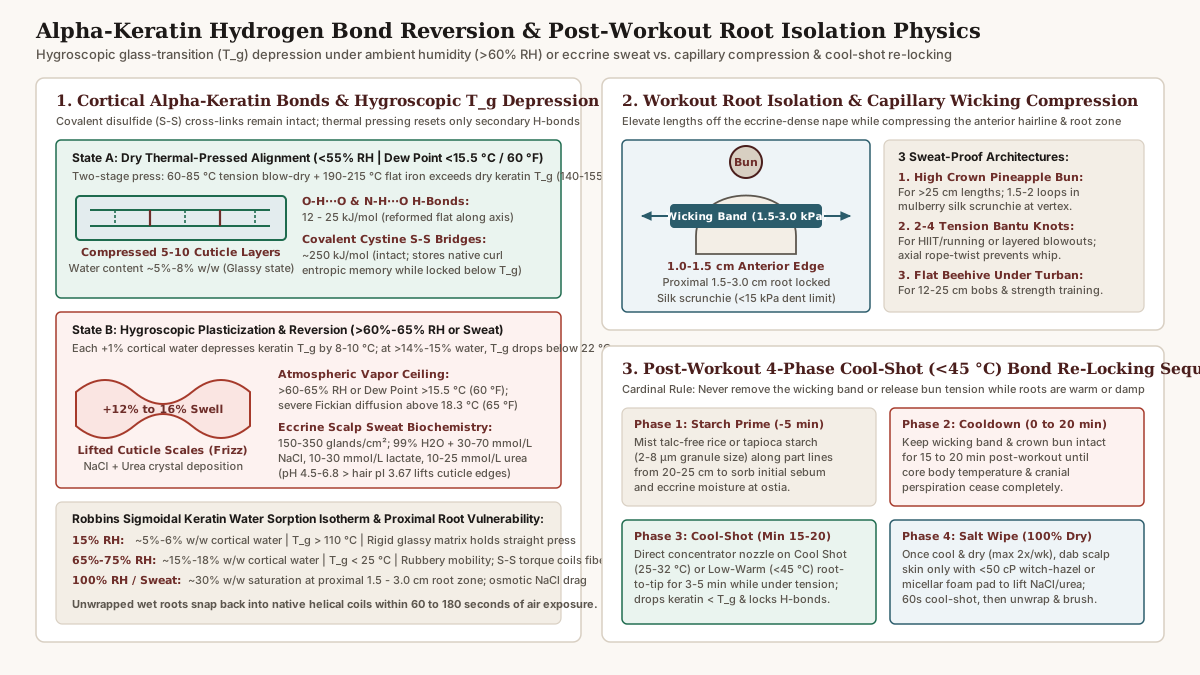
Understanding why a bone-straight press frizzes in humid weather or during exercise starts with the molecular architecture of the hair cortex. As documented in NIH / PMC research on thermal keratin degradation and hydrogen bonding, the cortex comprises 85% to 90% of total hair fiber mass and consists of crystalline alpha-helical keratin intermediate filaments (microfibrils) embedded inside an amorphous, high-sulfur matrix. In Type 3 curly and Type 4 coily hair, elliptical follicle cross-sections and asymmetric distribution of paracortical and orthocortical cells generate natural three-dimensional helical curvature.
Temporary Hydrogen Bonds (12 to 25 kJ/mol) vs. Covalent Disulfide Bridges (~250 kJ/mol)
Unlike chemical sodium hydroxide, guanidine, or ammonium thioglycolate relaxers that permanently cleave covalent cystine disulfide cross-links (S–S bonds between adjacent polypeptide chains, bond dissociation energy ~250 kJ/mol) via irreversible lanthionization, a silk press leaves every covalent disulfide bridge intact. Thermal pressing relies exclusively on breaking and reforming weak secondary interactions:
- Polypeptide Hydrogen Bonds (
O–H···OandN–H···O): Form between amide carbonyl (C=O) and imide (N–H) groups or hydroxyl side chains along adjacent keratin chains, with a bond energy of only12 to 25 kJ/mol(~5% to 10%of a covalentS–Sbond). - Electrostatic Salt Bridges (Ionic Bonds): Form between acidic carboxylate side chains (glutamate, aspartate) and basic protonated amine side chains (arginine, lysine), which weaken whenever liquid water or pH shifts alter cortical ionization.
Achieving a sleek press without permanent structural damage requires a controlled two-stage thermal transition on clean, conditioned hair:
- Stage 1 (Tension Blow-Drying at
60 to 85 °C): Bulk free water evaporates while mechanical bristle tension aligns damp cortical chains longitudinally along the fiber axis. - Stage 2 (Single-Pass Flat Ironing at
190 to 215 °C/375 to 420 °F;175 to 190 °Cfor Fine or Color-Treated Hair): Passing a titanium or tourmaline-ceramic flat iron once (using the comb-chase method) momentarily raises the cortex above the dry glass transition temperature (T_g ≈ 140 to 155 °C) of the amorphous keratin matrix. AtT > T_g, bound water molecules strip away and the alpha-keratin matrix softens just enough to stretch into a flattened beta-like conformation with tightly compressed cuticle scales (5 to 10overlapping layers). As the strand cools belowT_gwithin seconds behind the iron plate, denseO–H···OandN–H···Ohydrogen bonds lock the stretched polypeptide backbone in place against the entropic restoring torque of the intactS–Scross-links.
Hygroscopic Sorption Isotherms, T_g Depression Math, and the 15.5 °C (60 °F) Dew Point Ceiling
As established in Clarence R. Robbins’ Chemical and Physical Behavior of Human Hair, human hair keratin is a strongly hygroscopic biopolymer whose equilibrium moisture content (W_eq, expressed as % w/w of dry fiber mass) follows a sigmoidal sorption isotherm: from 5% to 6% w/w at 15% RH, to 10% to 12% w/w at 45% to 50% RH, 15% to 18% w/w at 65% to 75% RH, and ~30% w/w at 100% RH.
Absorbed water molecules act as an internal low-molecular-weight plasticizer inside the amorphous keratin matrix. Each 1% w/w increase in cortical water content depresses the keratin glass transition temperature (T_g) by approximately 8 to 10 °C:
T_g_wet (°C) ≈ T_g_dry (145 °C) - [ k_p (9 °C per 1% H2O) * W_eq (% cortical water) ]
At 40% RH (W_eq = 9.5% w/w):  T_g_wet ≈ 145 °C - (9 * 9.5)  = 59.5 °C  (> 24 °C ambient -> Glassy & Straight)
At 68% RH (W_eq = 15.5% w/w): T_g_wet ≈ 145 °C - (9 * 15.5) =  5.5 °C  (< 24 °C ambient -> Rubbery & Reverts)
This glass-transition depression defines two environmental reversion thresholds:
- Relative Humidity (
RH) Ceiling (60% to 65% RH): Above60% to 65% RHat normal room temperatures (22 to 28 °C), equilibrium cortical moisture exceeds14% to 15% w/w, droppingT_g_wetbelow ambient air temperature. - Atmospheric Dew Point Ceiling (
15.5 °C / 60 °FModerate;>18.3 °C / 65 °FSevere): Because relative humidity fluctuates with air temperature, dew point provides a more exact measure of absolute atmospheric water vapor pressure. Once the outdoor dew point crosses15.5 °C(60 °F)—and rapidly above18.3 °C(65 °F)—high partial vapor pressure drives Fickian water diffusion through microscopic gaps between overlapping cuticle scales. Water molecules competitively bind to polypeptideC=OandN–Hgroups, severing the flat-iron-set hydrogen bonds. Freed from its glassy lock, entropic elasticity stored in the covalentS–Sbridges snaps the polypeptide backbone back toward its native helical curl, radially swelling fiber diameter by12% to 16%and lifting cuticle scales into light-scattering frizz.
Eccrine Scalp Sweat Biochemistry (NaCl, Lactate, Urea, and pH 4.5 to 6.8 Cuticle Lift)
While atmospheric humidity attacks a silk press from the outside in, exercise attacks from the scalp outward. Per physiological studies of human eccrine sweat gland function, cranial scalp skin houses 150 to 350 eccrine sweat glands per cm²—one of the highest densities on the body. Primary eccrine sweat consists of:
~99.0%Liquid Water: Immediately floods the proximal1.5 to 3.0 cmof the hair shaft (the root zone, anterior hairline/edges, and occipital nape), saturating keratin to~30% w/wmoisture and severing root hydrogen bonds on contact.0.5% to 1.0%Electrolytes (30 to 70 mmol/L NaCland4 to 8 mmol/L K+) plus Organic Metabolites (10 to 30 mmol/LLactic Acid / Lactate,10 to 25 mmol/LUrea, Trace Ammonia): Fresh eccrine sweat exits the duct at an acidicpH of 4.5 to 6.5, well above the isoelectric point of human hair keratin (pI ≈ 3.67). As sweat warms on the scalp and urea/ammonia volatilize or undergo resident Corynebacterium and Staphylococcus metabolism, local scalp pH shifts toward6.0 to 6.8, increasing net negative surface charge on the cuticle and amplifying electrostatic scale repulsion.- Hygroscopic Salt Crystallization and Osmotic Drag: If damp, sweat-soaked roots air-dry without tension, the root coils back while evaporating water precipitates microscopic, sharp-edged
NaClcrystals and sticky urea/lactate films along the cuticle exterior. These salt deposits roughen inter-fiber friction (causing severe tangling and matting at the nape) and osmotically draw bound moisture out of the hair cortex, leaving strands stiff, dull, and brittle.
Workout Protocol: Sweat-Proof Hairstyles, Capillary Wicking Compression, and Cool-Shot Re-Locking
Preserving a silk press through cardiovascular or strength training requires a two-part engineering strategy: pre-workout mechanical isolation (holding cortical chains under longitudinal tension while elevating lengths off the sweaty neck) and post-workout thermal phase locking (driving keratin back below T_g before releasing tension).
Pre- and Mid-Workout Mechanical Isolation: Three Sweat-Proof Hairstyle Architectures
Before heart rate rises, secure dry hair into one of three sweat proof hairstyles matched to strand length and impact intensity, following AAD healthy hair handling guidelines that forbid tight traction along the fragile temporal hairline:
- High Crown Loose Pineapple Bun (
SingleorDual-Tier| For Lengths>25 cm): Gather hair at the highest point of the vertex/crown so zero strands touch the eccrine-dense posterior neck (nape), trapezius, or shoulders. Loop the hair1.5 to 2turns inside a large100%mulberry silk scrunchie or seamless spiral polyurethane coil, tucking the ends smoothly around the base. Never use a thin rubber or braided elastic band: narrow elastics concentrate>15 kPaof radial line pressure onto a2 mmcontact ring, imprinting a permanent mechanical crease as warm, damp hydrogen bonds reset around the band. - Two to Four Large Tension Bantu Knots (
or Jumbo Twist Buns| For HIIT, Running & Layered Blowouts): During high-impact cardio (running, plyometrics, indoor cycling), a loose crown bun can whip back and forth, loosening root tension. Part dry hair into2(upper/lower horizontal) or4quadrant sections. Gently rope-twist each section under moderate axial tension until it coils smoothly onto itself into a flat rose knot against the scalp, securing the base with coated snag-free pins or satin scrunchies. The uniform torsional tension holds cuticle scales flat during perspiration and releases into structured body waves once completely cooled and dried. - Cross-Pinned Flat Beehive Wrap Under a Wicking Turban (
For 12 to 25 cm Bobs & Strength Training): For short-to-medium bobs that cannot reach a crown pineapple, brush the hair tangentially around the skull into a flat circular wrap or occipital cross-wrap and immediately compress the entire dome under a wide moisture-wicking workout headband or turban.
Capillary Wicking Headband Physics (Washburn Dynamics & 1.5 to 3.0 kPa Planar Compression)
Positioning a multi-layer hydrophobic-to-hydrophilic moisture-wicking headband 1.0 to 1.5 cm anterior to the frontal hairline (covering the forehead sweat zone and temporal edges) and wrapping it firmly across the occipital nape performs two simultaneous physical functions:
- Capillary Liquid Transport (
Washburn Equation Dynamics): Unlike100%cotton terrycloth sweatbands—which absorb liquid into their cellulose lumen and sit like a wet poultice against the hairline—an engineered tri-layer wicking band pairs a hydrophobic inner micro-denier polyester/spandex mesh against the skin with an outer evaporative wicking layer. Micro-grooved hydrophobic filaments create high capillary suction pressure (Delta_P_cap = (2 * gamma * cos(theta)) / r_pore), pulling liquid sweat away from the scalp boundary layer to the outer fabric surface where ambient airflow evaporates it. - Planar Cuticle Compression (
1.5 to 3.0 kPa): Exerting1.5 to 3.0 kPa(~11 to 22 mmHg) of uniform planar pressure across the anterior edges and nape physically restricts radial fiber swelling (12% to 16%) and holds damp cuticle scales flat against the cranial contour while hydrogen bonds are vulnerable.
The 4-Phase Post-Workout Cool-Shot (<45 °C) Bond Re-Locking Sequence
The Cardinal Rule of Post Workout Hair Care: Never remove the moisture-wicking headband or take down the high bun/Bantu knots while the scalp is still warm or damp. Exposing warm, sweat-plasticized roots (T > T_g_wet) to open air without longitudinal tension allows cortical alpha-keratin chains to snap into tight coils within 60 to 180 seconds. Execute this four-phase recovery sequence instead:
- Phase 1: Optional Pre-Workout Botanical Starch Priming (
5 Minutes Pre-Exercise): Mist a light, talc-free rice starch (Oryza sativa) or tapioca starch dry shampoo along part lines and the occipital nape from20 to 25 cmaway before sweating begins. Native rice starch granules have the smallest particle diameter among botanical starches (2 to 8 µm), allowing them to sit invisibly at the follicular ostia and sorb initial eccrine moisture and sebum on contact without chalky caking. - Phase 2: Post-Exercise Thermal Cooldown (
Minutes 0 to 15–20 Post-Workout): Leave the wicking headband and crown bun/knots firmly in place for15 to 20 minutesafter exercise stops until core body temperature returns to baseline and post-exercise thermoregulatory sweating ceases completely. - Phase 3: Directed Cool-Shot (
25 to 32 °C) or Low-Warm (<45 °C) Tension Blow-Dry (Minutes 15 to 20): With the headband and bun still secured (or immediately upon sliding the damp headband backward while holding the hairline taut with a boar-bristle brush), attach a narrow concentrator nozzle to a blow dryer set to the Cool Shot button (25 to 32 °C) or Low-Warm (<45 °C). Direct airflow strictly downward from root to tip along the frontal hairline, temples, crown, and nape for3 to 5 minutes. Cool convective airflow accelerates evaporation of residual water and drops cortical keratin belowT_gwhile the fibers remain stretched under tension, re-locking straightO–H···OandN–H···Ohydrogen bonds without baking salt or sebum onto the cuticle. - Phase 4: Low-Water Scalp Salt Removal (
After 100% Dry & Cool | Max 2x per Week): After heavy sweat sessions, prevent precipitatedNaClcrystals and urea from itching or osmotically dehydrating the root zone without wetting the hair shaft. Part the completely dry, cooled hair into3 to 4quadrants and gently dab the scalp skin only using a microfiber pad lightly dampened with a non-rinsing witch-hazel (Hamamelis virginiana) or micellar scalp cleanser. As detailed in our foam pump bottle mesh ratio and liquid viscosity specification, formulating aqueous micellar scalp refreshers at1 to 50 cPinside a10:1coaxial100/200-meshfoam pump bottle converts0.40 to 0.80 mLof liquid into a dry, non-dripping50 to 120 µmmicro-mousse that cleanses the scalp epidermis without soaking adjacent hair roots. Follow with a60-secondcool-shot pass before releasing the bun and brushing smoothly with a boar-bristle paddle brush.
Nighttime Wrapping Architectures and 19 to 22 Momme Silk Textile Tribology
During 7 to 8 hours of sleep, the human head exerts 3 to 8 kPa of compressive pressure against the pillow while shifting position 15 to 30 times per night, and basal nocturnal cranial perspiration elevates the bedding micro-climate to 55% to 70% RH. Sleeping with loose hair allows pillow shear to abrade lifted cuticle scales while nocturnal humidity kinks the roots. Nighttime wrapping uses the curved cranium as a zero-heat tension roller so strands remain aligned tangentially.
Circular Beehive Wrap (“Doobie Wrap”) vs. Occipital Cross-Wrap and Pin Curls
Select the nighttime wrapping geometry that matches cut length, layering, and desired morning volume:
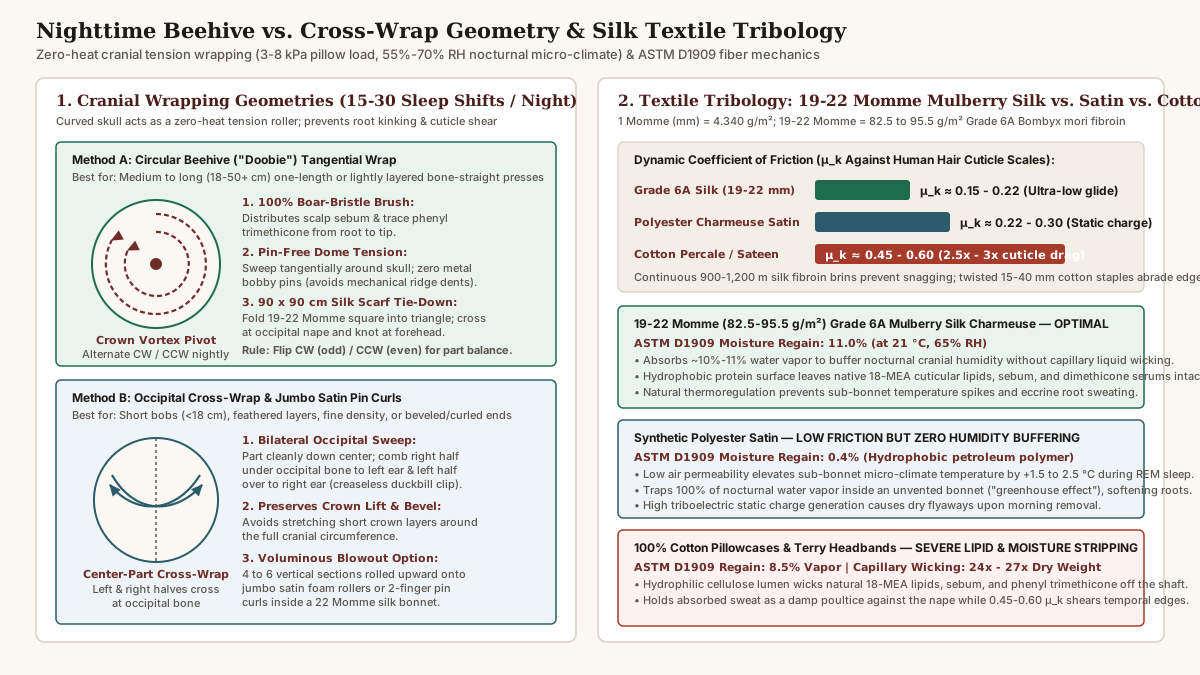
- Method 1: Circular Beehive Tangential Wrap (
For 18 to 50+ cm Sleek, One-Length or Lightly Layered Presses):- Establish a small central pivot at the crown vortex and detangle gently with a wide-tooth cellulose acetate or carbon comb.
- Using a medium-firm
100%natural boar-bristle smoothing brush (whose keratinous scales distribute natural scalp sebum and trace finishing silicones from root to tip), brush the hair continuously in one tangential direction around the circumference of the skull—sweeping the right side across the forehead to the left ear, the left side across the occipital bone to the right nape, and the back upward over the opposite parietal ridge into a smooth dome (“beehive”). - Secure using brush tension alone (zero metal bobby pins or clips, which leave sharp mechanical ridges), then tie a
90 x 90 cm(35 x 35 in)19 to 22 MommeGrade 6A Mulberry Silk square scarf folded into a triangle snugly around the hairline, crossing the tails at the occipital nape and knotting at the forehead. - Mandatory Directional Alternation: Wrap clockwise on odd nights and counterclockwise on even nights (
every 1 to 2 nights). Wrapping in the same direction every night subjects temple follicles to asymmetric traction and trains one side of the crown to lie permanently flat while the opposite side flips outward.
- Method 2: Occipital Cross-Wrap and Jumbo Satin Pin Curls (
For <18 cm Bobs, Feathered Layers, Fine Density, or Beveled Ends): Short bobs (<18 cm) and heavily face-framed layers cannot reach around the full cranial dome without pulling loose, and fine-density hair often looks limp after a tight beehive wrap. Instead, part the hair cleanly down the center from forehead to nape into left and right halves. Comb the right half smoothly underneath the occipital bone toward the left ear (holding temporarily with a creaseless duckbill clip), comb the left half smoothly over the right section toward the right ear so they cross at the back of the head, remove the clip, and tie down with a silk scarf. For voluminous blowout presses (or during Days8 to 14of the wash cycle), divide hair into4 to 6large vertical sections, roll the ends upward onto jumbo satin-covered foam rollers or flat two-finger pin curls clipped at the base, and enclose inside a structured22 Mommesilk bonnet.
Textile Tribology and ASTM D1909 Moisture Regain: 19 to 22 Momme Grade 6A Mulberry Silk vs. Polyester Satin vs. Cotton
Not all nocturnal headwraps or pillowcases protect a silk press. In textile metrology, Momme (mm) measures areal silk density: 1 Momme = 4.340 g/m² (the weight in pounds of a silk bolt 45 inches wide by 100 yards long). A 19 to 22 Momme (82.5 to 95.5 g/m²) Grade 6A Mulberry Silk charmeuse weave (spun by Bombyx mori silkworms into continuous 900 to 1,200 m triangular fibroin protein filaments degummed of outer sericin, where warp threads float over 3 to 4 weft threads) balances ultra-low cuticle shear against nocturnal thermoregulation:
| Textile Fiber & Weave Specification | Dynamic Coefficient of Friction (μ_k vs. Hair Cuticle) |
ASTM D1909 Vapor Regain (21 °C, 65% RH) & Liquid Wicking |
Sub-Bonnet Thermal Conductivity & Micro-Climate Effect | Impact on 14-to-21-Day Silk Press Integrity |
|---|---|---|---|---|
19 to 22 Momme Grade 6A Mulberry Silk Charmeuse (82.5 to 95.5 g/m² Bombyx mori fibroin) |
μ_k ≈ 0.15 to 0.22 (Ultra-low shear; continuous triangular protein brins glide over cuticle scales) |
11.0% vapor regain; hydrophobic surface buffers humidity without capillary liquid wicking |
Natural breathable protein fiber; dissipates cranial heat so eccrine glands stay below sweat threshold | Gold Standard Pass: Preserves 18-MEA cuticular lipids, natural sebum, and silicone serums; zero temporal breakage or morning static |
Synthetic Polyester Charmeuse Satin (100% Polyethylene Terephthalate filament weave) |
μ_k ≈ 0.22 to 0.30 (Low mechanical drag, but high triboelectric static charge generation) |
0.4% moisture regain (Hydrophobic petroleum polymer; zero vapor buffering capacity) |
Low air permeability; elevates sub-bonnet temperature by +1.5 to 2.5 °C during REM sleep |
Condensation Risk: Traps 100% of nocturnal water vapor inside an unvented bonnet (“greenhouse effect”), softening roots by morning |
100% Cotton Percale or Sateen (15 to 40 mm twisted staple cellulose fibers) |
μ_k ≈ 0.45 to 0.60 (2.5x to 3x higher drag; protruding staple ends snag lifted cuticle scales) |
8.5% vapor regain, plus 24x to 27x dry weight in hydrophilic capillary liquid absorption |
Breathable to dry air, but retains absorbed sweat dampness against the nape for hours | Severe Failure: Strips natural 18-MEA lipids, sebum, and phenyl trimethicone off the shaft; causes frizz, split ends, and edge thinning |
As standardized in ASTM D1909 commercial moisture regain tables, Mulberry Silk’s 11.0% vapor regain allows the fabric to absorb ambient water vapor molecules from nocturnal scalp perspiration into its amorphous fibroin regions without wicking liquid oils off the hair surface. By contrast, cotton’s hollow cellulose lumen acts as a capillary sponge that strips protective conditioning films within 2 to 3 nights, while 0.4%-regain polyester satin reflects heat and moisture back onto the roots.
Hydrophobic Barrier Chemistry, Mid-Week Product Failures, and the 14-to-21-Day Lifecycle
Extending a silk press across the full 2-to-3-week interval without mid-week flat ironing depends on establishing an invisible hydrophobic elastomer shield on Day 1 and respecting strict rheological boundaries on Days 2 through 21.
Functional Silicone and Anti-Humidity Polymer Classes (Polysilicone-29, Amodimethicone, D5, Phenyl Trimethicone)
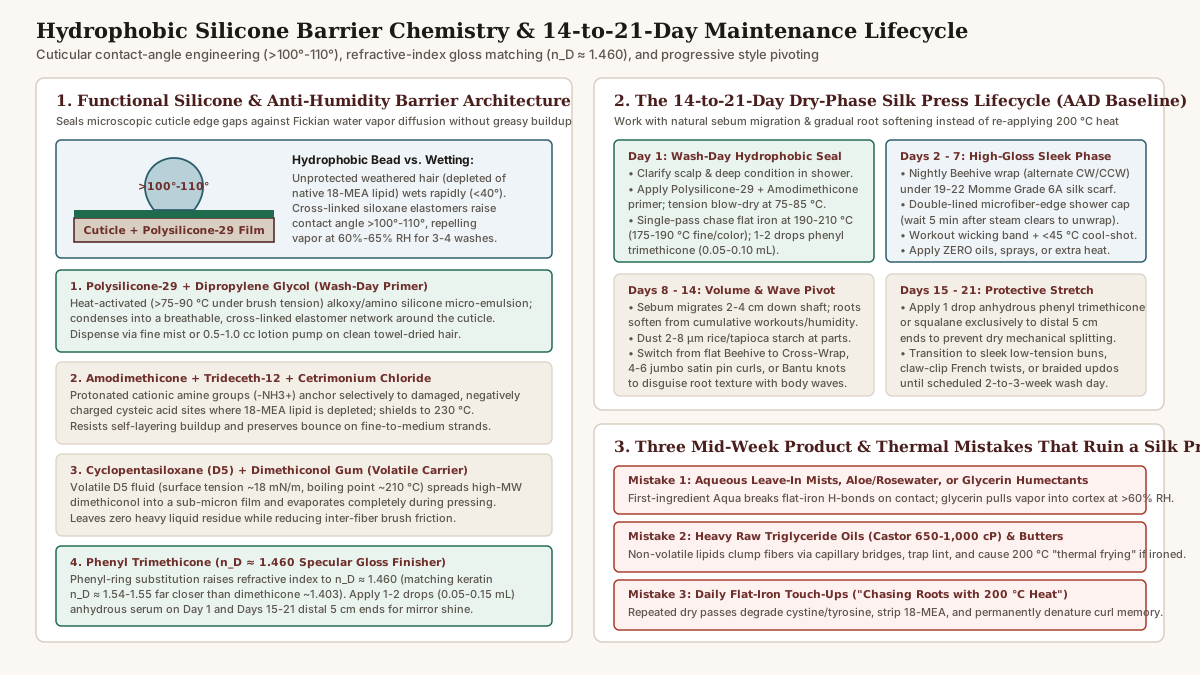
Healthy virgin hair is covered by a covalently bound monolayer of 18-methyleicosanoic acid (18-MEA) attached via thioester linkages to the outer epicuticle, giving the fiber a hydrophobic surface. Chemical processing, UV exposure, and mechanical weathering strip 18-MEA, exposing hydrophilic, negatively charged cysteic acid groups (–SO3-) that rapidly absorb atmospheric moisture. Modern thermal styling systems restore cuticular hydrophobicity using four distinct polymer classes:
Polysilicone-29(Formulated withDipropylene Glycol): A heat-activated, cross-linking alkoxy/amino-functional silicone micro-emulsion copolymer applied to clean, towel-dried hair prior to tension blow-drying. When heated above75 to 90 °Cunder mechanical brush tension, its silanol and alkoxy functional groups condense into a continuous, breathable, hydrophobic elastomer network around the cuticle perimeter. This cross-linked shield elevates the water contact angle on the hair surface above100° to 110°, slowing Fickian water vapor diffusion at60% to 65% RHfor3 to 4shampoo cycles without greasy buildup.Amodimethicone(Paired withTrideceth-12andCetrimonium Chloride): An amino-functional polydimethylsiloxane polymer carrying protonated cationic amine groups (–NH3+). Because cationic amine sites anchor electrostatically and selectively to damaged, negatively charged (18-MEA-depleted) cuticle gaps, amodimethicone forms a targeted thermal shield (protecting up to230 °C) that resists self-layering, preserving aerodynamic bounce on fine-to-medium strands. When packaged as a500 to 5,000 cPblow-dry lotion, our lotion pump bottle dosage and dip tube sizing specification shows why a0.5 to 1.0 ccfine-dosage treatment pump on a20/410or24/410neck (operating below the3.0 lbfaccessibility force limit detailed in our packaging ease-of-use guide) prevents over-application that would weigh down the press.Cyclopentasiloxane (D5)andDimethiconol / Dimethicone: Volatile cyclic decamethylcyclopentasiloxane (D5, surface tension~18 mN/m, boiling point~210 °C, low latent heat of vaporization) acts as a transient spreading vehicle. It distributes high-molecular-weight linearDimethiconolgum into a uniform sub-micron film across the cuticle and evaporates completely during blow-drying and pressing, leaving a frictionless moisture barrier with zero liquid drag.Phenyl Trimethicone(n_D ≈ 1.460Optical Gloss Finisher): Substituting bulky aromatic phenyl rings onto the siloxane backbone raises the fluid’s refractive index ton_D ≈ 1.460—closely matching the refractive index of human hair cuticle keratin (n_D ≈ 1.54 to 1.55, compared to standard polydimethylsiloxane at~1.403). Dispensing just1 to 2 drops(0.05 to 0.15 mL) of an anhydrousPhenyl Trimethicone+D5finishing serum from an amber glass dropper bottle onto mid-lengths and ends restores specular mirror reflection and seals split ends against humidity without adding water.
Three Mid-Week Product and Thermal Mistakes That Destroy a Silk Press
- Failure Mode 1: Water-Based Leave-In Sprays, Aloe/Rosewater Mists, or Glycerin Humectant Gels:
Any mid-week product listing
Aqua(Water) among its top ingredients immediately penetrates the cuticle and cleaves flat-iron-set hydrogen bonds on contact, causing instant localized frizz and reversion. Pure humectants (Glycerin,Propylene Glycol,Sorbitol,Honey) bind atmospheric water vapor whenever ambient humidity exceeds60% RHand pull it directly into the cortex (or draw bound water out of the cortex into arid<30% RHwinter air). - Failure Mode 2: Heavy Raw Triglyceride Oils (
Castor Oil 650 to 1,000 cP), Coconut Oil, or Shea Butter Applied Mid-Week: High-viscosity botanical triglycerides (Ricinus communis castor oil dynamic viscosity650 to 1,000 cP), raw butters, and petrolatum pomades do not evaporate. Applying them to dry silk-pressed hair collapses aerodynamic volume, binds individual fibers together via capillary liquid bridges into stringy clumps, and attracts atmospheric dust and lint. Worse, passing a200 °Cflat iron over oil-coated strands mid-week conducts concentrated thermal energy through the trapped lipid film directly into the cortex, causing thermal frying and steam-void “bubble hair” fracture. - Failure Mode 3: Daily Flat-Iron Touch-Ups (“Chasing Reverted Roots with
200 °CHeat”): As emphasized in NIH / PMC thermal keratin damage analyses and AAD thermal styling guidance, passing a190 to 215 °Ciron over dry hair multiple times per week progressively oxidizes cortical cystine and tyrosine residues, strips the remaining18-MEAlipid layer, and causes irreversible thermal denaturation of alpha-helical keratin (“heat damage” or permanent curl loss) where strands neither hold a sleek press nor revert cleanly when washed.
The 14-to-21-Day Dry-Phase Silk Press Maintenance Schedule
Rather than fighting natural sebum migration and cumulative root softening with extra heat, manage the press through four progressive phases aligned with the 2-to-3-week adult wash cycle:
- Day 1 (
Wash-Day Foundation & Hydrophobic Cross-Linking): Clarify the scalp and hair shaft to remove old sebum and cationic buildup (residual oils smoke under flat irons and produce a stiff, coated press), then deep condition and detangle thoroughly in the shower with a wide-tooth comb. Apply a heat-activatedPolysilicone-29+Dipropylene Glycolanti-humidity spray and0.5 to 1.0 ccofAmodimethiconethermal primer to towel-dried sections. Tension blow-dry at75 to 85 °Cwith a concentrator nozzle to stretch the roots and activate siloxane cross-linking, execute a single-pass comb-chase flat iron press at190 to 210 °C(175 to 190 °Cfor fine or color-treated hair), and finish with1 to 2 drops(0.05 to 0.10 mL) of anhydrousPhenyl Trimethicone+Cyclopentasiloxaneserum on mid-lengths and ends. - Days 2 to 7 (
High-Gloss Bone-Straight Phase | Zero Added Product): Wrap nightly using the Circular Beehive Wrap (alternating clockwise on odd nights and counterclockwise on even nights) with a100%boar-bristle brush under a19 to 22 MommeGrade 6A Mulberry Silk scarf. During showers, wear a double-lined waterproof shower cap edged with a microfiber terry perimeter band, and wait5 minutesafter bathroom steam clears before unwrapping. For workouts, pair a high crown pineapple bun with a1.5 to 3.0 kPacapillary wicking headband and execute the15-to-20-minutecooldown plus25 to 32 °Ccool-shot lock before unwrapping. Apply zero oils, mists, or creams. - Days 8 to 14 (
Root-Swell Transition & Heatless Volume/Wave Pivot): As natural scalp sebum migrates2 to 4 cmdown the shaft and cumulative humidity or workouts slightly soften root alignment, never touch up the roots with a flat iron. Instead, mist or dust2 to 8 µmrice or tapioca starch dry shampoo along part lines to sorb excess sebum, and switch nightly from the flat Beehive wrap to an Occipital Cross-Wrap,4 to 6jumbo satin pin curls, a heatless mulberry silk curling ribbon, or2 to 4overnight Bantu knots. Transitioning the press into an intentional textured blowout or body wave disguises root texture while adding movement. - Days 15 to 21 (
Protective Low-Manipulation Stretch to Wash Day): Apply1 drop(0.05 mL) of lightweight anhydrousPhenyl Trimethiconeor squalane serum exclusively to the distal5 cmof hair ends to prevent dry mechanical splitting. Transition into low-tension sleek buns secured with silk scrunchies, acetate claw-clip French twists, or loose braided updos until the scheduled14-to-21-dayclarifying shampoo and deep-conditioning wash day.