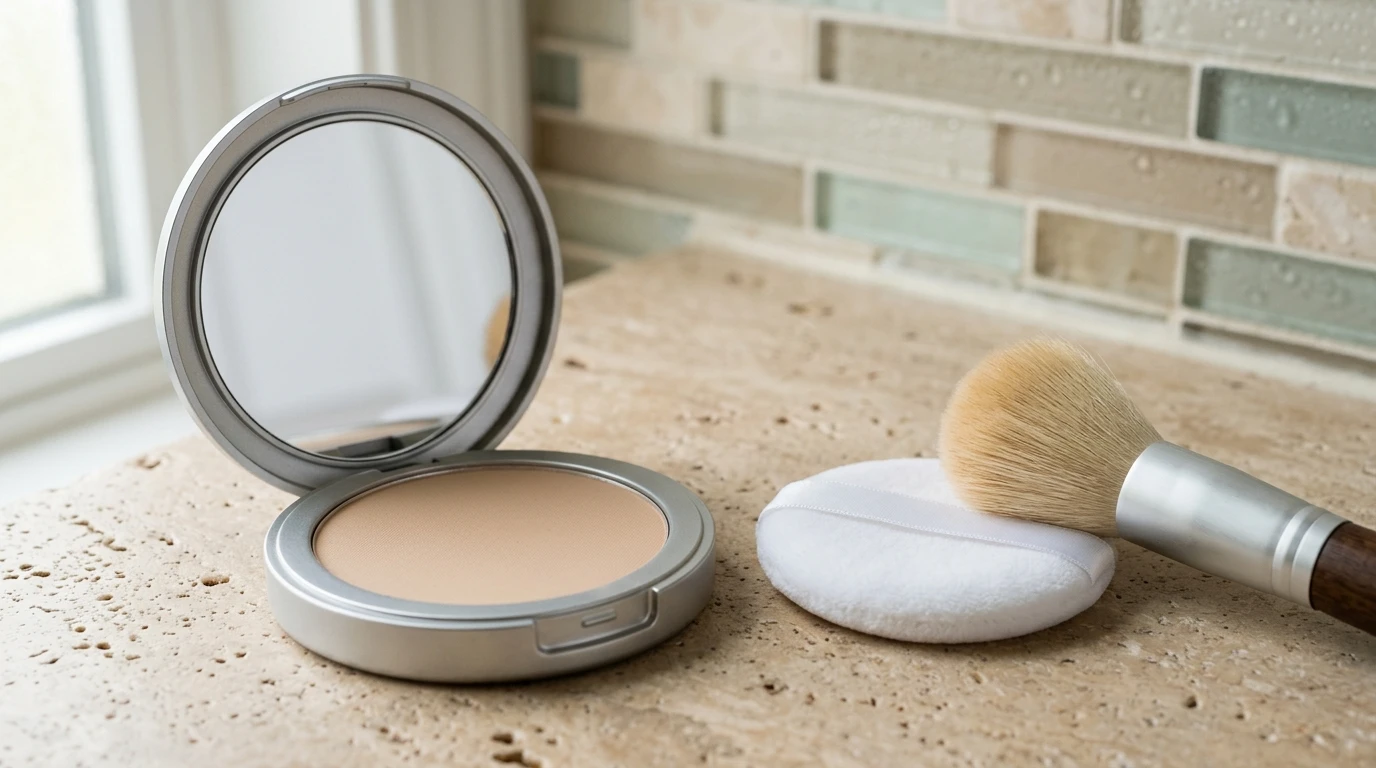
Evaluating pressed powder compact pan adhesion alongside pressed powder hard pan humidity failure requires separating top-surface binder glazing from bottom-interface makeup compact pan glue delamination inside the case. Within our beauty and hair guides, this reference examines powder compact binder oil transfer, pressure-sensitive tape peeling, hot-melt adhesive chemistry, metal pan metallurgy, and dry storage hygiene.
A cosmetic compact is usually a small round metal case containing two or more of the following: a mirror, pressed or loose face powder, and a powder puff; British manufacturer Stratton began assembling powder boxes in Birmingham in 1923 and developed self-opening inner lids in 1948 to protect the powder and prevent damage to fingernails.
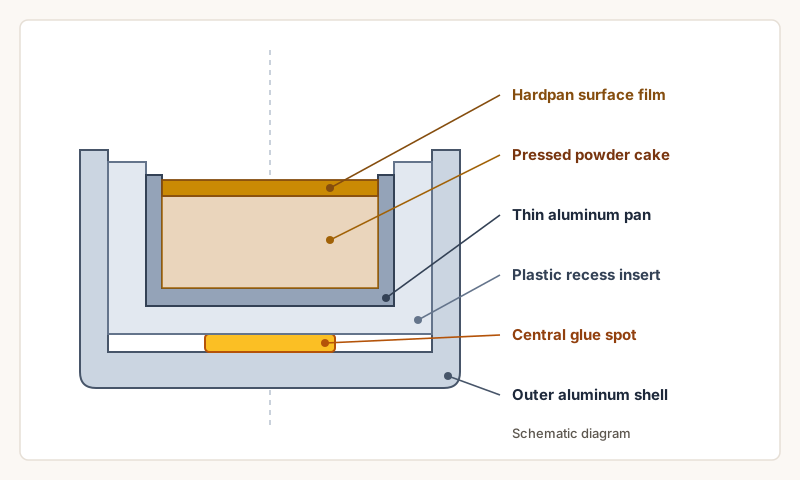
In a metal-shell compact powder case, a thin aluminum pan sits inside a plastic powder-pan recess (insert) to hold the powder directly, while the plastic insert is bonded to the outer aluminum base shell by a spot of glue at the center of the inner bottom surface.
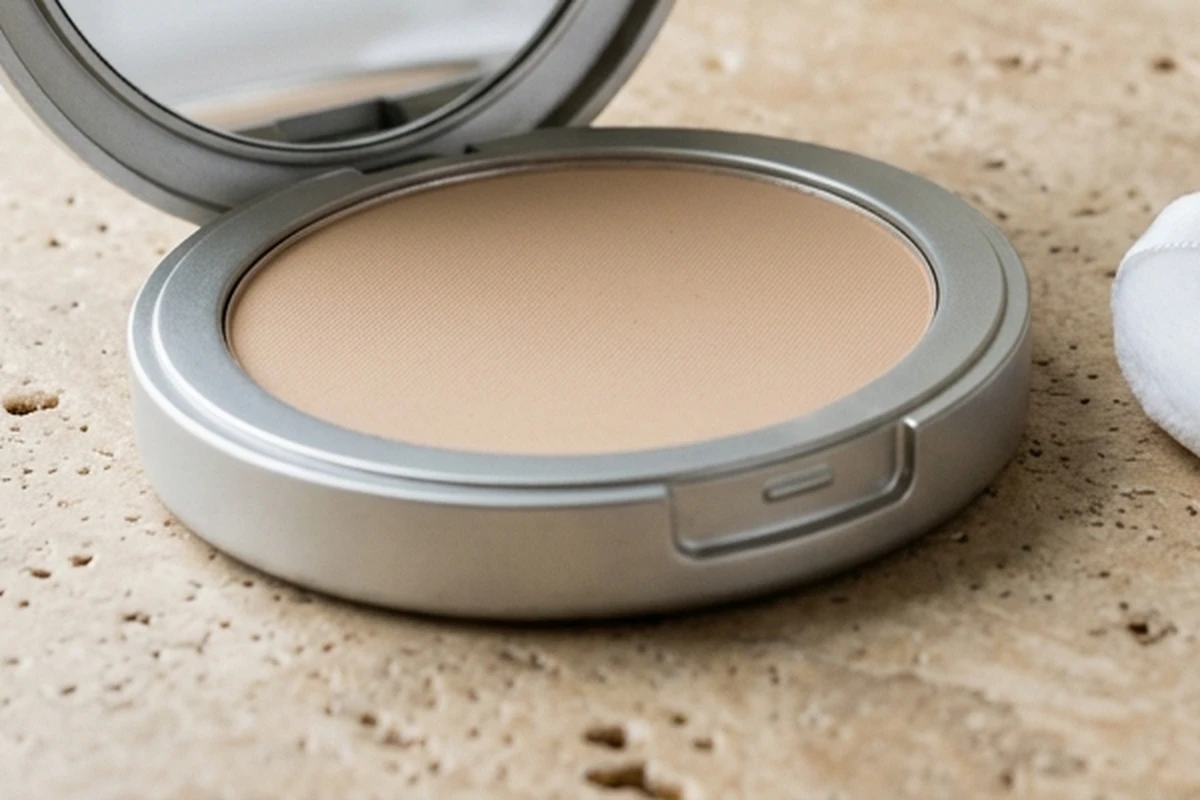
Hardpan is a hardened, shiny film over the top layer of pressed powder makeup (bronzer, blush, setting powder, eyeshadow) caused by skin oils or liquids from fingers, double-dipped brushes, or wet brushes transferring onto the powder surface and blocking the soft product underneath.
Powder Compact Binder Oil Transfer and Cake Compaction Balance
In compact powder manufacturing, loose or dry powders are compressed into a cake with a binder; low compaction pressure forms a cake that breaks easily during use, whereas high compaction pressure forms a very hard cake that will not adhere to the puff easily.
Compact powders are prepared by the Wet Method, the Dry Method, or the Damp Method (the most widely used commercial method, where base powder and liquid or oil-in-water emulsion binder are blended, screened, compressed by machine, and dried at elevated temperature).
Compact powder formulations use dry binders (zinc stearate, magnesium stearate, which require increased pressure for compaction), oil binders (mineral oil, isopropyl myristate, lanolin derivatives), water-soluble binders (tragacanth, karaya, Arabic, CMC), water-repellent binders, and emulsion binders (triethanolamine stearate, glycerol monostearate).
Modern face powders use absorbents (talc, silica, kaolin, corn starch, rice starch), binders (magnesium stearate, zinc stearate, isopropyl myristate, dimethicone), and emollients (cyclopentasiloxane, isopropyl palmitate), and pressing compacts the powder mixture into pans using precise pressure and dwell times.
Textbook Pressed Compact and Face Powder Formulation Batches
In textbook compact powder Formula 1 (for 100 g), the dry base consists of 69 g talc, 18 g kaolin, 8 g titanium dioxide, and 5 g zinc stearate, paired with a binder of 1 g gum Arabic, 5 g glycerol, and 94 g water.
In textbook compact powder Formula 2 (for 100 g), the dry base consists of 79 g talc, 9 g calcium carbonate, 7 g zinc oxide, and 5 g slip agent (slip character), paired with a binder emulsion of 2 g gum tragacanth, 6 g glycerol monostearate, 4 g mineral oil, 5 g sorbitol, and 83 g water.
In textbook Light Type face powder (for dry skin, 100 g batch), the formulation contains 63 g talc, 20 g kaolin, 5 g calcium carbonate, 5 g zinc oxide, 5 g zinc stearate, 1 g magnesium carbonate, 0.5 g color, and 0.5 g perfume.
In textbook Medium Type face powder (for normal or moderately oily skin, 100 g batch), the formulation contains 39.7 g talc, 39.5 g kaolin, 5 g calcium carbonate, 7 g zinc oxide, 7 g zinc stearate, 1 g magnesium carbonate, 0.2 g color, and 0.6 g perfume.
In textbook Heavy Type face powder (for extremely oily skin, 100 g batch), the formulation contains 5 g magnesium stearate, 20 g kaolin, 15 g zinc oxide, 39 g calcium carbonate, and 20 g talc.
| Formulation Batch | Target Application or Process | Documented Batch Composition |
|---|---|---|
| Textbook compact powder Formula 1 (100 g) | Compressed compact cake with water-soluble and emulsion binder | Dry base of 69 g talc, 18 g kaolin, 8 g titanium dioxide, and 5 g zinc stearate with binder of 1 g gum Arabic, 5 g glycerol, and 94 g water |
| Textbook compact powder Formula 2 (100 g) | Compressed compact cake with gum, oil, and emulsion binder | Dry base of 79 g talc, 9 g calcium carbonate, 7 g zinc oxide, and 5 g slip agent (slip character) with 2 g gum tragacanth, 6 g glycerol monostearate, 4 g mineral oil, 5 g sorbitol, and 83 g water |
| Textbook Light Type face powder (100 g) | Unpressed face powder applied on dry skin | Contains 63 g talc, 20 g kaolin, 5 g calcium carbonate, 5 g zinc oxide, 5 g zinc stearate, 1 g magnesium carbonate, 0.5 g color, and 0.5 g perfume |
| Textbook Medium Type face powder (100 g) | Unpressed face powder applied on normal or moderately oily skin | Contains 39.7 g talc, 39.5 g kaolin, 5 g calcium carbonate, 7 g zinc oxide, 7 g zinc stearate, 1 g magnesium carbonate, 0.2 g color, and 0.6 g perfume |
| Textbook Heavy Type face powder (100 g) | Unpressed face powder applied on extremely oily skin | Contains 5 g magnesium stearate, 20 g kaolin, 15 g zinc oxide, 39 g calcium carbonate, and 20 g talc |
Tape Peel Restoration for Pressed Powder Hard Pan Humidity Glazing
Dry powders in compact containers can last several years; a blush can last 3 to 4 years in a dry environment where bacteria do not thrive, and hardpan is fixed by cutting off about 1 inch of scotch tape, pressing and rubbing it onto the powder, and peeling off the hardened top layer.
ASTM D3330 measures peel adhesion strength of pressure-sensitive adhesive (PSA) tapes across six test methods (A through F, with 180° or 90° peel angles) using 25 mm wide specimens conditioned for 24 hours at 23 °C and 50% RH, applied to polished stainless steel with a 2 kg roller (<1 minute dwell time), and peeled at 300 mm/min (ignoring the first 25 mm and averaging over the next 50 mm).
Adhesives Research notes that under D3330 testing, drafting or painter’s tape may require just 1–3 N/25 mm to avoid surface damage, general-purpose masking tapes may be rated at 3–5 N/25 mm, and high-performance acrylic or foam tapes may exceed 15 N/25 mm for permanent mounting; failure modes distinguish clean adhesive failure (detaching without residue) from cohesive failure (adhesive splits, leaving residue).
Pressed Powder Compact Pan Adhesion and Metal Godet Delamination
In compact assembly, the adhesive must suit the plastic resin and the aluminum surface condition, and the mating surfaces must be clean.
Stamped aluminum compact shells are formed by shallow-cup deep drawing from a flat aluminum blank, and polyester powder coating (such as AkzoNobel’s specification of a 200 °C workpiece temperature for 10-15 minutes) must be cured before temperature-sensitive plastic parts are fitted.
Tinplate consists of sheets of steel coated with a thin layer of tin to impede rusting; unlike a zinc coating that protects iron via sacrificial oxidation, tin only protects the underlying steel or iron if the tin surface remains unbroken.
Hot-Melt Pressure-Sensitive Adhesive Classes and Drop Testing
Hot melt adhesives are thermoplastic polymer adhesives consisting entirely of solids that are solid at room temperature, liquefy on heating, and are often divided into pressure-sensitive hot melt adhesives (PSAs, which remain permanently sticky with high bonding strength but less cohesive and tensile strength) and setting hot melt adhesives (which lose tack upon cooling; most setting adhesives have both high bonding and high cohesive strength).
Thermoplastic elastomer hot melt pressure-sensitive adhesives (HMPSA) based on styrene-butadiene block (SBS) and styrene-isoprene block (SIS) copolymers have good cohesion and small melt viscosity, but due to low molecular polarity and unsaturated double bonds, traditional SBS/SIS HMPSA has low bonding strength to polar materials, poor oil and solvent resistance, and insufficient heat/oxygen aging resistance.
In acrylate HMPSA, flexible monomers have a low glass transition temperature (Tg) while hard monomers have a high Tg that provides cohesion and significantly improves water resistance; amorphous polyolefin HMPSA adheres well to metal, polyethylene, and polypropylene, and rubber HMPSA offers better wettability to PE substrates plus relatively good water and oil resistance.
Crosslinked UV hot melt acrylic pressure-sensitive adhesives (PSAs) provide high shear strength and adhesion to low surface energy plastics, resisting shifting, moving, peeling, and degrading under fluctuating temperatures and extreme environmental factors; GEW UV curing systems cure them across web widths up to 2.5 meters (98 inches).
The Lorenzato DP table-top pneumatic drop tester for cosmetic compacted powders adjusts drop height from 0 to 500mm, tests powder pans, compacts, and godets from 20mm to 120mm, operates on a single 6 bar air pressure supply, and drops onto a standard steel or optional marble surface.
| Compact Component or Adhesive System | Material or Test Condition | Documented Mechanical or Chemical Behavior |
|---|---|---|
| Metal-shell compact assembly | Thin aluminum pan in plastic recess insert over outer aluminum base shell | Thin aluminum pan sits inside the plastic recess while the plastic insert is bonded to the outer aluminum base shell by a central spot of glue |
| Aluminum-plastic adhesive bond | Plastic resin and aluminum mating surface preparation | Adhesive must suit the plastic resin and the aluminum surface condition, and the mating surfaces must be clean |
| Stamped aluminum shell curing | Shallow-cup deep drawing and polyester powder coating (such as AkzoNobel 200 °C for 10-15 minutes) | Polyester powder coating cured at a 200 °C workpiece temperature for 10-15 minutes must be completed before temperature-sensitive plastic parts are fitted |
| Tinplate pan substrate | Steel sheet coated with a thin layer of tin compared with sacrificial zinc | Tin only protects the underlying steel or iron from rusting if the tin surface remains unbroken |
| Traditional SBS and SIS HMPSA | Styrene-butadiene (SBS) and styrene-isoprene (SIS) block copolymers | Low molecular polarity and unsaturated double bonds yield low bonding strength to polar materials, poor oil and solvent resistance, and insufficient heat/oxygen aging resistance |
| Acrylate, amorphous polyolefin, and rubber HMPSA | High-Tg hard monomers, amorphous polyolefin, and rubber HMPSA | High-Tg hard monomers improve water resistance, amorphous polyolefin adheres well to metal, polyethylene, and polypropylene, and rubber HMPSA offers relatively good water and oil resistance |
| Crosslinked UV hot melt acrylic PSA | GEW UV curing systems across web widths up to 2.5 meters (98 inches) | High shear strength and adhesion to low surface energy plastics, resisting shifting, moving, peeling, and degrading under fluctuating temperatures |
| Lorenzato DP pneumatic drop tester | Single 6 bar air supply onto steel or optional marble surface | Adjusts drop height from 0 to 500mm and tests powder pans, compacts, and godets from 20mm to 120mm |
Bathroom Humidity Boundaries, Applicator Hygiene, and Packaging Standards
Exposure to moisture, such as in a bathroom, may make it easier for bacteria and fungi to grow in cosmetics.
Cosmetic products can dry out over time, causing them to harden and crack.
A cosmetic product may go bad if stored in a place that is too warm or too moist, and containers should be kept clean and tightly closed when not in use.
Cosmetics should be stored in a dry, clean space at room temperature and out of direct sunlight, and powder eyeshadow or blush that starts to crumble or fall apart should be tossed.
Indoor relative humidity (RH) should be maintained below 60 percent, and ideally between 30 percent and 50 percent.
Relative humidity greater than 60 percent is likely to result in condensation in the building, which can lead to mold growth.
Wet or damp areas and items should be dried within 24-48 hours to prevent mold growth.
Bathroom and kitchen fans that exhaust to the outdoors increase ventilation, and indoor humidity should be kept between 30 and 50 percent using a moisture or humidity gauge.
On the site’s silk press maintenance technical guide (silk press humidity and wrapping guide), alpha-keratin hydrogen bonds revert above 60% to 65% relative humidity (or a 15.5 °C / 60 °F atmospheric dew point) across a typical dry-phase duration of 14 to 21 days. In that same guide, nighttime wrapping uses 19 to 22 Momme (82.5 to 95.5 g/m²) Grade 6A Mulberry Silk with an 11.0% ASTM D1909 vapor regain.
Applicator Cleaning Intervals and Ferrule Glue Protection
Makeup brushes should be washed every 7 to 10 days because brushes collect product residue, dirt, and oil and act as a breeding ground for bacteria.
When washing makeup brushes in lukewarm water with a tablespoon of gentle or clarifying shampoo, only rinse the brush tip because submerging the whole brush head will eventually dissolve the glue connecting the brush head to the handle.
Makeup sponges should be cleaned after every use by massaging soapy water into the sponge for 15 seconds, rinsing under warm running water, and air drying on a clean paper towel.
On the site’s adult and child hair-care reference (active-lifestyle hair care guide), straight hair with an oily scalp may be shampooed daily, whereas dry, textured, curly, or thick adult hair is shampooed at least once every 2 to 3 weeks as needed. In that same reference, children ages 8 to 12 with dry and curly hair are listed at a shampoo frequency of every 7 to 10 days.
Regulatory Stability Rules and ISO Packaging Standards
There are no U.S. laws or regulations that require cosmetics to have specific shelf lives or have expiration dates on their labels.
Drugs, including products that are both drugs and cosmetics, must be tested for stability under 21 CFR 211 and are required to have expiration dates printed on the labels.
FDA reports that some companies test products by exposing samples to different temperatures and humidity levels to see how different conditions affect the products.
The Period After Opening symbol on some cosmetics shows an open jar icon with a number next to the letter M (such as 9 months), though Period After Opening information is not required on cosmetics in the United States.
ISO 22715:2006 (Cosmetics — Packaging and labelling, prepared by ISO/TC 217) defines primary packaging (Clause 2.1) as packaging designed to come into direct contact with the contents and secondary packaging (Clause 2.2) as packaging designed to contain one or more primary packages, and requires in Clause 3 that packaging protect against damage and deterioration under manufacturer-specified storage, transport, and handling conditions.
Under ISO 22715:2006 Clause 4.1.1 and Clause 4.2.1, cosmetic ingredients present at greater than 1 % shall be listed in descending order of weight followed by those at less than or equal to 1 % in any order, storage conditions are listed when appropriate, and small packages between less than 15 g or 15 ml and more than 10 g or 10 ml have modified labeling rules while packages of 10 g or 10 ml and below do not require nominal content (4.1.1 f).
ISO 2233:1994 (Packaging — Complete, filled transport packages — Conditioning for testing, prepared by ISO/TC 122/SC 3) specifies in Clause 4.1 and Clause 4.2 that conditioning temperatures shall have a mean within ± 2 °C of nominal (peak deviation ± 3 °C for conditions A, B, C, K and ± 2 °C for other conditions), and relative humidity over at least 1 h shall have a maximum peak difference of ± 5 percentage units and a mean deviation within ± 2 percentage units.
Under ISO 2233:1994 Clause 6, packages are conditioned for a minimum period selected from 4 h, 8 h, 16 h, 24 h, 48 h, or 72 h (or 1 week to 4 weeks) with free air access to the top, sides, and at least 75 % of the base, and for moisture-hysteresis materials like fibreboard it may be necessary to predry for at least 24 h unless the specified relative humidity is 40 % or below.
On the site’s rigid packaging accessibility reference (packaging and ease of use guide), the Arthritis Foundation component guide specifies keeping pump closure depression force below 3.0 pounds and container grip span at no more than 2.5 to 3.0 inches. That same reference notes that ISO 22015:2019 (Packaging — Accessible design — Handling and manipulation) covers one-hand opening and lists 30 mm as a common PET drinking-bottle screw-top diameter.
Verifiable Pressed Powder Compact Inspection Checklist
Use the table below to record storage humidity, applicator washing schedules, pan substrate condition, and surface glaze recovery across cosmetic compacts. For additional grooming and material care notes, return to our beauty and hair section.
| Inspection Dimension | Parameter to Verify | Documented Target or Threshold |
|---|---|---|
| Ambient storage relative humidity | Indoor moisture gauge reading and condensation limit | Maintain indoor relative humidity below 60 percent and ideally between 30 percent and 50 percent |
| Wet item drying window | Post-exposure drying time to prevent mold growth | Dry wet or damp areas and items within 24-48 hours |
| Makeup sponge hygiene | Wash duration and drying surface | Clean after every use by massaging soapy water for 15 seconds, rinsing under warm running water, and air drying on a clean paper towel |
| Makeup brush washing interval | Bristle wash cycle for bacterial hygiene | Wash makeup brushes every 7 to 10 days because brushes collect product residue, dirt, and oil |
| Makeup brush ferrule glue care | Water temperature, shampoo dose, and rinse boundary | Wash in lukewarm water with a tablespoon of gentle or clarifying shampoo, rinsing only the tip so ferrule glue does not dissolve |
| Surface hardpan tape peel restoration | Adhesive strip width and dry compact shelf life | Press and peel about 1 inch of scotch tape to remove the hardened top layer; dry powders in compact containers can last several years, and a blush can last 3 to 4 years in a dry environment |
| ASTM D3330 PSA peel test procedure | Specimen width, conditioning, roller load, and peel speed | Uses 25 mm wide specimens conditioned 24 hours at 23 °C and 50% RH, applied with a 2 kg roller (<1 minute dwell), and peeled at 300 mm/min (averaging over 50 mm after the first 25 mm) |
| ASTM D3330 PSA peel strength ratings | Peel force range by tape class and failure mode | Adhesives Research notes drafting or painter’s tape may require 1–3 N/25 mm, general-purpose masking tape may be rated at 3–5 N/25 mm, and high-performance acrylic or foam tapes may exceed 15 N/25 mm |
| Compact pan drop test qualification | Lorenzato DP pneumatic drop tester parameters | Adjusts drop height from 0 to 500mm for 20mm to 120mm pans, compacts, and godets on a 6 bar air supply onto steel or marble |
| Transport package climate tolerances | ISO 2233:1994 Clause 4.1 and Clause 4.2 temperature and humidity limits | Mean temperature within ± 2 °C (peak ± 3 °C for A, B, C, K) and relative humidity within ± 5 percentage units peak and ± 2 percentage units mean over at least 1 h |
| Transport package conditioning duration | ISO 2233:1994 Clause 6 duration, air access, and predrying | Conditioned for 4 h, 8 h, 16 h, 24 h, 48 h, or 72 h (or 1 week to 4 weeks) with at least 75 % base air access; for moisture-hysteresis materials, predrying for at least 24 h may be necessary unless the specified relative humidity is 40 % or below |
Sources
- U.S. Food and Drug Administration (FDA) — Shelf Life and Expiration Dating of Cosmetics
- U.S. Food and Drug Administration (FDA) — Using Cosmetics Safely Fact Sheet (June 2015)
- U.S. Environmental Protection Agency (EPA) — Mold Course Chapter 9: Prevention
- U.S. Environmental Protection Agency (EPA) — Care for Your Air: A Guide to Indoor Air Quality
- American Academy of Dermatology (AAD) — How to clean your makeup brushes
- American Academy of Dermatology (AAD) — When to toss your makeup and sunscreen
- International Organization for Standardization — ISO 22715:2006 Cosmetics — Packaging and labelling
- International Organization for Standardization — ISO 2233:1994 Packaging — Complete, filled transport packages — Conditioning for testing
- Adhesives Research — ASTM D3330 Peel Adhesion Testing for Pressure Sensitive Tapes
- Textbook of Cosmetic Formulation — Classification of Powders
- Aurora Global Brands — Face Powder Formulation Expert Guide
- L’Oréal Paris — What Is Makeup Hardpan and How Can You Fix It
- Glam — What Is Hardpan And How Do You Fix It In Your Favorite Makeup Product?
- Making.com — Lorenzato DP Drop Tester for Compacted Powders
- WBMetal — Aluminum Compact Powder Cases: Structure, Stamping and Finishes
- SABA Adhesives — Pressure sensitive vs. setting hot melt adhesives
- Sinograce Chemical — Common types and characteristics of hot melt pressure sensitive adhesive
- Converting Quarterly — Industrial Uses of UV Hot Melt Adhesives
- Wikipedia — Tinplate
- Wikipedia — Compact (cosmetics)