
Engineering a reliable foam pump bottle requires synchronizing three internal fluid-mechanical variables that differ fundamentally from standard emulsion pumps: maintaining a 10:1 to 12:1 volumetric air-to-liquid compression ratio inside a coaxial dual-piston chamber (0.40 to 0.80 mL liquid cylinder surrounded by a 4.5 to 9.0 mL concentric air bell on a wide 30/410, 40/400, 42/410, or 43/400 neck finish), shearing the two-phase jet through a dual-stage 100 to 150 mesh (100 to 150 µm) and 200 to 250 mesh (58 to 74 µm) monofilament homogenizing cartridge, and restricting the bulk formulation to an optically clear, water-thin Newtonian micellar solution below the 80 to 100 cP (mPa*s) dynamic viscosity ceiling (1 to 50 cP optimal). Crossing any of these boundaries causes immediate dispensing failure: liquids thicker than 100 cP cannot reach turbulent bubble-breakup velocity without exceeding the 3.0 lbf (13.3 N) palm-press accessibility threshold, un-solubilized carrier oils above 0.5% to 1.0% rupture foam lamellae via Marangoni spreading, and suspended pearlizers or clay particulates larger than 20 to 25 µm arch-bridge across the 58 to 74 µm exit screen pores within 10 to 30 strokes.
Where our foundational overview on what makes a pump bottle easier to hold and press establishes the external human-factors requirements from the Arthritis Foundation Ease of Use Rigid Packaging Guide and ISO 22015:2019 (a broad palm-press actuator head, single-action dispensing below 3.0 pounds of force, and a wide, low-center-of-gravity base that resists tipping), and our companion specification on lotion pump bottle dosage and dip tube sizing covers single-chamber hydraulic pumps for 500 to 45,000 cP emulsions on narrow 20/410 to 28/410 necks, this reference examines non-aerosol mechanical foamers across the personal care section. It details coaxial air-liquid piston ratios, dual-mesh micron apertures, surfactant Critical Micelle Concentration (CMC) chemistry, selection boundaries against an airless pump bottle and an amber glass dropper bottle, and the 40 to 45 °C distilled water reverse back-flush protocol for recovering clogged mesh cartridges and vacuum-locked air valves.
| Foamer Engine Format | Standard Neck Finish (mm / Series) |
Bottle Capacity Window (mL / fl oz) |
Liquid Stroke Dosage (mL / cc) |
Concentric Air Displacement (mL) |
Expanded Micro-Foam Output (10:1 to 12:1) |
Target Formulation Viscosity (cP at 20 °C) |
Commercial Reference Engines |
|---|---|---|---|---|---|---|---|
| Compact Travel & Eye Foamer | 30/410 or 32/410 (26 mm air bell) |
50 to 120 mL (1.7 to 4.0 fl oz) |
0.40 mL (250 strokes per 100 mL) |
4.0 to 4.8 mL ambient air |
4.5 to 5.2 mL (50 to 100 µm micro-foam) |
1 to 40 cP (80 cP max) |
Silgan Dispensing M3 / WRM3, Rieke Mini 0.4 mL |
| Standard Facial & Hand Foamer | 40/400 or 42/410 (30 to 32 mm air bell) |
150 to 300 mL (5.0 to 10.1 fl oz) |
0.75 to 0.80 mL (250 to 312 strokes / 200 mL) |
8.0 to 9.6 mL ambient air |
8.5 to 10.0 mL (50 to 120 µm dense mousse) |
1 to 50 cP (100 cP max) |
Silgan F2 / F3 / EZ’R, Rieke F1 / Singolo 0.8 cc |
| High-Output Bath, Hair & Sanitizer Foamer | 43/400 widefoamer (34 mm air bell) |
250 to 500 mL (8.5 to 16.9 fl oz) |
1.20 to 1.50 mL (200 to 250 strokes / 300 mL) |
12.0 to 16.5 mL ambient air |
13.0 to 18.0 mL high-volume lather |
1 to 60 cP (120 cP max) |
Silgan L7, Rieke F2 / F6 1.5 cc, ALPLAinject 1.5 mL PP |
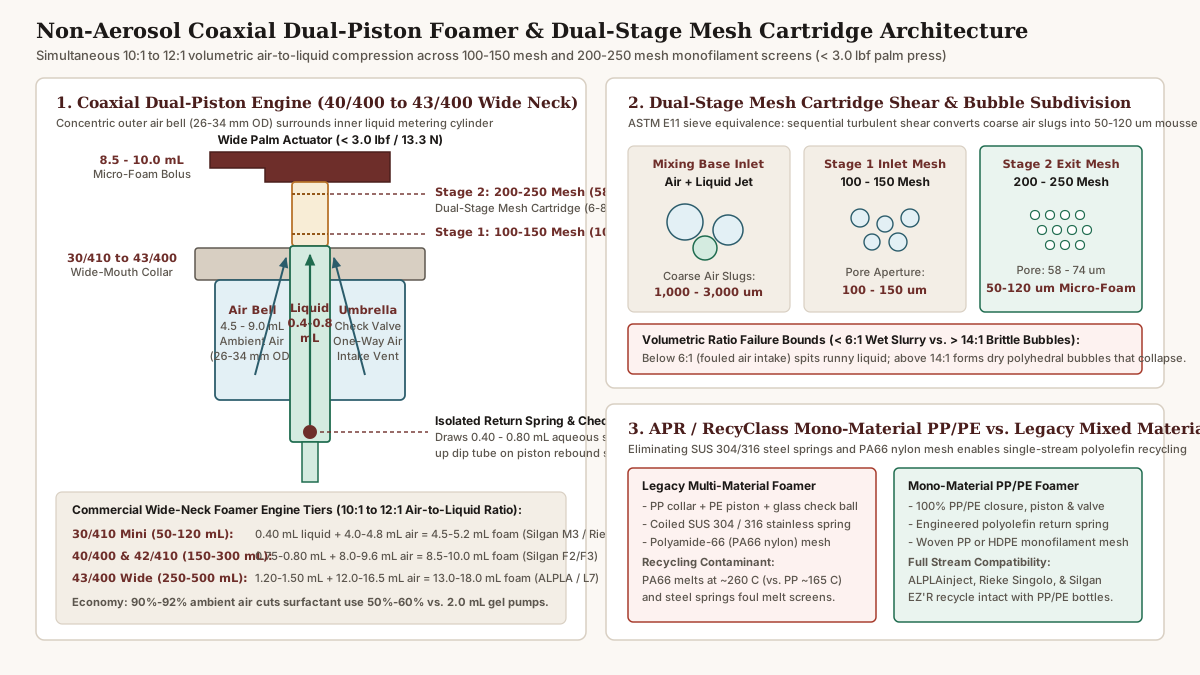
Non-Aerosol Coaxial Dual-Piston Architecture and the 10:1 to 12:1 Air-to-Liquid Ratio
Unlike pressurized aerosol mousse cans that dissolve liquefied volatile organic compound (VOC) hydrocarbon propellants (isobutane, propane, or n-butane at 2.5 to 4.5 bar / 36 to 65 psi) directly into the product phase inside a tinplate or aluminum can, a mechanical foam pump bottle operates at standard atmospheric pressure (101.3 kPa). Every downward press of the actuator head drives two concentric, mechanically linked pistons simultaneously inside a single polypropylene housing.
Why Mechanical Foamers Require Wide 30/410, 40/400, 42/410, and 43/400 Neck Finishes
In a conventional single-chamber lotion pump bottle, the internal fluid metering cylinder measures only 6 to 9 mm in diameter and slips easily through the 18.49 mm minimum inner bore of a narrow 24/410 bottle neck. A mechanical foamer cannot fit inside a 20/410 or 24/410 neck because it must house two coaxial cylinders around the same vertical axis:
- Inner Liquid Metering Cylinder (
0.40 to 0.80 mLSwept Volume): Located along the central axis directly above the lower check ball and dip tube, this narrow polyethylene cylinder draws and meters a small, exact dose of aqueous surfactant solution (0.40 mLon travel foamers,0.75 to 0.80 mLon standard facial and hand cleansers, or1.20 to 1.50 mLon high-output shower foamers). - Outer Concentric Air-Compression Bell (
4.5 to 9.0 mLSwept Volume): Surrounding the inner liquid cylinder is a wide-diameter annular air chamber (26 to 34 mmouter housing diameter) fitted with a flared low-density polyethylene (LDPE) air piston lip seal. To pass that26 to 34 mmair bell through the mouth of the container during capping, the bottle must be molded with a wide30/410,40/400,42/410, or43/400neck finish (32 to 36 mmclear neck bore).
As noted in our accessible pump ergonomics guide, this wide-neck geometry delivers three human-factors advantages alongside its mechanical function:
- Anti-Tip Base Geometry: Accommodating a
40 to 43 mmneck requires a broad container body diameter (55 to 75 mmbase footprint on a150 to 250 mLcylinder bottle), which lowers the center of gravity and prevents the bottle from tipping on wet sink ledges during one-handed operation. - Wide Palm-Press Actuator Saddle: Wide-neck foamer closures support a
32 to 42 mmcontoured actuator head, distributing the2.0 to 2.8 lbfdownward stroke across the palm or two fingers in full compliance with the Arthritis Foundation’s<3.0 lbf(13.3 N) Ease of Use standard. - Spill-Free Refilling: A
32 to 36 mmmouth opening allows consumers and institutional staff to pour aqueous refill solutions without a funnel, cutting single-use plastic bottle turnover when paired with a durable mono-material pump engine.
Volumetric Expansion Math (10:1 to 12:1 Ratio) and Surfactant Economy
On the downward stroke, both coaxial pistons descend across the same vertical travel (7.5 to 10.5 mm), forcing ambient air from the outer bell through radial transfer slots into a pre-mixing chamber at the base of the stem where it collides with the upward jet of liquid surfactant solution:
Volumetric_Air_to_Liquid_Ratio (R_v) = V_air_stroke (mL) / V_liquid_stroke (mL)
Standard Facial Foamer (0.80 mL engine) = 8.8 mL air / 0.80 mL liquid = 11.0 : 1
Gas Volume Fraction (Phi_air) = V_air / (V_air + V_liquid) = 8.8 / (8.8 + 0.80) = 91.7% ambient air
Maintaining the volumetric ratio within the 10:1 to 12:1 engineering window (90.9% to 92.3% gas volume fraction) governs both foam rheology and per-wash formula economy:
50%to60%Surfactant Consumption Reduction: A standard liquid hand soap or facial gel pump dispenses1.5 to 2.0 mLof viscous surfactant per stroke, yielding100 to 133washes from a200 mLbottle, and requires the user to add tap water and rub vigorously to build lather. A0.75 to 0.80 mLfoam pump bottle injects8.0 to 9.6 mLof air before the product leaves the nozzle, delivering a9.0 mLbolus of pre-sheared micro-foam (250 to 312washes per200 mLbottle) that spreads across the skin or scalp immediately.- Under-Aeration Failure Bound (
R_v < 6:1): If the air-to-liquid ratio drops below6:1(<85%air fraction, typically caused by a splitLDPEair-piston skirt seal or surfactant residue partially blocking the air-intake check valve), the liquid fraction is too high to form self-supporting Plateau borders. The nozzle expels a wet, runny slurry (“spitting”) that drips off the fingers. - Over-Aeration Failure Bound (
R_v > 14:1): If the air-to-liquid ratio exceeds14:1(>93.3%air fraction) without a compensatory boost in surfactant film elasticity, the liquid lamellae stretch too thin (<50 nm), producing coarse, dry, polyhedral bubbles that crackle and collapse within3 to 5 seconds.
Dual-Stage Homogenizing Mesh Cartridge (100 to 150 Mesh Inlet vs. 200 to 250 Mesh Exit)
Colliding 8.8 mL of air with 0.80 mL of liquid at the base of the actuator stem produces only a chaotic, coarse two-phase slug with air pockets measuring 1,000 to 3,000 µm (1 to 3 mm) across. To transform that turbulent mixture into a uniform, velvety cosmetic mousse (50 to 120 µm spherical bubble diameter), the two-phase jet must pass serially through a dual-stage homogenizing mesh cartridge press-fitted inside the vertical riser tube directly below the nozzle channel.
ASTM E11 Mesh-to-Micron Equivalency and Two-Stage Turbulent Shear
The homogenizing cartridge consists of a rigid cylindrical polypropylene or high-density polyethylene sleeve (6.0 to 8.0 mm outer diameter by 10.0 to 14.0 mm length) with two precision-woven monofilament screens thermally or ultrasonically welded across its opposite ends. In packaging engineering and ASTM E11 sieve specifications, mesh count specifies the number of openings (wires or polymer monofilament threads) per linear inch (25.4 mm). The clear square micron aperture (w) depends on both the mesh count (M) and the monofilament thread diameter (d_f, typically 35 to 55 µm on polymeric screens):
Aperture_Microns (w) = (25,400 / Mesh_Count) - Thread_Diameter_Microns (d_f)
100-Mesh Pre-Mix Screen (d_f = 100 um) = (25,400 / 100) - 100 = 154 um (~150 um nominal)
200-Mesh Homogenizer (d_f = 53 um)     = (25,400 / 200) - 53  =  74 um
250-Mesh Homogenizer (d_f = 43 um) = (25,400 / 250) - 43 = 58.6 um (~58 um)| Cartridge Stage | Position in Stem Riser | Standard Mesh Count (threads / in) |
Micron Pore Aperture (µm per ASTM E11) |
Approximate Open Pore Count (6 mm Disk) |
Hydrodynamic Function & Output Bubble Diameter |
|---|---|---|---|---|---|
| Pre-Mix Collision Base | Below Cartridge Inlet | None (Annular Mixing Slots) | 800 to 1,200 µm injection channels |
4 to 8 radial slots |
Collides 4.5 to 9.0 mL air with 0.40 to 0.80 mL liquid; forms coarse 1,000 to 3,000 µm slugs |
| Stage 1: Primary Inlet Screen | Lower Bottom Face of Cartridge | 100 to 150 Mesh |
100 to 150 µm (0.10 to 0.15 mm) |
~900 to 1,600 pores |
Shears macroscopic air slugs into an initial pre-foam dispersion (250 to 500 µm bubbles) |
| Internal Mixing Spacer | Cylindrical Sleeve Cavity (10 to 14 mm tall) |
Open Turbulent Chamber | 5.0 to 6.5 mm ID column |
Continuous axial flow | Re-accelerates and redistributes two-phase boundary layers prior to final screen impact |
| Stage 2: Secondary Exit Screen | Upper Top Face Below Nozzle | 200 to 250 Mesh (up to 300 Mesh) |
58 to 74 µm (50 µm on 300 Mesh) |
~3,500 to 5,200 pores |
Subdivides pre-foam into monodisperse 50 to 120 µm micro-bubbles; holds peak >60 seconds |
Why can a single 200-mesh screen not do the job alone? If coarse 2,000 µm air-liquid slugs strike a single 58 to 74 µm screen directly, the high local gas-liquid interfacial tension causes phase separation: air jets channel through the center pores while liquid sheets bypass along the outer wall, producing a sputtering, uneven foam. Placing the 100 to 150 mesh (100 to 150 µm) pre-mix screen 10 to 14 mm upstream breaks the initial air pockets into 250 to 500 µm bubbles so the mixture arrives at the 200 to 250 mesh (58 to 74 µm) exit screen as a homogeneous two-phase emulsion.
Mono-Material PP/PE Foamers vs. Legacy SUS 304/316 and PA66 Nylon Screens
Historically, mechanical foam pumps failed single-stream curbside recycling audits under the Association of Plastic Recyclers (APR) Design Guide and European RecyClass protocols because a single closure combined four incompatible material classes:
- Polypropylene (
PP) and Polyethylene (PE): Closure collar, actuator head, coaxial pistons, and dip tube (density 0.90 to 0.96 g/cm³, melting point130 to 165 °C). - Stainless Steel (
SUS 304orSUS 316): Coiled internal return spring (density ~7.9 g/cm³), which sinks in float-sink separation tanks, triggers metal detectors, and blinds extruder melt-filter screens. - Borosilicate Glass or POM Acetal: Lower inlet check ball (
density 1.41 to 2.23 g/cm³). - Polyamide-66 (
PA66Nylon) Woven Mesh: Legacy mesh cartridges used wovenPA66nylon monofilament because of its high tensile stiffness during ultrasonic welding. However,PA66melts at~260 °C(nearly100 °CabovePPregrind processing temperatures), creating unmelted gel inclusions that degrade recycled polyolefin resin.
Modern mono-material foamers, including ALPLA’s ALPLAinject 100% PP metal-free foam pump, TriMas Packaging’s APR-recognized Rieke Singolo all-plastic foamer, and Silgan Dispensing’s EZ’R mono-material foamer, replace the metal coil spring with an external-chamber injection-molded polyolefin or TPE spring and substitute precision-woven polypropylene (PP) or high-density polyethylene (HDPE) monofilament mesh for PA66 nylon. Because the entire pump head, mesh cartridge, spring, and dip tube share the same polyolefin density (<1.0 g/cm³) and melt window (130 to 168 °C), the complete foam pump bottle assembly can be recycled intact without removing the mesh cartridge.
The <100 cP Newtonian Viscosity Boundary, Surfactant CMC, and Three Clogging Ingredient Classes
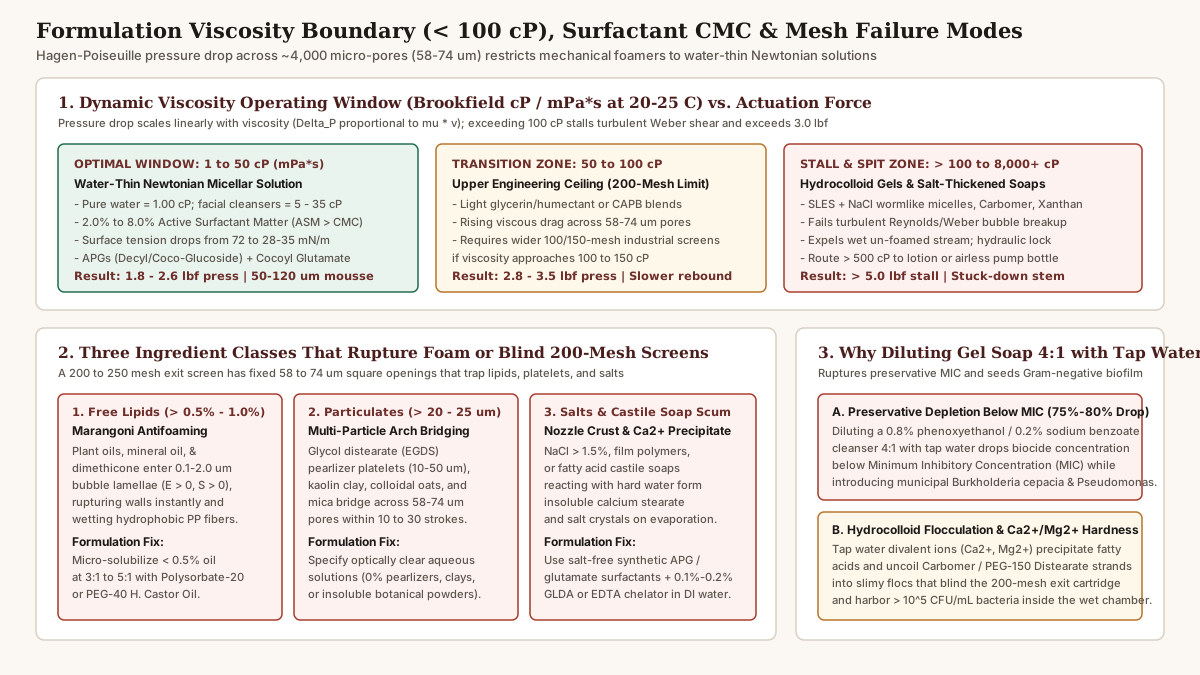
The most frequent formulation error in personal-care packaging is pouring a standard lotion or gel cleanser into a foam pump bottle. While a dip-tube lotion pump easily handles 3,000 to 45,000 cP emulsions, a mechanical foamer is governed by a strict 100 cP (mPa*s) upper dynamic viscosity ceiling, with an optimal operating window of 1 to 50 cP at 20 to 25 °C (for reference, pure water at 20 °C has a dynamic viscosity of 1.00 cP, and typical commercial foaming facial cleansers measure 5 to 35 cP).
Hagen-Poiseuille Pressure Drop Across 58 to 74 µm Micro-Pores
During a normal 0.3 to 0.5 second palm press, the coaxial engine must force 9.6 mL of combined air and liquid through roughly 4,000 microscopic pores (58 to 74 µm wide) on the 200 to 250 mesh screen while keeping finger actuation force below the 3.0 lbf (13.3 N) accessibility limit. By Darcy’s law for screen resistance and the Hagen-Poiseuille relation for laminar-to-turbulent transition through micro-orifices, the hydraulic pressure drop (Delta_P) across the mesh weave scales directly with dynamic viscosity (mu) and superficial velocity (v), and inversely with the square of the micron pore opening (w^2):
Delta_P_mesh = K_screen * (mu * v * L_mesh) / (w^2) + (0.5 * rho * v^2 * C_inertial)
Weber Number (We_pore) = (rho * v^2 * w) / gamma_dynamic   (Must exceed We_crit > 10 - 15 for bubble shear)
When dynamic viscosity (mu) rises above 80 to 100 cP:
- Actuation Force Spike (
>4.5 to 7.0 lbf): Viscous drag across the58 to 74 µmpores drives the required finger press force well past the3.0 lbfthreshold, causing the user to slow down the press stroke. - Collapse of Turbulent Weber Shear (
We < We_crit): As stroke velocity (v) drops and viscous damping increases, the jet exiting the mesh pores cannot reach the critical Weber (We) and Reynolds (Re) numbers required to pinch off50 to 120 µmbubbles. Instead of foam, the nozzle expels a thick, un-aerated liquid slug. - Slow Piston Rebound: On the upward return stroke, viscous fluid resistance through the narrow inner cylinder chokes the return spring, leaving the actuator sluggish or stalled mid-stroke.
Surfactant CMC, Dynamic Surface Tension, and Low-Viscosity Cleanser Chemistry
Because a foam pump bottle cannot rely on polymeric thickeners (such as Carbomer or xanthan gum) to stabilize bubbles after dispensing, foam stability depends entirely on surfactant thermodynamics:
- Operating Above the Critical Micelle Concentration (
CMC): Formulations must contain2.0% to 8.0%total Active Surfactant Matter (ASM) dissolved in water-thin micellar solution, well above the surfactant system’sCMC. When the100/200-meshcartridge shears0.80 mLof liquid into9.0 mLof50 to 120 µmbubbles inside0.3 seconds, the total air-water interfacial area expands by more than1,000-fold. Abundant micelles act as instant monomer reservoirs that diffuse to the newly created air-water interface within milliseconds, dropping dynamic surface tension from72.8 mN/m(pure water at20 °C) down to28 to 35 mN/mand establishing Gibbs-Marangoni film elasticity across the Plateau borders. - Preferred Water-Thin Surfactant Systems (
5 to 35 cP):- Alkyl Polyglucosides (
APGsNon-Ionic):Decyl Glucoside(CMC ~0.07 wt%, high flash-foam volume, water-thin rheology) andCoco-Glucoside(stabilizes cohesive lamellae without salt thickening). - Amino-Acid Anionic Surfactants:
Sodium Cocoyl Glutamate,Disodium Cocoyl Glutamate, andSodium Lauroyl Sarcosinate(mild pH 5.0 to 6.0 skin-barrier cleansers that remain below 25 cP at 3% to 6% ASM). Whether formulating a daily facial cleanser or a post-exercise scalp wash paired with our active-day hair care guide, amino-acid glutamates rinse cleanly without stripping surface lipids. - Amphoteric Co-Surfactants:
Cocamidopropyl Betaine (CAPB)orSodium Cocoamphoacetate(0.5% to 2.5% ASM), which pack tightly with anionic headgroups to slow gravitational drainage from the bubble walls, provided sodium chloride (NaCl) is kept below0.3% to 0.5%so a wormlike-micelle viscosity peak is never triggered.
- Alkyl Polyglucosides (
Why Diluting Commercial Gel Cleansers 4:1 with Tap Water Fails (Rheological & FDA Microbial Hazards)
A pervasive consumer and salon shortcut is mixing 1 part commercial gel facial cleanser or liquid hand soap (3,000 to 8,000 cP) with 3 to 4 parts municipal tap water inside a foam pump bottle. Packaging and microbiological testing demonstrate two severe failure modes with tap-water dilution:
- Hydrocolloid Flocculation and
Ca2+ / Mg2+Mesh Blinding: Gel cleansers are thickened with cross-linked polyacrylic acid (Carbomer),Xanthan Gum,PEG-150 Distearate, or entangledSLES + NaClwormlike micelles, and frequently containGlycol Distearatepearlizing platelets. When diluted with hard tap water (50 to 300 ppmdivalentCa2+andMg2+ions), anionic surfactants and fatty acid soaps react with calcium to precipitate insoluble calcium soap curds (calcium stearate/laurate), while partially hydrated polymer strands uncoil into slimy flocs that coat and blind the58 to 74 µmpores of the200-meshexit screen. - Preservative Depletion Below
MICandBurkholderia cepaciaBiofilm Proliferation: Ready-to-use cleansers are preserved with a calibrated biocide system (such as0.5% to 1.0% phenoxyethanol,0.15% to 0.30% sodium benzoate, orpotassium sorbate) engineered to remain above the Minimum Inhibitory Concentration (MIC) only at full bottle strength. Diluting the product4:1or5:1with tap water cuts preservative concentration by75% to 80%(dropping it well below theMIC) and raises solutionpH(inactivating organic acid preservatives like sodium benzoate that requirepH < 5.5), while simultaneously seeding the bottle with municipal tap-water Gram-negative bacteria. As documented in U.S. FDA safety advisories on Burkholderia cepacia complex (Bcc) in non-sterile aqueous products, waterborne Burkholderia cepacia and Pseudomonas aeruginosa colonize the wet polymer mesh cartridge and coaxial chamber, multiplying to>10^5 CFU/mLbiofilms within days.
Three Ingredient Classes That Rupture Foam or Permanently Blind 200-Mesh Screens
| Incompatible Ingredient Class | Representative Raw Materials | Quantitative Failure Threshold | Physical / Chemical Failure Mechanism Inside the Foamer | Compliant Formulation Alternative |
|---|---|---|---|---|
| 1. Free Lipids, Carrier Oils & Low-HLB Silicones | Jojoba, argan, sweet almond, sunflower, or mineral oil; dimethicone; cyclomethicone; un-solubilized essential oils | >0.5% to 1.0% w/w free oil droplets |
Marangoni Antifoaming & Fiber Wetting: Hydrophobic oil droplets enter the 0.1 to 2.0 µm aqueous bubble lamellae (E > 0, S > 0), spread rapidly across the air-water interface, and rupture bubbles inside the stem while coating hydrophobic PP mesh threads |
Keep fragrance/emollient oils <0.3% to 0.5% and micro-solubilize completely into an optically clear solution (<15 NTU turbidity) using Polysorbate-20 or PEG-40 Hydrogenated Castor Oil at a 3:1 to 5:1 ratio, or use water-soluble PEG-7 Glyceryl Cocoate |
| 2. Suspended Particulates, Pearlizers & Clays | Glycol Distearate (EGDS) or Glycol Stearate pearlizers (10 to 50 µm platelets); kaolin/bentonite clay; colloidal oatmeal; mica; scrub beads |
Any insoluble particle >20 to 25 µm (>1/3 of 58 to 74 µm pore) |
Multi-Particle Arch Bridging: Particles measuring one-third or more of the 58 to 74 µm square aperture bridge across pore intersections, building an impermeable filter cake inside the cylindrical mesh spacer within 10 to 30 strokes |
Eliminate all crystalline pearlizers, clays, pigments, and insoluble botanical powders (0.0% suspended solids); filter bulk batch through a 10 to 25 µm bag or cartridge filter prior to filling |
| 3. High Electrolytes, Castile Soaps & Film Polymers | NaCl or MgSO4 (>1.5%); unchelated potassium cocoate/olivate castile soap; Polyquaternium-7 / 10 (>0.2%); acrylates/PVP |
>1.0% to 1.5% salt or unchelated hard-water soap |
Evaporative Salt Crust & Umbrella Valve Cementing: Residual liquid trapped at the nozzle tip and upper 200-mesh screen evaporates between daily uses, precipitating sharp salt crystals or calcium soap scum across the mesh and air-return valve |
Formulate with salt-free synthetic APG / glutamate surfactants in deionized water (0 ppm hardness) plus 0.1% to 0.2% tetrasodium glutamate diacetate (GLDA) or disodium EDTA chelator |
Dispenser Format Selection Matrix: Foam Pump Bottle vs. Airless Pump Bottle vs. Amber Glass Dropper Bottle
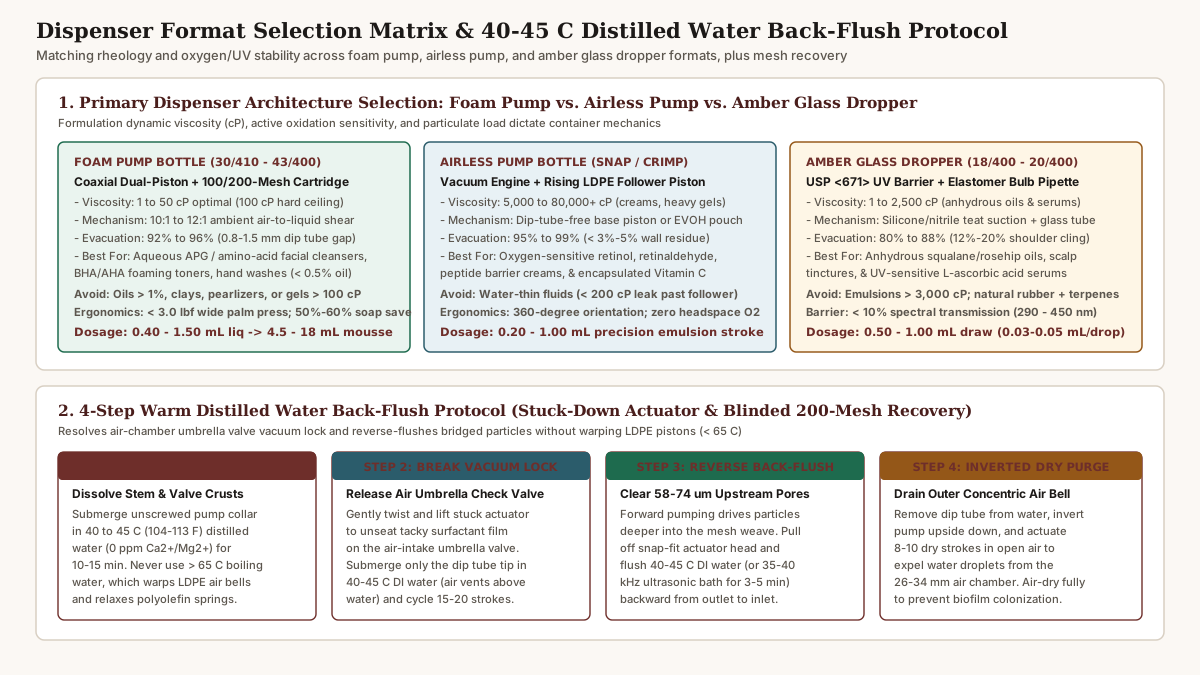
When developing a multi-step personal-care line, packaging engineers routinely evaluate a foam pump bottle alongside two complementary primary packaging formats: an airless pump bottle and an amber glass dropper bottle. Because each dispenser relies on a distinct fluid-mechanical principle, matching the container to formulation viscosity (cP), oxygen sensitivity, and spectral UV barrier requirements prevents field failures:
| Engineering Parameter | Foam Pump Bottle (Coaxial Mechanical Foamer) |
Airless Pump Bottle (Rising Follower Piston / Pouch) |
Amber Glass Dropper Bottle (Elastomer Bulb & Pipette) |
|---|---|---|---|
Target Dynamic Viscosity (cP / mPa*s at 20 °C) |
1 to 50 cP optimal (80 to 100 cP hard ceiling); strictly water-thin Newtonian aqueous solutions |
5,000 to 80,000+ cP; handles medium-to-heavy emulsions, gels, and non-slumping barrier creams that cavitate dip tubes |
1 to 2,500 cP; low-viscosity anhydrous botanical oils, hydroalcoholic scalp tinctures, and light hyaluronic serums |
| Dispensing Engine & Closure Neck Finish | Coaxial dual-piston (10:1 to 12:1 air-to-liquid ratio) + dual 100/200-mesh cartridge on wide 30/410, 40/400, 42/410, or 43/400 neck |
Dip-tube-free vacuum pump + rising LDPE follower disc (or collapsing EVOH pouch) in precision cylinder (snap-on or crimp neck, 0.20 to 1.00 mL/stroke) |
Narrow GPI 18/400, 18/415, or 20/400 threaded collar + silicone, nitrile (NBR), or butyl rubber teat bulb + Type III/I glass pipette (0.50 to 1.00 mL/draw) |
Oxygen Headspace & UV Light Protection |
Deliberately aerates dispensed bolus 10:1 with ambient air; bulk liquid protected if molded in opaque HDPE/PP or amber PET |
Near-zero oxygen backflow (100% air-isolated bulk chamber) + 100% UV/visible block in opaque double-wall PP; preserves retinoids and peptides |
Superior USP <671> spectral UV barrier (<10% light transmission across 290 to 450 nm), but unscrewing the pipette exposes headspace to ambient O2 at every use |
| Container Evacuation & Residual Waste | 92% to 96% evacuation (uses straight center dip tube with 0.8 to 1.5 mm bottom floor clearance) |
95% to 99% evacuation (<3% to 5% residual waste as wiper seal on rising follower plate scrapes cylinder walls clean) |
80% to 88% evacuation (12% to 20% residual oil clings to interior glass walls and settles below the rigid glass pipette tip) |
Ergonomics & One-Hand Accessibility (ISO 22015) |
Single-hand <3.0 lbf (13.3 N) palm press on stable wide-base bottle; instant non-drip mousse bolster |
Single-hand 360° orientation press (2.0 to 3.2 lbf); dispenses upside-down without losing prime |
Two-handed fine pinch action: requires unscrewing cap, squeezing elastomer teat (8 to 15 N pinch), and aiming glass dropper |
| Ideal Personal-Care Formulations | Aqueous APG and amino-acid facial cleansers, hand washes, baby washes, BHA/AHA foaming toners, and sunless tanning waters (2% to 8% ASM, <0.5% oil) |
Oxygen-sensitive encapsulated retinol creams, retinaldehyde serums, peptide eye treatments, ceramide barrier creams, and SPF foundations |
Anhydrous facial oils (squalane, rosehip, marula, jojoba), essential oil blends, scalp serums, and UV-sensitive 10% to 20% L-ascorbic acid solutions |
| Critical Incompatibility & Failure Mode | Oils >1%, clays, pearlizers (glycol distearate), or gels >100 cP cause instant Marangoni defoaming or permanent 200-mesh screen blinding |
Water-thin liquids (<200 cP) bypass the bottom follower-plate wiper seal and leak out the lower air intake vents; salt scrubs score cylinder walls |
Creams >3,000 cP cannot draw up the 1.2 mm pipette tip; citrus/terpene essential oils swell natural rubber bulbs unless silicone or butyl/FKM bulbs are specified |
Decision Rules for Routing Formulas Across the Three Formats
- Why Oils Belong in an
Amber Glass Dropper Bottle(Not a Foamer): Anhydrous botanical oils (squalane, rosehip, argan) and oil-soluble actives lack an aqueous phase (0% ASM) and act as physical antifoams inside a foam pump bottle. Packaging them in an amber glass dropper bottle (GPI 18/400or20/400neck) provides a chemically inert Type III soda-lime or Type I borosilicate glass container that blocks>90%of actinic ultraviolet light between290 and 450 nmperUSP <671>spectral transmission standards, preventing photo-oxidation of polyunsaturated fatty acids. When formulating with volatile essential oils or terpenes (limonene,linalool,tea tree), specify a platinum-cured silicone or butyl/nitrile (NBR) dropper bulb rather than natural latex rubber, which absorbs terpenes, swells, and degrades into tacky residue. - Why Retinoids and Thick Creams (
>5,000 cP) Belong in anAirless Pump Bottle: As established in our lotion pump specification and our airless pump bottle piston tolerance and vacuum dispensing guide, standard dip-tube lotion pumps cavitate above45,000 to 50,000 cPand draw replacement ambient air into the bottle headspace after every stroke. An airless pump bottle eliminates both the dip tube and headspace air: a precision-moldedLDPEfollower piston rests beneath the emulsion and rises incrementally down to0.20 to 1.00 mLper stroke as atmospheric air enters through a tiny vent hole in the container base below the piston. However, airless follower-plate bottles must never be filled with water-thin1 to 50 cPfoaming cleansers, because low-viscosity aqueous surfactant solutions seep past the radial wiper seal of the bottom follower piston and leak out the base vents during parcel transit.
Diagnosing and Recovering a Stuck-Down Actuator or Clogged 200-Mesh Cartridge (40 to 45 °C Back-Flush Protocol)
When a foam pump bottle fails in service, it exhibits one of two mechanical symptoms: either the actuator head stays depressed at the bottom of its stroke (“stuck-down actuator”) or the nozzle spits a weak, watery stream instead of dense foam. Both symptoms originate from reversible fouling inside the coaxial air valve or the dual-stage mesh cartridge.
Root Cause 1: Fouled Air-Return Umbrella Valve and Negative-Pressure Vacuum Lock
On the upward return stroke after a press, the internal return spring must push both coaxial pistons back to their top rest position. For the wide 26 to 34 mm outer air piston to rise, 4.5 to 9.0 mL of replacement ambient air must enter the outer air bell through a one-way elastomeric umbrella check valve (or duckbill / micro-clearance lip vent) while 0.40 to 0.80 mL of liquid is drawn up the dip tube past the lower check ball.
If the bottle is actuated while tilted horizontally, dropped in the shower, or overfilled above the neck shoulder line, aqueous surfactant solution splashes backward into the outer concentric air chamber and coats the umbrella check valve seat. As that thin surfactant film dries, it cements the flexible elastomer umbrella flap shut against its polymer port. When the user next presses the actuator down, air is expelled through the nozzle, but on the return stroke the sealed intake valve blocks replacement air from entering the air bell. The rising piston pulls a -40 to -70 kPa negative-pressure vacuum (“vacuum lock”) inside the 30 mm air chamber that overpowers the return spring and holds the actuator head pinned down.
Root Cause 2: Blinded 200-Mesh Exit Screen and Hydraulic Stem Lock
When dehydrated surfactant crust, hard-water calcium soap scum, or suspended 10 to 50 µm pearlizer platelets occlude more than 60% of the 58 to 74 µm openings in the upper 200 to 250 mesh screen, downward actuation force spikes above 6.0 to 8.0 lbf. Forcing the actuator down traps high residual hydraulic pressure in the vertical stem between the lower ball check valve and the blocked mesh cartridge, wedging the piston seal against the cylinder wall.
The 4-Step 40 to 45 °C Distilled Water Reverse Back-Flush Protocol
Forward pumping with tap water rarely clears a blinded mesh cartridge because particulate debris is trapped on the upstream (bottom/inlet) face of the 100-mesh and 200-mesh screens; forward strokes simply drive bridged particles deeper into the monofilament weave. Packaging QA laboratories and maintenance teams restore full 10:1 foam output using a four-step thermal and reverse-flow recovery sequence:
- Step 1: Thermal Soak in
40 to 45 °C(104 to 113 °F) Distilled Water (10 to 15 Minutes): Unscrew the wide-neck foamer closure from the bottle and wipe bulk cleanser from the exterior of the dip tube. Submerge the entire pump collar and actuator assembly in a vessel of warm distilled or deionized (DI) water (0 ppm Ca2+/Mg2+) heated to40 to 45 °C(104 to 113 °F) for10 to 15 minutes.- Critical Temperature Limit (
<65 °C): Never immerse a foam pump in boiling or near-boiling water (>65 to 70 °C). Thin-walledLDPEconcentric air pistons (0.4 to 0.6 mmwall thickness) and mono-material polyolefin return springs undergo thermal stress relaxation and permanent ovality warpage above65 °C, destroying the coaxial air seal. Using0 ppmdistilled water prevents calcium soap precipitation inside the mesh during soaking.
- Critical Temperature Limit (
- Step 2: Release the Air-Bell Vacuum Lock and Cycle the Check Valves (
15 to 20 Strokes): Once the warm soak dissolves dried surfactant films on the stem and umbrella valve seat, gently twist and lift the actuator head upward to its full top position until a faint hiss confirms that ambient air has equalized the vacuum inside the outer air chamber. Place only the lower tip of the dip tube into a clean beaker of40 to 45 °Cdistilled water (keeping the upper closure collar and air-intake vents completely above the waterline so air and water cycle together in their normal10:1ratio) and actuate the pump15 to 20full strokes to purge dissolved surfactant from the inner cylinder. - Step 3: Remove the Actuator Head and Reverse Back-Flush the
200-MeshCartridge: Pull the snap-fit actuator head straight upward off the vertical stem riser (exposing the top exit of the cylindrical100/200-meshcartridge; on two-piece stems, slide the6 to 8 mmpolymer mesh cylinder out with non-marring nylon tweezers). Direct a pressurized stream of40 to 45 °Cdistilled water from a laboratory wash bottle or syringe in the reverse direction (entering through the upper200-meshexit screen and exiting out the lower100-meshinlet screen) for30 to 60 seconds, or place the removed mesh cartridge in a35 to 40 kHzultrasonic bath filled with40 °Cdistilled water for3 to 5 minutes. Reverse flushing lifts bridged platelets and hydrocolloid films directly off the upstream face of the58 to 74 µmweave without tearing the35 to 45 µmpolymer monofilaments. - Step 4: Inverted Dry-Stroke Air Bell Purge (
8 to 10 StrokesUpside Down): Reinsert the clean mesh cartridge and snap the actuator head firmly onto the stem. Remove the dip tube from the water beaker, invert the entire pump assembly upside down (180°) in open air, and depress the actuator8 to 10full dry strokes.- Why Inverted Purging Is Mandatory: During Step 1 soaking, water enters the wide outer
26 to 34 mmconcentric air chamber. Because the air chamber ports sit at the top of the bell when the pump is upright, upright pumping cannot drain trapped water droplets from the air side, causing the pump to spit wet slurry for20+strokes. Actuating the pump upside down drains water droplets downward through the air transfer slots and out the nozzle. Allow the assembly to air-dry completely on a clean lint-free rack before reinstalling it onto the bottle to prevent waterborne biofilm growth.
- Why Inverted Purging Is Mandatory: During Step 1 soaking, water enters the wide outer
Engineering Specification Checklist for Foam Pump Bottle Qualification
Before approving a foam pump bottle assembly for production filling or e-commerce distribution, verify all six technical gates alongside our accessible pump handling checklist and neck finish torque procedures:
- Match Wide Neck Finish & Dosage Tier to Container Volume: Specify
30/410(0.40 mLliquid /4.5 mLfoam) for50 to 120 mLtravel bottles,40/400or42/410(0.75 to 0.80 mLliquid /9.0 mLfoam) for150 to 300 mLfacial and hand bottles, and43/400(1.20 to 1.50 mLliquid /15.0 mLfoam) for250 to 500 mLbath and sanitizing containers. - Audit Volumetric Air-to-Liquid Ratio (
10:1to12:1) & Foam Density: Measure dispensed foam bolus mass (0.75 to 0.80 g) versus expanded volume in a graduated cylinder (8.5 to 10.0 mL), verifying a specific foam density of0.08 to 0.10 g/mL(90% to 92%gas fraction) and a bubble hold time exceeding60 secondsat20 °C. - Specify Dual-Stage
100/200-MeshMonofilament Cartridge & Mono-MaterialPP/PEBuild: Confirm the stem riser contains both a100 to 150 mesh(100 to 150 µm) lower inlet screen and a200 to 250 mesh(58 to 74 µm) upper exit screen welded to aPP/HDPEsleeve; select anAPR-compliant all-plastic mono-material engine (eliminatingSUS 304/316steel springs andPA66nylon mesh) when single-stream polyolefin recyclability is required. - Enforce the
<50 to 100 cPNewtonian Viscosity &<15 NTUClarity Gate: Verify on a Brookfield viscometer (LV-1orULadapter spindle at20 to 25 °C) that bulk formulation viscosity lies between1 and 50 cP(80 to 100 cPabsolute ceiling) with2.0% to 8.0% ASMabove theCMC,0.0%suspended particulates/pearlizers>20 µm, and<0.5%fully micro-solubilized oil. - Validate Full-Stroke Palm Actuation Force (
<3.0 lbf/13.3 N): Test full-stroke depression force at10 mm/scompression speed across50consecutive strokes to confirm viscous back-pressure across the200-meshcartridge never pushes actuation force past the Arthritis Foundation’s3.0 lbfaccessibility limit. - Verify Headspace Fill Clearance &
-68 to -95 kPaVacuum Transit Seal: Leave12% to 18%headspace volume in the bottle so liquid remains below the lower rim of the26 to 34 mmconcentric air bell when upright, preventing surfactant splash into the air-intake umbrella check valve duringISTA 3Aparcel vibration and-68 to -95 kPaaltitude pressure cycling.