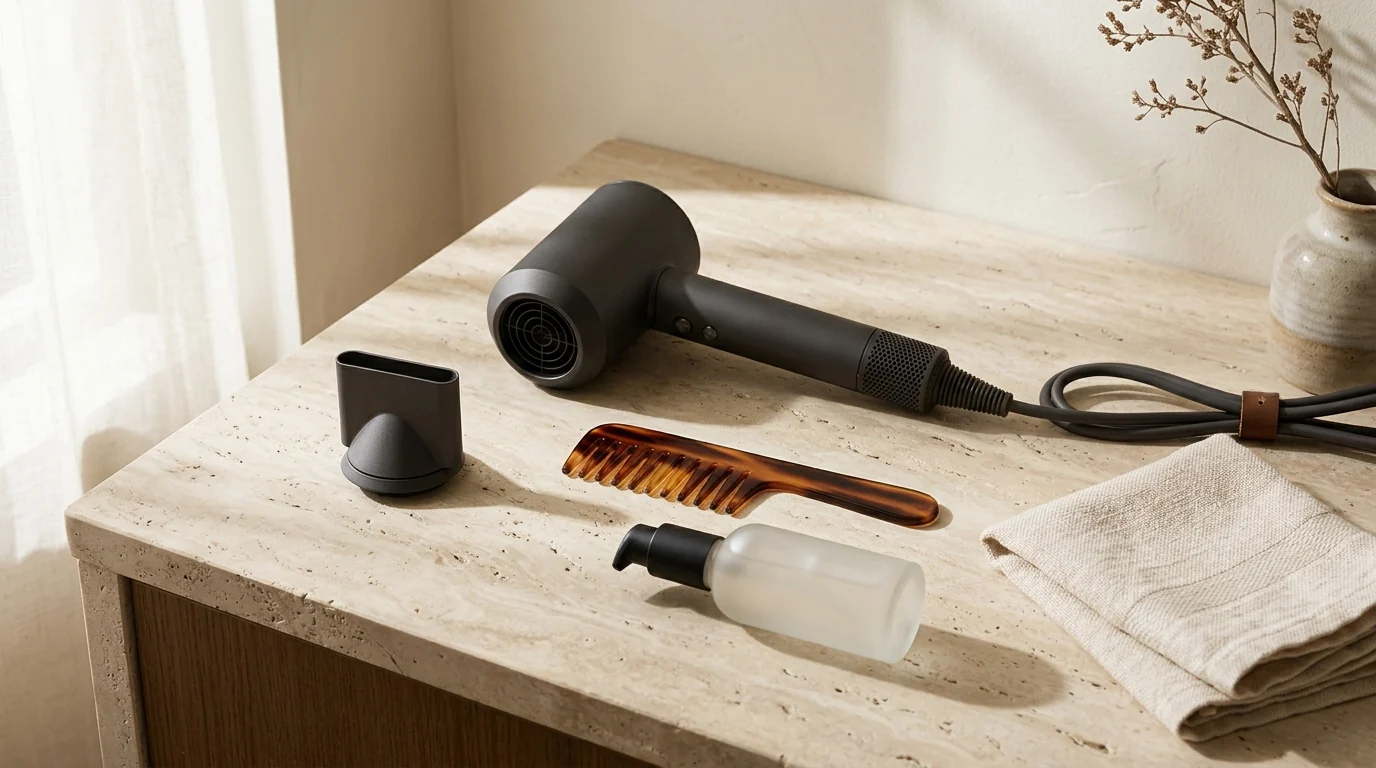
An ionic hair dryer is a hand-supported electric blow dryer equipped with a high-voltage corona discharge ionizer that releases negatively charged air ions into the warm airstream to reduce static electricity, help disperse surface water droplets for faster drying, and smooth the outer hair cuticle. Real-world results still depend heavily on hair density, nozzle distance, and continuous motion.
Within our beauty and hair section, this reference pairs with our notes on active lifestyle wash timing and wet-hair handling and silk press maintenance against humidity and sweat. Because product labels routinely blend electrical, heating, and mineral terms, separating what a corona ionizer actually does from ceramic elements, tourmaline coatings, and safe drying geometry prevents both flat roots and avoidable heat damage.
| Dryer Design Feature | Primary Physical Mechanism | Practical Styling Effect | Key Boundary or Caveat |
|---|---|---|---|
| Active Ionic Generator | High negative voltage on a sharp electrode generates negative air ions that cluster with 20 to 30 water molecules | Targets static buildup, surface water breakup, and smoother cuticles | Efficacy remains debated; corona ionizers can indirectly emit ozone |
| Ceramic Heating Element | Ceramic heater replaces bare coiled nichrome wire on mica insulators | Faster heat-up and shorter drying time (standard across most dryers by 2007) | Air temperature at the shaft still climbs sharply if the nozzle is held closer than 15 cm |
| Tourmaline Mineral Coating | Asymmetric pyroelectric mineral crystals generate surface charge during heating or cooling | Mineral infusion paired with ceramic or ionic internals for smooth styling | At steady temperature (zero temperature change), polarization stays constant with no current |
| Non-Ionic Dryer / Diffuser | Warm airflow without active ionizer; diffuser slows and spreads the air jet | Gentler drying with less physical disturbance and fuller lift on fine or thin hair | Slower evaporation on very dense, coarse, or high-porosity hair |
How Does an Ionic Hair Dryer Work Compared to a Regular Dryer?
A regular hand-supported hair dryer combines electric heating coils and a universal-motor fan to push warm or hot air over wet hair, evaporating water and guiding temporary hydrogen-bond formation inside each strand. An ionic hair dryer adds an internal high-voltage corona discharge ionizer that generates negative air ions to curb static buildup and help break up surface water droplets.
Negative Ion Generation, Hydrogen Bonds, and Surface Water Clearance
Under U.S. federal safety definitions in 16 CFR Part 1120, a hand-supported hair dryer is an electrical appliance held with one hand that creates a flow of air over or through a self-contained heating element to dry hair. Styling hold comes from temporary hydrogen bonds that form within each strand as water evaporates; as noted in hair dryer construction references, those bonds are strong enough to set shape yet remain vulnerable to humidity and disappear with a single wash.
In conventional dryers, heat comes from bare coiled nichrome wire wrapped around mica insulators—chosen for nichrome’s high electrical resistivity and corrosion resistance—paired with a fan typically driven by a universal motor. An ionic model adds an artificial corona discharge generator. As detailed in a peer-reviewed review of negative air ion physics on NIH PubMed Central, applying a high negative voltage to a sharp needle-type electrode intensifies the local electric field and ionizes surrounding air molecules. Negative air ions (NAIs) are molecules or atoms that gain an electron (while positive ions lose one), and these negative ions combine with several or up to 20 or 30 water molecules to form hydrated negative-ion clusters in the airflow.
Styling industry descriptions explain that ionic hair dryers use negative ions to break down surface water droplets so hair dries faster with less prolonged heat exposure, while helping the cuticle lie smoother and shinier with less frizz. At the same time, engineering summaries of handheld hair dryers emphasize that the measurable effectiveness of ionic operation remains debated—meaning negative ions complement, rather than replace, proper washing, conditioning, and temperature technique.
Hair Isoelectric Point (pH 3.67), 18-MEA Lipids, and Why Static Still Needs Care
Peer-reviewed trichology clarifies why airflow ions alone cannot eliminate every cause of frizz. According to the NIH PubMed Central hair cosmetics overview, each overlapping cuticle cell carries a covalently bound outer lipid coating of 18-methyl eicosanoic acid (18-MEA) that keeps virgin hair hydrophobic. Repeated rough washing, unprotected drying, mechanical friction, sunlight, and alkaline chemical procedures deplete that surface lipid layer, turning the outer cuticle from hydrophobic into a hydrophilic, negatively charged surface.
Human hair also has a low isoelectric point of pH 3.67, so any wash routine above that pH leaves a net negative electrical charge along the fiber surface. Strong anionic shampoo surfactants strip sebum effectively but can heighten negative surface charges, increasing strand-to-strand static repulsion, friction, and frizz. Cationic conditioners counteract that charge by depositing positively charged lubricating ingredients onto the negative cuticle net, while polysiloxane silicone heat protectants help re-cement lifted cuticle scales and limit heat damage before the dryer even switches on.
Is an Ionic Hair Dryer Better for Reducing Frizz and Heat Exposure?
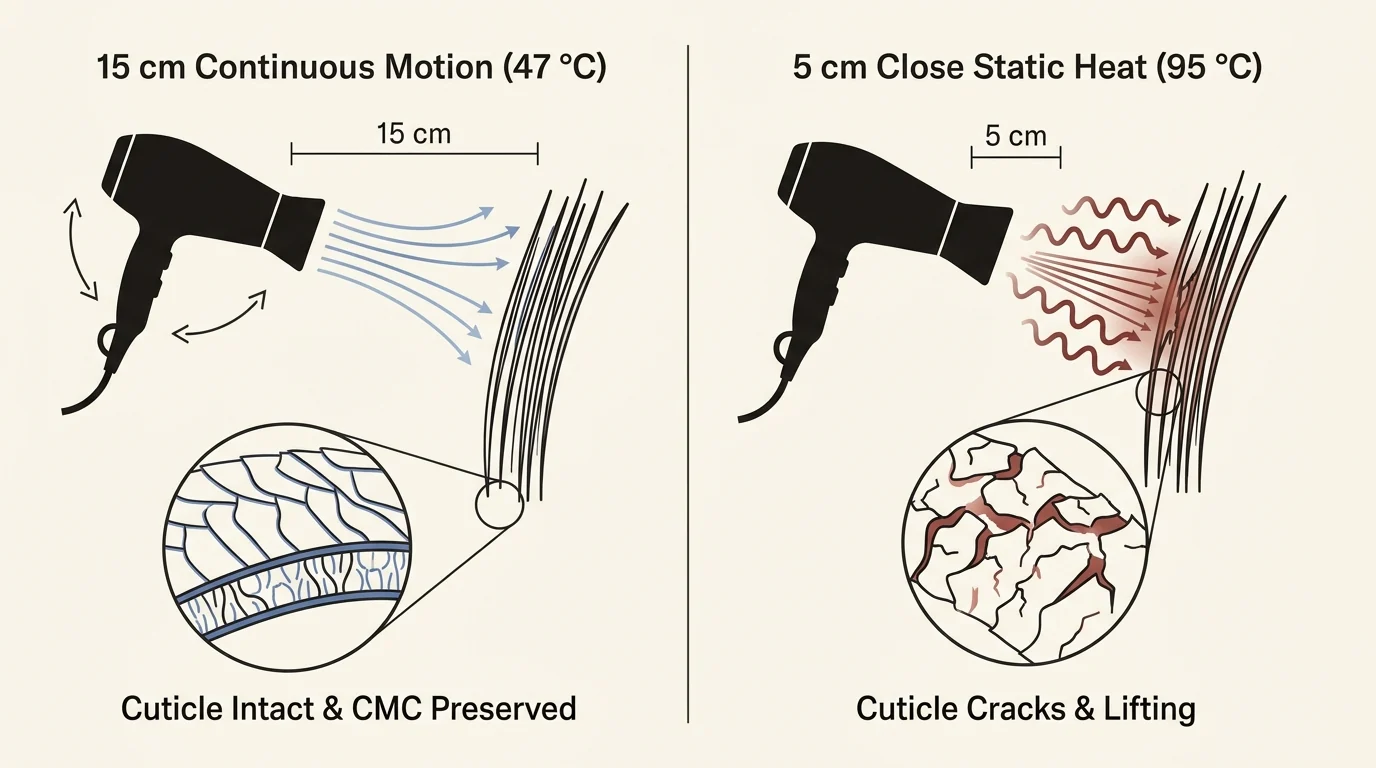
An ionic hair dryer can help cut static flyaways and shorten drying passes on frizz-prone hair, but controlled dermatological testing proves nozzle distance and continuous movement govern actual hair shaft damage far more than any ion label. Drying at 15 cm with continuous motion (47 degrees Celsius) causes less overall damage than prolonged 2-hour ambient air-drying or close-range 5 cm heat (95 degrees Celsius).
Controlled 30-Cycle Microscopy: 15 cm Continuous Motion vs 5 cm Close Heat vs Air-Drying
In controlled hair-drying research published in the Annals of Dermatology on NIH PubMed Central, investigators divided hair tresses into five groups across 30 repeated shampoo-and-dry cycles over 30 days: an untreated control, ambient room-temperature drying at 20 degrees Celsius without a dryer, and blow-drying at three distances on a fixed dryer setting. Even though the dryer’s internal setting stayed unchanged, air temperature at the hair surface surged sharply as the nozzle moved closer—from 47 degrees Celsius at 15 cm (60 seconds) to 61 degrees Celsius at 10 cm (30 seconds) and 95 degrees Celsius at 5 cm (15 seconds).
| Drying Protocol (30 Cycles Over 30 Days) | Measured Air Temperature | Drying Time per Cycle | Cuticle Surface Result (SEM / TEM) | Intercellular CMC & Color Lightness Result |
|---|---|---|---|---|
| Ambient Air-Drying (No Dryer) | 20 degrees Celsius | Over 2 hours | No surface cracks from blow-drying | CMC bulging damage observed; lightness shift after 10 cycles |
| Blow Dryer at 15 cm (Continuous Motion) | 47 degrees Celsius | 60 seconds | Minor longitudinal cuticle cracks; intact cortex | CMC preserved; less overall damage than natural drying |
| Blow Dryer at 10 cm | 61 degrees Celsius | 30 seconds | More obvious cuticle lifting and longitudinal cracks; intact cortex | CMC preserved |
| Blow Dryer at 5 cm | 95 degrees Celsius | 15 seconds | Severe cracks, holes, hazy borders, and punched-out cuticles | CMC preserved, but severe cuticle destruction and lightness shift after 10 cycles |
Two findings from that trial directly reshape safe everyday drying:
- Staying Wet for Hours Damages the CMC: Ambient drying took more than 2 hours and was the only condition that produced bulging damage in the intercellular cell membrane complex (CMC). Because the hair shaft swells when wet and the CMC delta-layer serves as the sole route for water diffusion into hair, staying waterlogged for hours strains internal cohesion and shifted hair lightness after just 10 treatments.
- Holding the Nozzle Too Close Punches Out Cuticles: Holding a concentrator or nozzle just 5 cm from the shaft pushed surface air temperature to 95 degrees Celsius, creating cracks, holes, hazy cuticle borders, punched-out outer cuticles on transmission electron microscopy, and measurable lightness shifts after 10 cycles—even though inner cortical cells and melanin granules remained preserved across all tested groups.
Moisture analysis also showed that post-drying water content dropped slightly in all treated groups compared with untreated hair, with no statistically significant difference among drying methods. That confirms why keeping any ionic or non-ionic dryer at least 15 cm away and moving continuously—then finishing with the cool-shot button that shuts off the heater to blow room-temperature air—sets hydrogen bonds smoothly while minimizing frizz and thermal cracking.
Wet-Hair Mechanical Limits Before Turning On the Dryer
Thermal stress is only half the story when styling wet strands. According to the NIH PubMed Central trichology review, wet virgin hair can stretch up to 30% of its original length without damage, suffers irreversible structural changes when stretched between 30% and 70%, and fractures outright at 80% extension. Pulling aggressively with a round brush while holding an ionic concentrator nozzle 5 cm from saturated roots combines high mechanical tension with 95 degrees Celsius surface heat—defeating any anti-frizz advantage the dryer offers.
How Do Ionic, Ceramic, and Tourmaline Hair Dryers Differ?
Ionic, ceramic, and tourmaline refer to three distinct engineering layers rather than mutually exclusive dryer categories, which is why many modern hair dryers combine all three in one housing. Ionic denotes an active corona discharge ionizer, ceramic describes the internal heating element material, and tourmaline is a pyroelectric mineral used as an internal coating or infusion.
Ceramic Heating Elements vs Bare Nichrome Coils
Conventional early handheld dryers relied on bare coiled nichrome wire wound over mica insulators, prized for high resistivity and resistance to corrosion at operating temperatures. By 2007, however, a retail store survey cited in hair dryer engineering summaries found that most hair dryers had shifted to ceramic heating elements because their faster heat-up shortens both warm-up delay and total drying time. Ceramic technology therefore addresses how quickly and steadily heat is generated, whereas ionic technology addresses electrical charge in the airstream.
Ionic vs Tourmaline Hair Dryer: Corona Ionizer vs Pyroelectric Mineral
Comparing an ionic vs tourmaline hair dryer clarifies the difference between an active high-voltage circuit and a passive crystalline mineral coating. Peer-reviewed materials physics on pyroelectric energy behavior in Sensors (NIH PubMed Central) explains that pyroelectricity—the appearance of surface electric charge on a polar material when temperature changes polarization—was first discovered in minerals such as tourmaline. In asymmetric tourmaline crystals, pyroelectric charge develops on opposite crystal faces during heating or cooling, and non-uniform heating also creates thermal-expansion stress that induces polarization via the piezoelectric effect. Crucially, at steady temperature (zero temperature change), polarization remains constant and generates no current—meaning tourmaline coatings act as a passive thermal-mineral layer rather than a continuously powered high-voltage emitter.
| Comparison Axis | Active Ionic Hair Dryer | Ceramic Hair Dryer | Tourmaline-Coated Hair Dryer |
|---|---|---|---|
| Component Role | High-voltage corona discharge ionizer | Internal heating element (replacing bare nichrome on mica) | Mineral powder infused into grille, barrel, or ceramic coating |
| Underlying Physics | Sharp needle electrode ionizes air into negative ion clusters (up to 20 to 30 water molecules) | Rapid-response ceramic heater for fast heat-up and shorter drying time | Asymmetric pyroelectric crystal develops surface charge during heating or cooling |
| Primary Styling Target | Static reduction, faster droplet clearance, smoother cuticle finish | Faster, steadier warm-up and reduced drying duration | Complements ceramic heat and ionic smoothing on thick or frizz-prone hair |
| Operational Tradeoff | Can flatten fine roots; corona ionizers can emit ozone | Still scorches cuticles at 5 cm (95 degrees Celsius) if held too close | No current at steady temperature (zero temperature change); relies on airflow and 15 cm motion |
Because an active ionic dryer uses high voltage inside the airflow path, both the U.S. Environmental Protection Agency guidance on ion generators and the NIH PubMed Central review of negative air ions highlight ozone as a potential indirect byproduct. In reviewed ionizer testing, 5 out of 27 ionizers emitted ozone, with corona systems generating ozone above a 16,000-volt threshold, and the U.S. Food and Drug Administration caps ozone at 0.05 parts per million for regulated medical devices. Running any ionic dryer in a ventilated bathroom keeps trace byproducts well dispersed while preserving normal drying comfort.
Why Do People with Fine or Flat Hair Sometimes Choose a Non-Ionic Dryer?
People with fine, straight, or thin hair sometimes choose a non-ionic hair dryer—or an ionic model with an on/off ion switch—because heavy cuticle smoothing and static elimination can make fine strands lie flat against the scalp. Fine straight hair also distributes natural scalp sebum efficiently along the shaft, causing strands to clump and lose lift much faster than thick, coarse, or tightly coiled hair.
Cuticle Scale Count, Medulla Presence, and Sebum Transport Across Hair Types
Structural hair biology documented in the NIH PubMed Central hair cosmetics review explains why one dryer setting cannot fit every head equally:
- Medulla and Fiber Bulk: The hair shaft comprises three concentric regions—cuticle, cortex, and medulla. A central medulla is present in coarser, thicker hair and absent in fine hair, leaving fine strands with less inherent structural stiffness.
- Cuticle Scale Thickness and Shape: Overlapping cuticle scales average 6 to 8 layers thick in Asian hair, slightly fewer in Caucasian hair, and fewer still in African hair—which also exhibits an ellipsoid cross-section with narrower diameters at twisting points, elevating sensitivity to breakage and frizz.
- Sebum Flow vs Volume Retention: Fine straight hair transports sebum readily down the fiber length, whereas curly-coarse hair resists tress clumping and limpness while struggling with dry lengths and higher combing friction.
Consequently, styling comparisons consistently separate hair types along a clear boundary: ionic dryers suit thick, coarse, frizzy, or weathered hair that needs faster surface-water clearance and smoother cuticle alignment, while non-ionic dryers suit straight, fine, or thin hair where retaining subtle inter-fiber separation preserves natural root lift.
| Hair Profile | Key Structural Trait | Preferred Dryer Mode | Recommended Nozzle & Technique |
|---|---|---|---|
| Fine, Straight, or Flat Hair | Absent medulla; efficient scalp sebum transport causes quick clumping and limpness | Non-ionic dryer or ionic switch turned off | Use a diffuser or keep dryer 15 cm away in continuous motion; finish with cool shot |
| Thick, Coarse, or Frizzy Hair | Coarser shaft with central medulla; resists limpness but dries slowly and frizzes easily | Ionic + ceramic (with or without tourmaline coating) | Use a concentrator at 15 cm moving continuously along downward cuticle direction; seal with cool shot |
| Tightly Coiled or Delicate Damaged Hair | Thinner cuticle layer (fewer than 6 scales), ellipsoid cross-section, narrow twist points | Ionic on low or medium heat, or diffuser mode | Avoid 5 cm close heat (95 degrees Celsius) and keep wet stretching below 30% |
Choosing Between a Diffuser, Airflow Concentrator, and Comb Nozzle
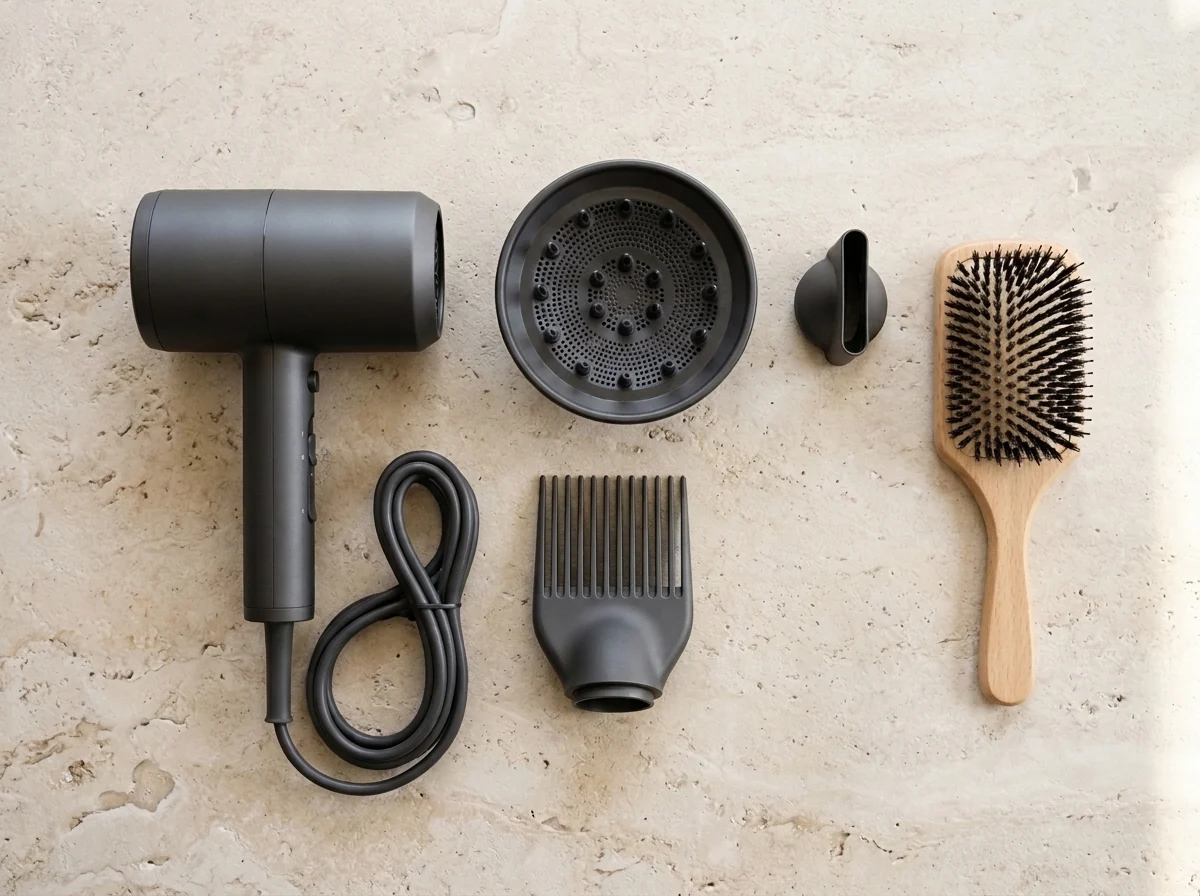
Attachments change airflow velocity and thermal concentration just as decisively as ion output. As outlined in hair dryer attachment specifications:
- Diffuser: Recommended for fine, colored, permed, or naturally curly hair. By dispersing the focused jet of air, a diffuser dries hair more slowly at a cooler temperature with less physical disturbance—reducing frizz while building natural volume.
- Airflow Concentrator: Performs the opposite role by narrowing the outlet to focus airflow and heat onto one targeted section for rapid drying. Because concentrated airflow raises local temperature quickly, maintaining a 15 cm working distance and continuous sweep is essential to avoid the 95 degrees Celsius close-range damage zone.
- Comb Nozzle: Pairs a narrowed concentrator exit with comb-like teeth so textured or tangled lengths can be dried without holding a separate brush—provided strands are detangled gently to stay well below wet hair’s 30% safe elastic stretch limit.
What Should Travelers Check on a Dual Voltage Hair Dryer?
When packing a dual voltage hair dryer for travel, verify that the appliance explicitly handles both 110 to 120 volt and 230 to 240 volt supplies rather than relying on a simple plug adapter. High-draw heating appliances plugged into mismatched foreign voltages can suffer permanent electrical damage.
International Voltage Differences (110/120 V vs 230/240 V 50 Hz)
As explained in U.S. International Trade Administration travel guidance, destinations operating on 230 to 240 volts at 50 Hz require a transformer or voltage converter to step power down for single-voltage 110 to 120 volt appliances, and failing to step down voltage will damage the appliance. Because a hair dryer combines resistive heating coils with a universal motor, travelers moving between 110 to 120 volt and 230 to 240 volt regions need a purpose-built dual-voltage switchable dryer rather than an unrated single-voltage travel model.
Federal Immersion Protection (16 CFR Part 1120, UL 859, UL 1727) and Bathroom Safety
Beyond voltage ratings, immersion shock protection on the cord plug is legally mandated in the United States. Under 16 CFR Part 1120 (enforced by the U.S. Consumer Product Safety Commission since June 28, 2011), any hand-supported hair dryer lacking integral immersion protection compliant with section 5 of UL 859 (10th Edition, for household personal grooming appliances) or section 6 of UL 1727 (4th Edition, for commercial salon grooming appliances) is legally deemed a substantial product hazard.
Before traveling or buying any everyday ionic dryer, run through four quick verification checks:
- Confirm Dual-Voltage Labeling: Verify explicit 110 to 120 V and 230 to 240 V support on the handle plate before international travel, and set the voltage selector before plugging in.
- Test the Immersion Safety Plug: Confirm the integral UL 859 or UL 1727 safety plug test and reset buttons trip cleanly before bathroom use.
- Check for an Ion Toggle and Cool Shot: If you have fine or flat hair—or share a dryer across hair types—an ion on/off switch plus a cool-shot button provides flexibility without buying two appliances.
- Dry in a Ventilated Room at 15 cm: Keep airflow moving continuously about 15 cm from the shaft in a ventilated bathroom to stay in the safer 47 degrees Celsius drying window and keep any indirect ozone well dispersed.