
Specifying an airless pump bottle (engineered in packaging metrology as a closed-loop vacuum cosmetic dispenser) requires balancing four mechanical and chemical parameters: holding a ±0.03 to 0.08 mm (30 to 80 µm) radial interference fit between the low-density polyethylene (LDPE) bi-lip wiper piston and a zero-draft (<0.05° to 0.10°, Ra <= 0.2 to 0.4 µm) polypropylene (PP) or styrene-acrylonitrile (SAN) cylinder bore—or specifying a collapsible multi-layer PE/EVOH/PE bag-in-bottle bladder with an ASTM D3985 oxygen transmission rate below 0.1 to 0.5 cm³/(m²·day·atm); maintaining a dip-tube-free fluid path that dispenses across 360° of container orientation with <1.5% to 5.0% residual waste (95% to 99% evacuation); isolating oxygen- and light-labile actives (10% to 20% L-ascorbic acid and 0.1% to 1.0% retinoids) from the 2.0 to 4.0 mL ambient oxygen headspace turnover inherent to an amber glass dropper bottle; and controlling post-filling sub-dome headspace (H_gap <= 1.0 to 2.5 mm) so initial consumer priming completes within 3 to 8 strokes. Violating any of these tolerances results in low-viscosity serum leakage out the 1.5 to 2.5 mm base atmospheric vent, piston stick-slip stalling mid-barrel, premature oxidative browning of antioxidants, or hydraulic air-lock during initial priming.
Where our parent evaluation on what makes a pump bottle easier to hold and press establishes the external human-factors baseline from the Arthritis Foundation Ease of Use Rigid Packaging Guide and ISO 22015:2019 (keeping downward actuation force below 3.0 lbf / 13.3 N across the stroke, providing a two-finger or palm-wide actuator head, maintaining a 2.5 to 3.0 inch container grip span, enabling single-hand operation in any orientation without simultaneous push-and-turn motions, and minimizing product waste), this specification within the personal care section details how dip-tube-free vacuum mechanics satisfy those accessibility clauses internally. Unlike atmospheric emulsion pumps covered in our lotion pump bottle dosage and dip tube sizing specification (which rely on GPI 20/410 to 28/410 threaded closures, FBOG dip tubes, and cavitate above 45,000 to 50,000 cP) or wide-neck coaxial aerators covered in our foam pump bottle mesh ratio and liquid viscosity reference (which mix 10:1 air and <100 cP surfactant liquid through 100/200-mesh screens), an airless dispenser isolates the bulk formula from ambient air from filling through final evacuation.
| Dispenser Architecture | Container & Barrier Materials | Oxygen Transmission (ASTM D3985 OTR) |
Target Viscosity Window (cP / mPa·s) |
Stroke Dosage Tiers (mL / cc) |
Evacuation Yield & Residual Waste | Primary Personal-Care & Dermocosmetic Applications |
|---|---|---|---|---|---|---|
| Rising-Piston Cylinder Airless | Rigid zero-draft PP, SAN, PCR-PP, or double-wall PMMA/PP barrel + LDPE/TPE bi-lip piston |
15 to 40 cm³/(m²·day) wall; 0.0 mL headspace air backflow |
300 to 80,000+ cP (shears heavy creams without dip-tube cavitation) |
0.15 to 0.25 mL (micro), 0.40 to 0.50 mL (mid), 0.80 to 1.50 mL (macro) |
95% to 99% yield (<1.5% to 3.5% residual with crown-matched piston) |
Retinol creams, peptide eye serums, niacinamide barrier lotions, mineral SPF emulsions, post-press hair smoothing creams |
| Collapsible Bag-in-Bottle (Pouch) Airless | Co-extruded PE/Tie/EVOH/Tie/PE or laminated PE/Alu/PET/PE (50 to 120 µm) inside rigid PET, glass, or PP |
<0.1 to 0.5 cm³/(m²·day) (EVOH) or <0.01 to 0.05 (Alu foil) + 0.0 mL air intake |
50 to 100,000+ cP (zero bore friction; handles fluid serums & stiff pastes) |
0.13 to 0.25 mL (fine) up to 0.50 to 1.00 mL |
95% to 98% yield (2.0% to 5.0% residual; <2% on 3D gusseted pouches) |
10% to 20% L-ascorbic acid aqueous serums, preservative-reduced dermocosmetics (Aptar Irresistible, Silgan Pearl 2 / ERA) |
Amber Glass Dropper Bottle (GPI 18/400–20/400) |
Type III soda-lime or Type I borosilicate amber glass + NBR, butyl (IIR), or silicone (VMQ) bulb + glass pipette |
0.00 cm³/(m²·day) glass wall, but 2.0 to 4.0 mL (20.9% O2) headspace ingress per opening |
1 to 2,500 cP ceiling (>3,000 cP fails to draw through 1.2 mm pipette tip) |
0.50 to 1.00 mL un-metered bulb squeeze (0.04 to 0.05 mL per drop) |
80% to 88% yield (12% to 20% stranded below pipette tip & on walls) |
100% anhydrous botanical oils, essential-oil terpene blends, pH 2.0 to 3.5 acid peels, and Phenyl Trimethicone hair gloss drops |
Airless Dispensing Architecture: Rising-Piston Cylinders vs. Collapsible EVOH Bag-in-Bottle Pouches
Despite the commercial name airless pump bottle, a vacuum cosmetic dispenser does not store bulk skincare formulations under a continuous static vacuum on the retail shelf. Instead, the container uses a closed-loop mechanical differential driven by external atmospheric pressure (101.3 kPa / 14.7 psi at sea level).
When the user depresses the actuator head (<3.0 lbf / 13.3 N downward force), the upper dosing piston compresses the contents of a 0.15 to 1.00 mL metering chamber and expels them through a self-sealing upper outlet valve (duckbill, elastomeric umbrella, or spring-loaded POM/PE pin). As the return spring (positioned in a dry external chamber above the piston seal so zero metal touches the formula) drives the stem back up, the upper outlet valve snaps shut while the lower intake check valve opens, pulling a transient negative pressure differential of -25 to -65 kPa inside the metering chamber. Simultaneously, 101.3 kPa ambient air entering through a bottom or neck vent port pushes the internal formula boundary upward (rising piston) or inward (collapsing pouch) by the exact swept volume displaced, without allowing a single bubble of replacement air to enter the product chamber.
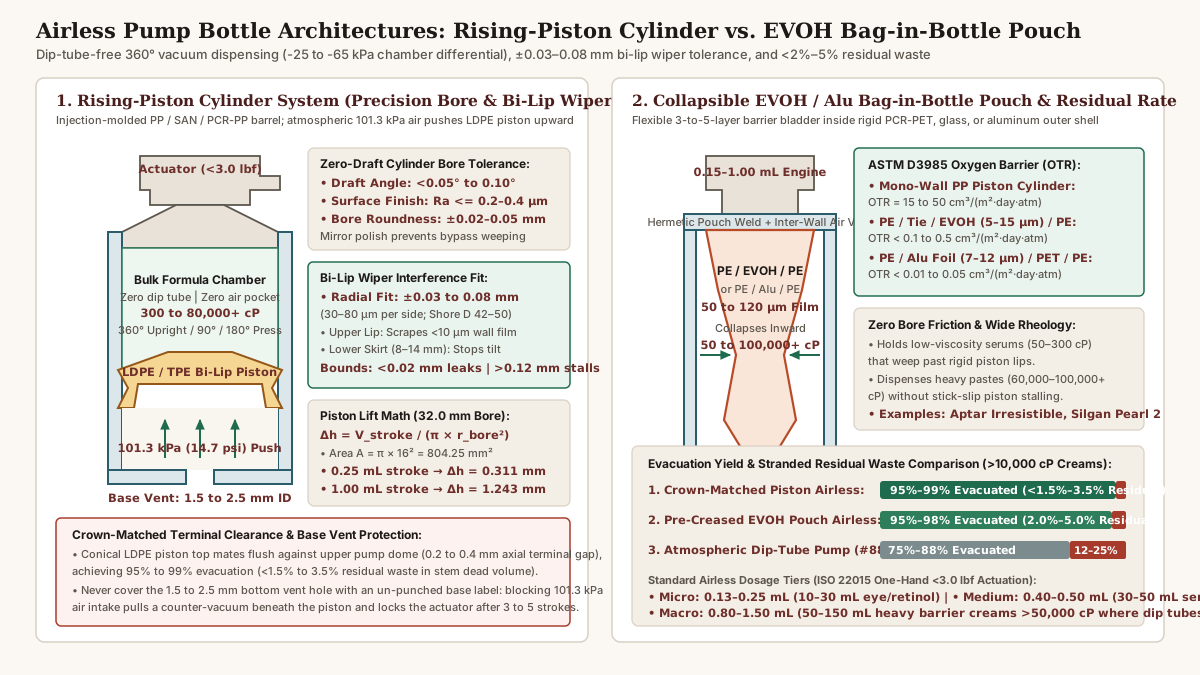
Rising-Piston Cylinder Tolerance (Ra <= 0.2 to 0.4 µm Bore & ±0.03 to 0.08 mm Bi-Lip Wiper Fit)
In a rising-piston airless pump bottle—exemplified by commercial platforms in the Aptar Beauty Airless Packaging portfolio (Eden, Mezzo, and Macro piston lines)—the container body functions as a precision hydraulic cylinder. Unlike extrusion blow-molded (EBM) or injection-stretch blow-molded (ISBM) atmospheric lotion bottles, whose internal wall diameters vary by ±0.5 to ±1.2 mm along the bottle height, a rising-piston cylinder must be injection-molded from homopolymer or random-copolymer polypropylene (PP), post-consumer recycled PCR-PP, styrene-acrylonitrile (SAN), or double-wall polymethyl methacrylate (PMMA outer shell over a PP inner barrel) to strict dimensional tolerances:
- Zero-Draft Mirror-Polished Internal Bore (
<0.05° to 0.10°Draft |Ra <= 0.2 to 0.4 µm): Standard injection-molded cups use a1.0° to 2.0°taper so parts eject easily from the steel core pin. An airless cylinder cannot tolerate a1°draft angle because a30 mmpiston fitting tightly at the bottom would lose wall contact near the top neck. Toolmakers grind the core pin to a near-zero draft (<0.05° to 0.10°), maintain diametral roundness (ovality) within±0.02 to ±0.05 mm, and diamond-polish the core to an arithmetic mean surface roughness ofRa <= 0.2 to 0.4 µm(SPI A-2optical polish) using stripper-ring ejection so no ejector-pin witness marks score the barrel wall. - Bi-Lip Wiper Piston Geometry (
±0.03 to 0.08 mmRadial Interference Fit): The follower piston is injection-molded from a softer, self-lubricating polyolefin—typically low-density polyethylene (LDPE), linear low-density polyethylene (LLDPE), or a thermoplastic elastomer (TPE) with a hardness ofShore D 42 to 50against the rigidShore D 70 to 85PP/SANbarrel wall. To maintain a dynamic vacuum seal across100 to 200strokes without galling, the piston features a dual-annular (bi-lip or double-skirt) profile engineered with a±0.03 to 0.08 mm(30 to 80 µm) radial interference fit (0.06 to 0.16 mmtotal diametral interference on a20 to 40 mmbore):- Upper Product Wiper Lip: Angled upward at an acute contact edge against the cylinder wall to shear viscous emulsions (
1,000 to 80,000+ cP) cleanly off the bore as the piston rises, leaving a residual wall film thinner than10 µm. - Lower Stabilizing Guide Lip & Skirt (
8.0 to 14.0 mmAxial Height): Separates the upper wiper lip from the lower air-sealing lip across an8 to 14 mmvertical wheelbase. This axial skirt prevents the piston from cocking, tilting, or chattering (stick-slip oscillation) under asymmetric vacuum pull while blocking101.3 kPaatmospheric air below the piston from bypassing into the formula chamber.
- Upper Product Wiper Lip: Angled upward at an acute contact edge against the cylinder wall to shear viscous emulsions (
- Interference Failure Bounds (
<0.02 mmWeeping vs.>0.12 mmStalling): If radial interference drops below0.02 mm(or if barrel ovality exceeds0.06 mm), low-viscosity serums (<300 to 500 cP) and volatile silicones weep downward past the wiper lip and leak out the base vent, or ambient air slips upward and breaks prime. Conversely, if radial interference exceeds0.12 mm(or ifLDPEpiston lips swell from incompatible terpene solvents), static breakaway friction exceeds the-40 to -65 kPasuction capability of the pump chamber, stalling the follower piston mid-bottle. - The
1.5 to 2.5 mmBase Atmospheric Vent & Piston Lift Math: A precision-molded circular aperture measuring1.5 to 2.5 mmin diameter in the snap-on base plate (or dual1.2 mmside-chime slots) admits101.3 kPaatmospheric air beneath the piston. For a30 mLor50 mLcylinder with an internal bore diameterD_bore = 32.0 mm(cross-sectional area A = π × 16.0² = 804.25 mm² = 8.04 cm²), the upward axial displacement (Δh) per stroke is:
Δh = V_stroke / (π × r_bore²)
For a 0.25 mL (250 mm³) micro-serum stroke: Δh = 250 mm³ / 804.25 mm² = 0.311 mm (311 µm) per press
For a 1.00 mL (1,000 mm³) cream stroke:     Δh = 1,000 mm³ / 804.25 mm² = 1.243 mm per press
If an un-punched bottom regulatory label, adhesive sticker, or standing bathroom counter water film seals that 1.5 to 2.5 mm base vent hole, atmospheric air cannot enter beneath the piston; within 3 to 5 strokes, a counter-vacuum forms below the follower plate and locks the pump.
Collapsible Multi-Layer PE/EVOH/PE and Aluminum Foil Bag-in-Bottle Systems (ASTM D3985 OTR)
A bag-in-bottle (pouch) airless dispenser—such as Aptar Beauty’s Irresistible 0.15 mL bag-in-bottle system and Silgan Dispensing’s Pearl 2 and ERA airless engines—replaces the sliding cylinder piston with a flexible, hermetically welded inner bladder (50 to 120 µm total film thickness) suspended inside a rigid outer container (PCR-PET, frosted glass, aluminum, or PP). Atmospheric air enters through discrete vent channels in the neck collar into the inter-wall space between the rigid outer bottle and the flexible pouch, collapsing the inner bladder symmetrically as product is drawn out.
ASTM D3985Oxygen Transmission Rate (OTR) Superiority: Per ASTM D3985 coulometric oxygen transmission testing (23 °C, 0% RH), a standard mono-wallPPorLDPErising-piston barrel exhibits a wall oxygen permeation rate of15 to 50 cm³/(m²·day·atm)(requiring a secondary outerPMMA/PPshell for multi-year shelf life). By contrast, co-extruding a5 to 15 µmEthylene Vinyl Alcohol copolymer (EVOH) core inside aPE / Tie / EVOH / Tie / PEpouch reduces oxygen permeation toOTR < 0.1 to 0.5 cm³/(m²·day·atm)(100xlower oxygen ingress), while a laminatedPE / Aluminum Foil (7 to 12 µm) / PET / PEpouch achievesOTR < 0.01 to 0.05 cm³/(m²·day·atm)(virtually zero gas or light transmission).- Elimination of Bore Friction and Silicone Lubrication: Rising-piston cylinders often apply a trace food-grade polydimethylsiloxane (
PDMS) slip film to the piston skirt to smooth breakaway friction, and require tight bore tolerances that struggle below300 cP. Because a bag-in-bottle pouch folds inward via film flexure (0.0 Nsliding wall friction), it dispenses both low-viscosity aqueous essences (50 to 300 cP) without base weeping and high-yield-stress pastes (60,000 to 100,000+ cP) without piston stick-slip stalling. APRRecyclability Alignment: Under the Association of Plastic Recyclers (APR) Design Guide, polyolefin pouches containing<= 5 wt% EVOHwith compatibilized polyethylene tie layers (or all-polyolefin mono-material engines like Silgan’s ERA that replace metal springs with polymeric return springs) qualify for polyolefin recycling streams while keeping the rigid outerPETor glass bottle clean and separable.
Dip-Tube-Free 360° Orientation Dispensing, Dosage Tiers, and <2% to 5% Residual Rate
In an atmospheric dip-tube lotion pump bottle or foam pump bottle, tilting the container past 45° to 60° uncovers the distal dip-tube tip at the bottle floor, causing the pump to draw headspace air and lose prime. Because an airless pump bottle eliminates both the dip tube and the internal air pocket—holding the formulation under continuous mechanical compression between the rising piston (or collapsing pouch) and the top intake port—it operates across 360° of spatial orientation (0° upright, 90° horizontal, or 180° completely inverted) with a single hand below 3.0 lbf (13.3 N), directly fulfilling ISO 22015:2019 manipulation accessibility clauses.
- Crown-Matched
<1.5% to 3.5%Residual Waste vs.12% to 25%Dip-Tube Stranding: The top face of a precisionLDPEfollower piston is molded with a stepped conical crown that mirrors the exact internal angle of the upper pump intake dome (0.2 to 0.4 mmterminal clearance at full travel). Combined with<10 µmwall wiping, rising-piston cylinders evacuate95% to 99%of net fill volume (<1.5% to 3.5%residual waste), and pre-creased 3D-gussetedEVOHpouches evacuate95% to 98%(2.0% to 5.0%residual). By comparison, a dip-tube lotion pump dispensing a15,000 to 45,000 cPcream strands12% to 25%(3.6 to 7.5 mLlost in a30 mLbottle) clinging to the upper shoulders and lower chime corners once the center tube cavitates.
Oxidation and Photostability: Airless Pump Bottle vs. Amber Glass Dropper Bottle
Formulators selecting primary packaging for potent dermocosmetic actives routinely weigh an opaque vacuum cosmetic dispenser against a traditional amber glass dropper bottle (GPI 18/400, 18/415, or 20/400 continuous-thread Boston Round or Euro-dropper neck). While both formats protect formulas in sealed warehouse storage, their in-use Period After Opening (PAO) performance diverges sharply once the consumer begins daily dosing.
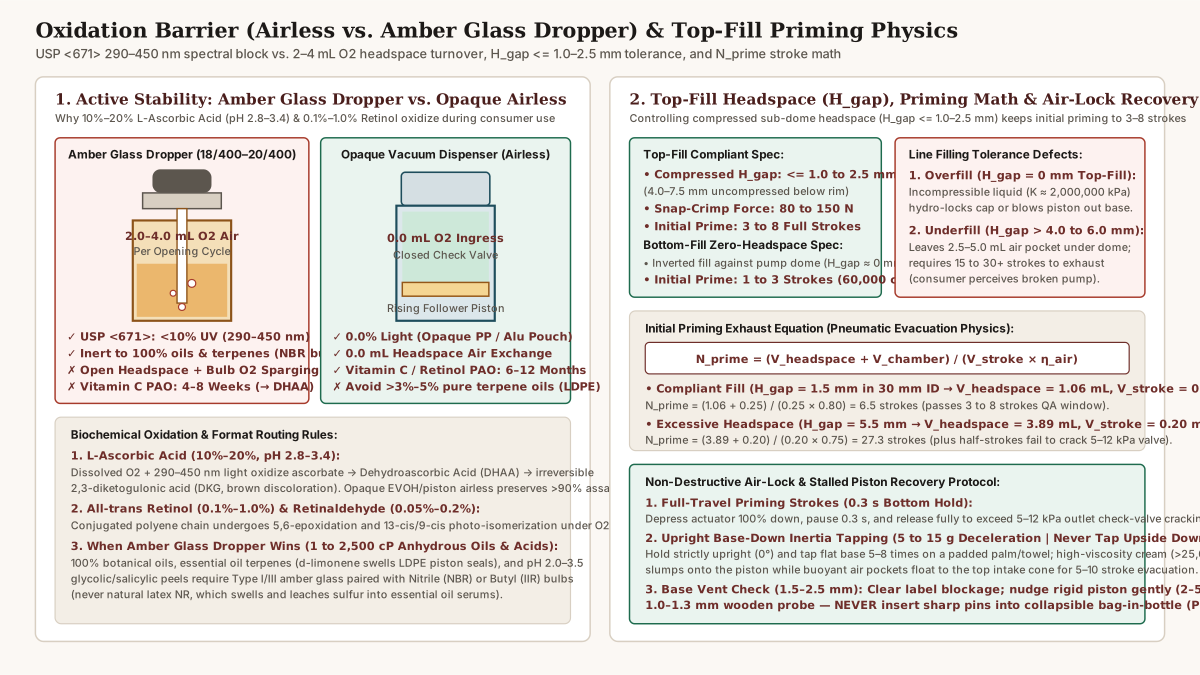
Active Degradation Kinetics (10% to 20% L-Ascorbic Acid, 0.1% to 1.0% Retinol, and Polyphenols)
10% to 20% L-Ascorbic Acid(Pure Vitamin C Aqueous Serums atpH 2.8 to 3.4): As documented in clinical dermatology reviews of L-ascorbic acid stability, aqueous Vitamin C must be formulated belowpH 3.5(below its first acid dissociation constantpKa1 = 4.17) to remain protonated for stratum corneum penetration. In the presence of dissolved molecular oxygen (O2),290 to 450 nmUV/violet photons, and trace metal ions, L-ascorbic acid undergoes rapid two-electron oxidation via the ascorbyl radical into dehydroascorbic acid (DHAA), followed by irreversible delactonization into 2,3-diketogulonic acid (DKG), L-xylosone, and brown furfural polymers. Once oxidized past15% to 20%(turning dark amber-orange to brown), the serum loses collagen-synthesis efficacy and generates pro-oxidant erythema on skin.0.1% to 1.0% All-trans Retinol&0.05% to 0.2% Retinaldehyde: The conjugated polyene side chain of Vitamin A (5conjugated double bonds) undergoes free-radical autoxidation (5,6-epoxyretinolformation) and rapid photo-isomerization from biologically activeall-transretinol into less active13-cisand9-cisisomers when exposed toO2and320 to 400 nmUVA radiation.- Preservative-Reduced & Microbiologically Sensitive Emulsions (
ISO 11930/ISO 29621): Peptide eye gels, ubiquinone (CoQ10), resveratrol, and microbiome barrier creams formulated with minimal preservative loads rely on physical packaging closure integrity (ISO 29621low-risk category) to prevent airborne fungal spores and skin flora (Staphylococcus epidermidis, Cutibacterium acnes) from entering the bulk container.
USP <671> Spectral Transmission (290 to 450 nm) vs. The 2.0 to 4.0 mL Open Headspace Flaw
An amber glass dropper bottle is blown or molded from Type III soda-lime-silica glass (or Type I neutral borosilicate glass) doped with iron oxide (Fe2O3) and carbon-sulfur chromophores. Under United States Pharmacopeia USP <671> spectral transmission standards, a light-resistant amber glass container must maintain maximum spectral light transmission below 10% at any wavelength between 290 nm and 450 nm (blocking >90% of actinic UV-B, UV-A, and high-energy blue-violet light while transmitting >500 nm amber light for visual fill inspection).
However, when packaging aqueous 15% L-ascorbic acid or emulsion retinoids, the amber glass dropper bottle suffers from three open-system mechanical vulnerabilities during consumer use:
2.0 to 4.0 mLAmbient Oxygen Headspace Turnover per Opening Cycle: Every time the consumer unscrews the18/400or20/400collar and withdraws the6.5 to 7.5 mm ODglass pipette,2.0 to 4.0 mLof fresh ambient air (20.95% O2/~210,000 ppmoxygen) rushes into the bottle neck. Worse, consumers routinely squeeze the elastomeric bulb after submerging the pipette tip into the serum, sparging air bubbles directly through the bulk liquid. As a30 mLdropper bottle is consumed down to10 mL, the oxygen-saturated headspace expands to67%of the interior volume, restricting unrefrigerated aqueousL-ascorbic acidstability to4 to 8 weeks(1M to 2M PAO) vs.6 to 12 months(6M to 12M PAO) in an opaque airless pump bottle (0.0 mLair backflow).- Elastomer Bulb Permeation & Terpene Swelling (
NRvs.NBR/IIR/VMQ): Standard natural latex rubber (NR) dropper bulbs rapidly absorb volatile citrus terpenes (d-limonene), essential oils, and squalane—swelling, softening, and leaching sulfur extractables into the formula—while standard silicone (VMQ) bulbs exhibit high oxygen gas permeability (~300xhigherO2permeation than butyl rubber). When an amber glass dropper bottle is selected—specifically for1 to 2,500 cPanhydrous botanical oils, essential-oil blends (which would swell anLDPEairless piston seal above3% to 5%concentration),pH 2.0 to 3.5glycolic/salicylic acid peels, or dispensing1 to 2 drops(0.05 to 0.15 mL) of anhydrousPhenyl Trimethiconefinishing serum in our silk press maintenance and humidity guide—engineers must specify a nitrile butadiene rubber (NBR) or chlorobutyl/bromobutyl (IIR) bulb paired with a polypropylene neck wiper.
| Engineering Comparison Criterion | Opaque Rising-Piston Airless Dispenser | Collapsible EVOH / Alu Bag-in-Bottle Airless |
USP <671> Amber Glass Dropper Bottle (18/400–20/400) |
|---|---|---|---|
Actinic Light Transmission (290 to 450 nm) |
0.0% transmission (100% block in opaque pigmented PP or metallized shell; clear SAN requires UV blocker) |
0.0% transmission (100% total UV/visible block with Alu foil pouch or opaque outer bottle) |
<10% transmission across 290 to 450 nm (>90% UV block per USP <671>; transmits >500 nm visible light) |
In-Use Headspace O2 Ingress per Dose |
0.0 mL air exchange (one-way upper valve + rising bi-lip wiper piston isolates bulk formula) |
0.0 mL air exchange (collapsing multi-layer pouch maintains zero headspace throughout life) |
2.0 to 4.0 mL fresh air (20.95% O2) per cap opening + direct dissolved O2 bubbling from submerged bulb squeeze |
10%–20% L-Ascorbic Acid (pH 3.0) In-Use PAO |
6 to 9 months (>90% assay retention in double-wall opaque PP) |
9 to 12 months (OTR < 0.05 to 0.5 cm³/(m²·day) prevents DHAA / DKG browning) |
4 to 8 weeks (oxidizes to yellow/brown DHAA and 2,3-DKG as headspace expands past 50% volume) |
| Solvent & Essential Oil Compatibility | Excellent for emulsions, gels, silicones; avoid >3%–5% pure terpenes/essential oils (swells LDPE piston lip) |
High resistance (PE or Barex/Surlyn inner contact layer); check laminating adhesive against low-MW esters |
Universal glass inertness toward 100% essential oils, terpenes, and pH 2.0 acids when paired with NBR or butyl (IIR) bulb |
Microbiological Contamination Risk (ISO 29621) |
Ultra-low risk: Self-sealing nozzle prevents finger/skin flora blowback; supports low-preservative formulas | Ultra-low risk: Hermetic sterile-grade pouch + one-way neutral valve (e.g., Aptar Irresistible) | High open-neck risk: Glass pipette frequently touches facial skin/fingers and re-immerses into bulk serum |
Filling Line Headspace Geometry (H_gap <= 1.0 to 2.5 mm), Initial Priming Math, and Air-Lock Recovery
A recurring quality-assurance failure on contract packaging lines—and the primary cause of consumer complaints that a new airless pump bottle “does not work out of the box”—stems from miscalibrating the post-filling headspace gap (H_gap) during top-fill assembly.
Top-Fill (H_gap <= 1.0 to 2.5 mm) vs. Bottom-Fill Zero-Headspace Assembly
Commercial airless containers are filled using one of two mechanical line configurations:
- Standard Top-Fill Configuration (
Compressed H_gap <= 1.0 to 2.5 mm):- Assembly Sequence: The injection-molded cylinder ships from the molding plant with the
LDPEbi-lip follower piston pre-seated flush against the bottom base plate (h_0 = 0.0 mm). On the filling line, a bottom-up diving volumetric piston nozzle injects the serum or cream from the piston crown upward toward the open neck. Next, a servo press-capping station seats the airless pump engine into the neck and locks it via tamper-resistant snap-on crimp retention (80 to 150 Nvertical press-fit over an undercut neck bead) or a precision threaded shoulder with anEPE/siliconegasket. - Critical Headspace Window: Because the lower housing of the airless pump protrudes
3.5 to 5.5 mmdown into the bottle neck during snapping, the uncompressed fill level must stop4.0 to 7.5 mmbelow the top rim of the open cylinder so that, once the pump collar snaps home, the final compressed vertical headspace gap (H_gap) between the liquid meniscus and the underside of the conical pump intake dome measures strictly<= 1.0 to 2.5 mm(V_headspace ≈ 0.80 to 2.00 mLin a30 to 32 mmbore cylinder). - Overfill (
H_gap = 0 mm) vs. Underfill (H_gap > 4.0 to 6.0 mm) Defects: Liquid emulsions are virtually incompressible (bulk modulus K_liquid ≈ 2,000,000 kPavs.K_air ≈ 101 kPa). If the cylinder is overfilled (H_gap = 0 mm), snapping the pump housing downward hydro-locks against the liquid, jetting cream out the actuator nozzle on the capping line or forcing the bottom follower piston backward past the base retainer ring. Conversely, if the cylinder is underfilled (H_gap > 4.0 to 6.0 mm), a2.5 to 5.0 mLair pocket remains trapped directly beneath the pump intake port.
- Assembly Sequence: The injection-molded cylinder ships from the molding plant with the
- Bottom-Fill Zero-Headspace Configuration (
H_gap ≈ 0.0 to 0.5 mm):- Assembly Sequence: The bottle ships with the top airless pump engine and overcap pre-snapped and sealed onto the neck while the bottom base remains open. The container travels inverted (
180°) in a pucked carrier; the diving nozzle fills the cream directly against the inverted conical pump intake dome with0.0 mmtop headspace. A vacuum-assisted piston-insertion head then presses theLDPEfollower piston into the open bottom bore until its upper wiper lip contacts the liquid surface (bleeding trapped air past a micro-vent groove during insertion), followed by snapping the vented base cap onto the bottom skirt. Bottom-filled packs prime in1 to 3strokes even with60,000+ cPpastes.
- Assembly Sequence: The bottle ships with the top airless pump engine and overcap pre-snapped and sealed onto the neck while the bottom base remains open. The container travels inverted (
Initial Consumer Priming Physics and the N_prime Stroke Equation
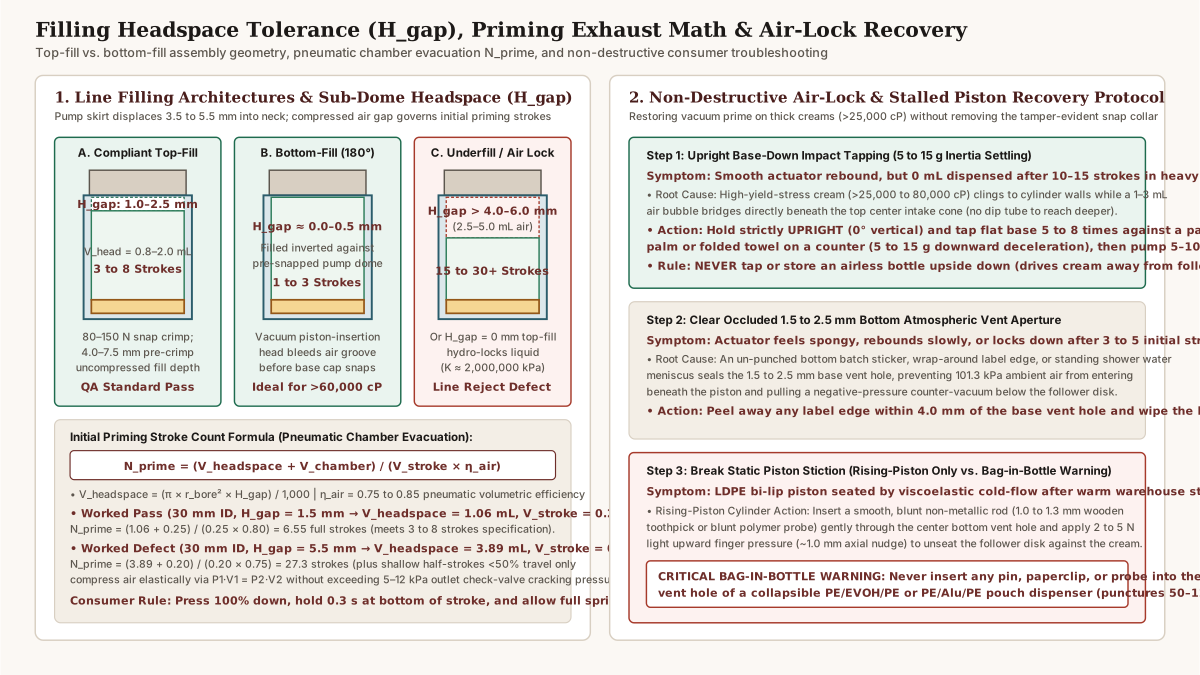
When a consumer unboxes a newly top-filled airless pump bottle, both the internal pump metering chamber (V_chamber = 0.15 to 0.50 mL) and the compressed sub-dome headspace (V_headspace = π × r_bore² × H_gap) contain ambient air at 101.3 kPa. Because air is compressible, each full downward press and upward spring return operates as a positive-displacement vacuum cycle that expels one stroke volume (V_stroke) multiplied by the pump’s pneumatic volumetric efficiency (η_air ≈ 0.75 to 0.85, accounting for dead-volume air compression ratio inside the chamber) out through the upper check valve (5 to 12 kPa cracking pressure).
The number of full-travel initial priming strokes (N_prime) required before bulk product reaches the nozzle is governed by:
N_prime = (V_headspace + V_chamber) / (V_stroke × η_air)
Where V_headspace (mL) = (π × r_bore² × H_gap_mm) / 1,000- Compliant Top-Fill Calculation (
30 mmID Bore,H_gap = 1.5 mm,0.25 mLSerum Engine): Withr_bore = 15.0 mm(A = 706.86 mm²),V_headspace = (706.86 × 1.5) / 1,000 = 1.06 mL. Pairing this withV_chamber = 0.25 mL,V_stroke = 0.25 mL, andη_air = 0.80yields:N_prime = (1.06 mL + 0.25 mL) / (0.25 mL × 0.80) = 1.31 / 0.20 = 6.55 strokes (Standard 3 to 8 strokes QA pass) - Underfilled Headspace Defect (
30 mmID Bore,H_gap = 5.5 mm,0.20 mLEye Serum Engine): If a filling nozzle under-doses by2.8 mL, leavingH_gap = 5.5 mm(V_headspace = 3.89 mL) under a0.20 mLmicro-pump (η_air = 0.75):N_prime = (3.89 mL + 0.20 mL) / (0.20 mL × 0.75) = 4.09 / 0.15 = 27.3 strokes (15 to 30+ strokes -> perceived defective) - Why Rapid Half-Strokes Never Prime an Airless Bottle: If a user presses the actuator rapidly to only
30% to 50%of its vertical travel, the trapped air pocket inside the metering chamber simply compresses and re-expands elastically (Boyle's Law, P1 × V1 = P2 × V2) without building the5 to 12 kPaoverpressure needed to crack open the upper outlet valve. Priming instructions on outer cartons should specify full-travel downward presses held for0.3 secondsat the bottom of the stroke, followed by complete upward spring release.
Diagnosing and Recovering Air-Locked Chambers or Stalled Follower Pistons
When an airless pump bottle fails to dispense on first use or stalls mid-bottle, packaging QA engineers and consumers can restore vacuum prime without disassembling the tamper-proof snap neck using a three-step diagnostic protocol:
- Upright Base-Down Impact Tapping (
5 to 15 gInertia Settling for High-Viscosity Creams>25,000 cP):- Symptom & Root Cause: The actuator presses smoothly and rebounds normally, but dispenses nothing after
10 to 15strokes (or sputters mid-bottle). In high-yield-stress creams (25,000 to 80,000 cP), top-filling or horizontal parcel transit can leave a1.0 to 3.0 mLair void bridged directly beneath the central pump intake port while stiff cream clings to the outer barrel walls. Because an airless pump has no dip tube reaching down into the container, the top intake port cavitates inside that suspended air bubble. - Recovery Action: Hold the container strictly upright (
0°vertical) and strike the flat bottom base firmly5 to 8times against a padded open palm or a folded towel on a countertop (generating5 to 15 gof downward axial deceleration). Never tap or store an airless pump bottle upside down like a standard lotion bottle: upright base-down tapping forces the denser emulsion (ρ ≈ 0.98 to 1.05 g/cm³) to slump downward onto the follower piston while forcing buoyant air bubbles upward to the conical intake apex, where5 to 10slow, full-travel strokes purge the air pocket immediately.
- Symptom & Root Cause: The actuator presses smoothly and rebounds normally, but dispenses nothing after
- Clearing an Occluded
1.5 to 2.5 mmBase Atmospheric Vent (Spongy or Locked Actuator):- Symptom & Root Cause: The actuator resists depression or rebounds sluggishly after
3 to 5strokes. Check the bottom base plate (or lower side rim) for the1.5 to 2.5 mmatmospheric intake hole. If an un-punched bottom batch label, security tape, or dried soap film blocks this aperture,101.3 kPaambient air cannot enter beneath the piston, creating a negative-pressure lock below the follower plate. Peel back any obstructing label edge and wipe the base dry.
- Symptom & Root Cause: The actuator resists depression or rebounds sluggishly after
- Releasing Piston Storage Stiction (
2 to 5 NBlunt Probe Nudge — Rising-Piston Cylinders Only):- Symptom & Root Cause: After months of warehouse storage at elevated temperatures (
30 to 40 °C), anLDPEbi-lip piston can develop static viscoelastic stiction (“cold-flow seating”) against thePP/SANcylinder wall. - Recovery Action & Bag-in-Bottle Warning: On rigid rising-piston cylinders with a visible center bottom vent hole, insert a blunt-tipped, non-metallic rod (
1.0 to 1.3 mmdiameter, such as a flat-ended wooden toothpick or blunt polymer swab shaft) gently through the bottom vent port until it touches the underside of the plastic follower disk, and apply light upward finger pressure (2 to 5 N, advancing the disk~1.0 mm) until the cream contacts the upper intake cone. Critical Boundary for Bag-in-Bottle Pouches: Never insert any pin, paperclip, or probe into the vent port of a collapsible bag-in-bottle (PE/EVOH/PEorPE/Alu/PE) dispenser; puncturing the50 to 120 µmflexible barrier film destroys the vacuum bladder permanently.
- Symptom & Root Cause: After months of warehouse storage at elevated temperatures (
Engineering Qualification Checklist for Airless Pump Bottle Specifications
Before releasing a vacuum cosmetic dispenser specification for production tooling or incoming lot inspection (AQL audit), verify all six engineering gates alongside the external one-hand <3.0 lbf ergonomics checklist:
- Select Rising-Piston vs.
EVOH/AluPouch by Rheology andASTM D3985OTR: Specify a rising-piston cylinder (PP/SANbarrel with<0.05° to 0.10°draft andRa <= 0.2 to 0.4 µmbore finish) for300 to 80,000+ cPemulsions; specify a collapsiblePE/EVOH/PE(OTR < 0.1 to 0.5 cm³/(m²·day)) orPE/Alu/PE(OTR < 0.05 cm³/(m²·day)) bag-in-bottle pouch for ultra-fluid serums (50 to 300 cP), shear-thickening pastes (>80,000 cP), or highly oxygen-labile10% to 20% L-ascorbic acidformulas. - Audit Bi-Lip Piston Radial Interference (
±0.03 to 0.08 mm) & Solvent Swell: VerifyLDPE/TPEwiper diameter against min/max cylinder bore cavities at20 °Cand after4-week45 °Ccompatibility aging; route anhydrous essential-oil or terpene serums (>3% to 5%) to an amber glass dropper bottle (USP <671><10%UV transmission from290 to 450 nm) fitted with anNBRorbutyl (IIR)bulb. - Verify Unobstructed
1.5 to 2.5 mmAtmospheric Venting: Confirm base label die-cuts leave at least a4.0 mmclear annulus around the1.5 to 2.5 mmbottom air vent hole (or specify side-chime vents) so101.3 kPaatmospheric pressure acts freely beneath the piston. - Calibrate Dosage Output Tier (
0.15 to 1.00 mL) &<3.0 lbf(13.3 N) Actuation Force: Match0.15 to 0.25 mLmicro-engines to10 to 30 mLeye/retinol treatments,0.40 to 0.50 mLengines to30 to 50 mLfacial serums, and0.80 to 1.50 mLmacro-engines to50 to 150 mLheavy creams across360°orientation (ISO 22015:2019). - Enforce Post-Fill Headspace (
H_gap <= 1.0 to 2.5 mm) & Priming Count (<= 8 Strokes): Audit diving-nozzle fill weight and compressed sub-dome gap soN_primestays within3 to 8full-travel strokes on top-fill lines (1 to 3strokes on bottom-fill lines), and validate container seal integrity underASTM D4991/-68 to -95 kPaair-cargo vacuum leak testing. - Qualify
<2% to 5%Residual Waste Rate (95% to 99%Evacuation): Weigh filled vs. exhausted containers across10lot samples at target viscosity to verify crown-matched piston or pre-creased pouch evacuation exceeds95%(<3.5% to 5.0%residual weight).