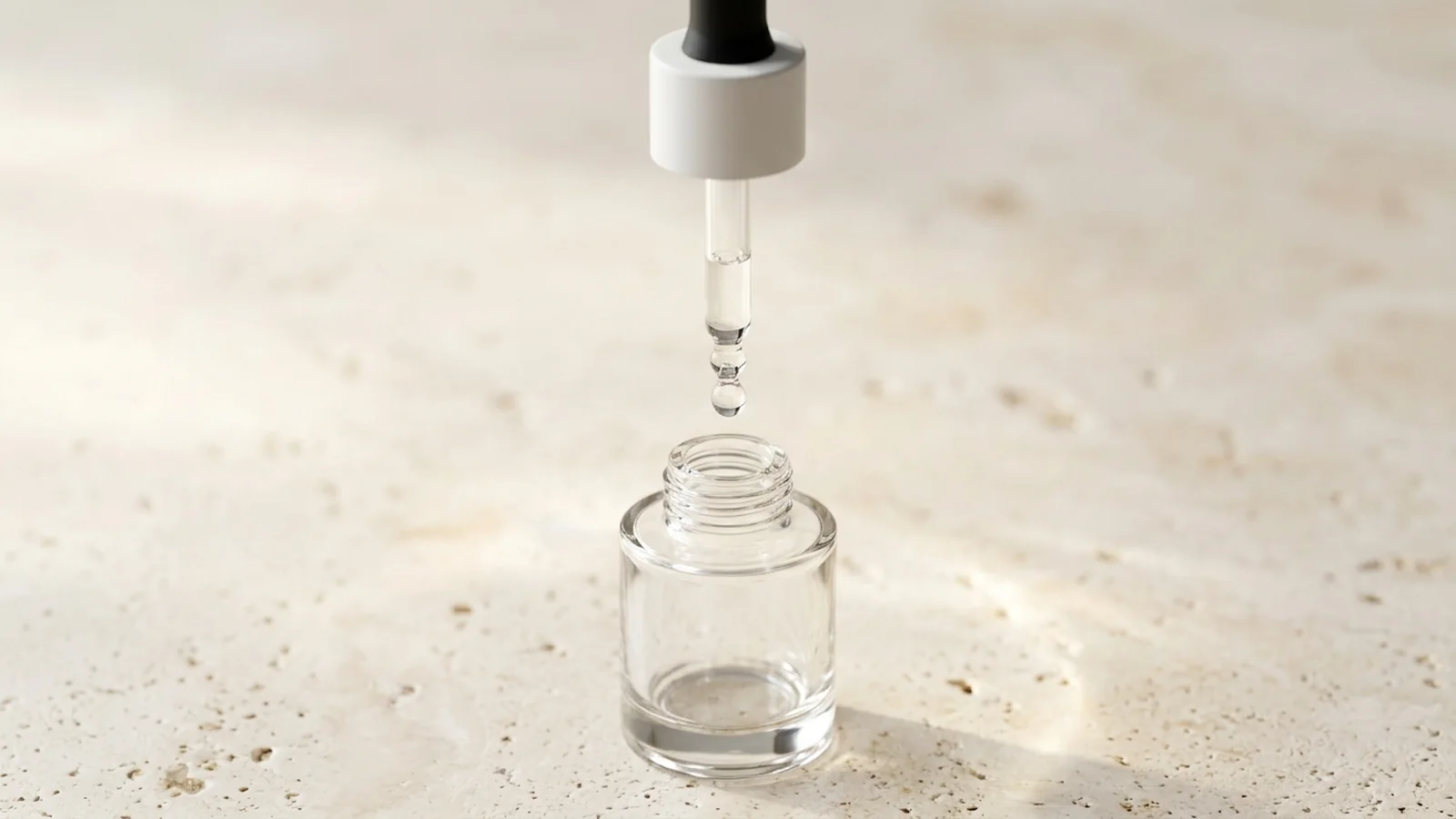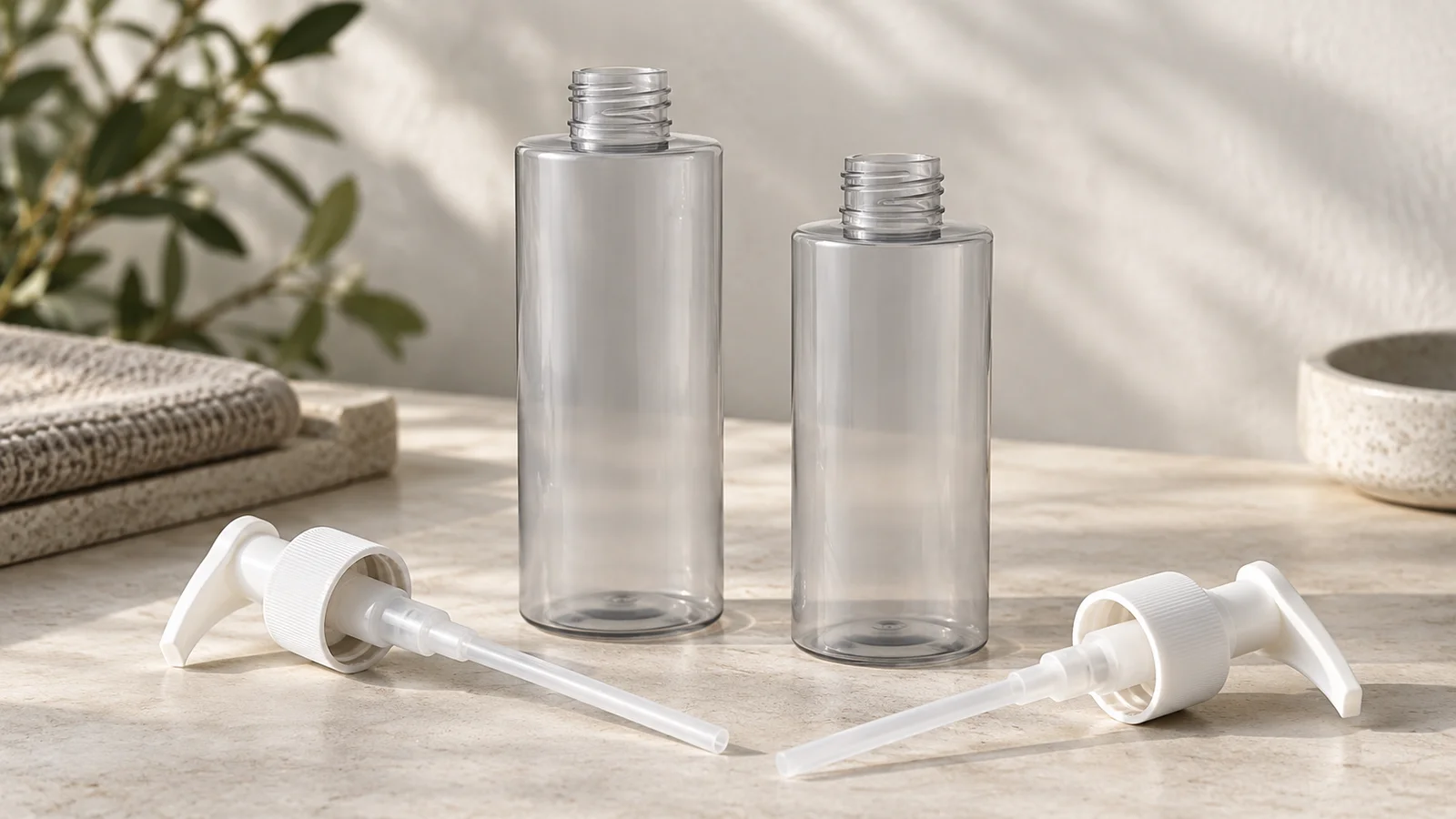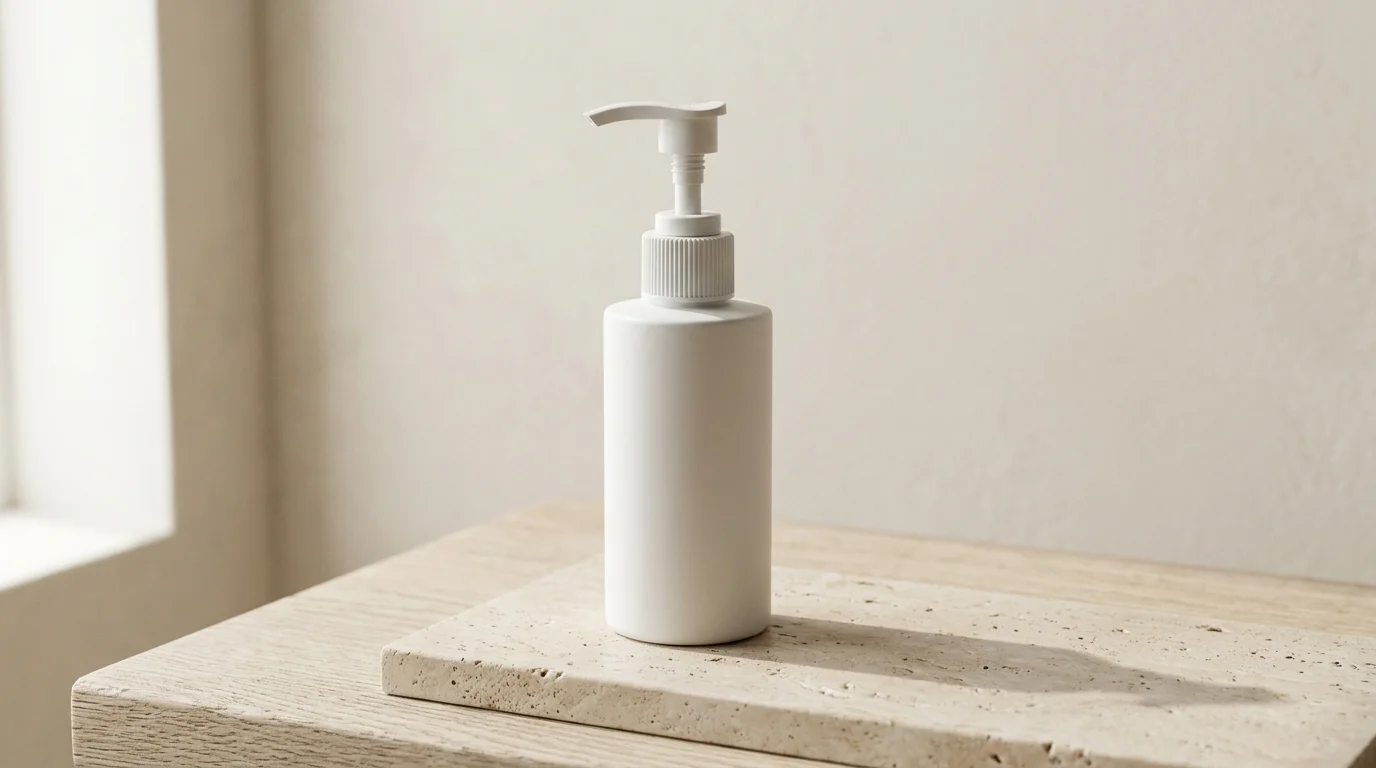
A pump bottle opens when the head turns while the collar stays still. If the collar spins with the head, hold it or tighten it to the right, then turn the head the way the arrow on that pump shows. One press fills the pump, and the next press is what lets the liquid out.
Pump dispensers sit on containers of liquids, including bottles holding viscous creams and lotions (Wikipedia, Pump dispenser), and liquid soap generally comes in squeeze bottles or plastic pump bottles (Wikipedia, Soap dispenser). While D6534 is the standard test method for determining peak force to actuate a mechanical pump dispenser, comfortable press force and one-hand bottle stability belong to our note on packaging and ease of use, and chamber output per stroke sits in lotion pump bottle dosage and dip tube sizing.
Which part has to move
Opening a locked dispenser requires separating the upper part you press from the threaded ring gripping the bottle. On a liquid-soap pump dispenser, the actuator is the top of the pump pressed down to get liquid out, while the closure is the smooth or ribbed collar fastened to the bottle neck. A plastic or rubber outer gasket fits inside that closure to prevent leakage. Below the neck, the housing holds the internal spring, ball, piston, or stem in place and routes liquid up from the visible dip tube at the bottom of the bottle.
Unlocking happens only when the dispensing head rotates relative to the closure collar. In Silgan Dispensing Systems Corp. patent US10870123B2, locking arrangements keep the dispensing head from deploying or actuating during shipment, stocking, and pre-purchase handling. During unlocking, the dispensing head and its locking lugs rotate relative to a chaplet in the closure between a locked position, where mating surfaces on the lugs and chaplet engage, and an unlocked position, where those surfaces disengage. Rieke LLC patent US7168594 shows a parallel constraint in its described figure, where the retaining cap is not rotatable relative to the tubular element.
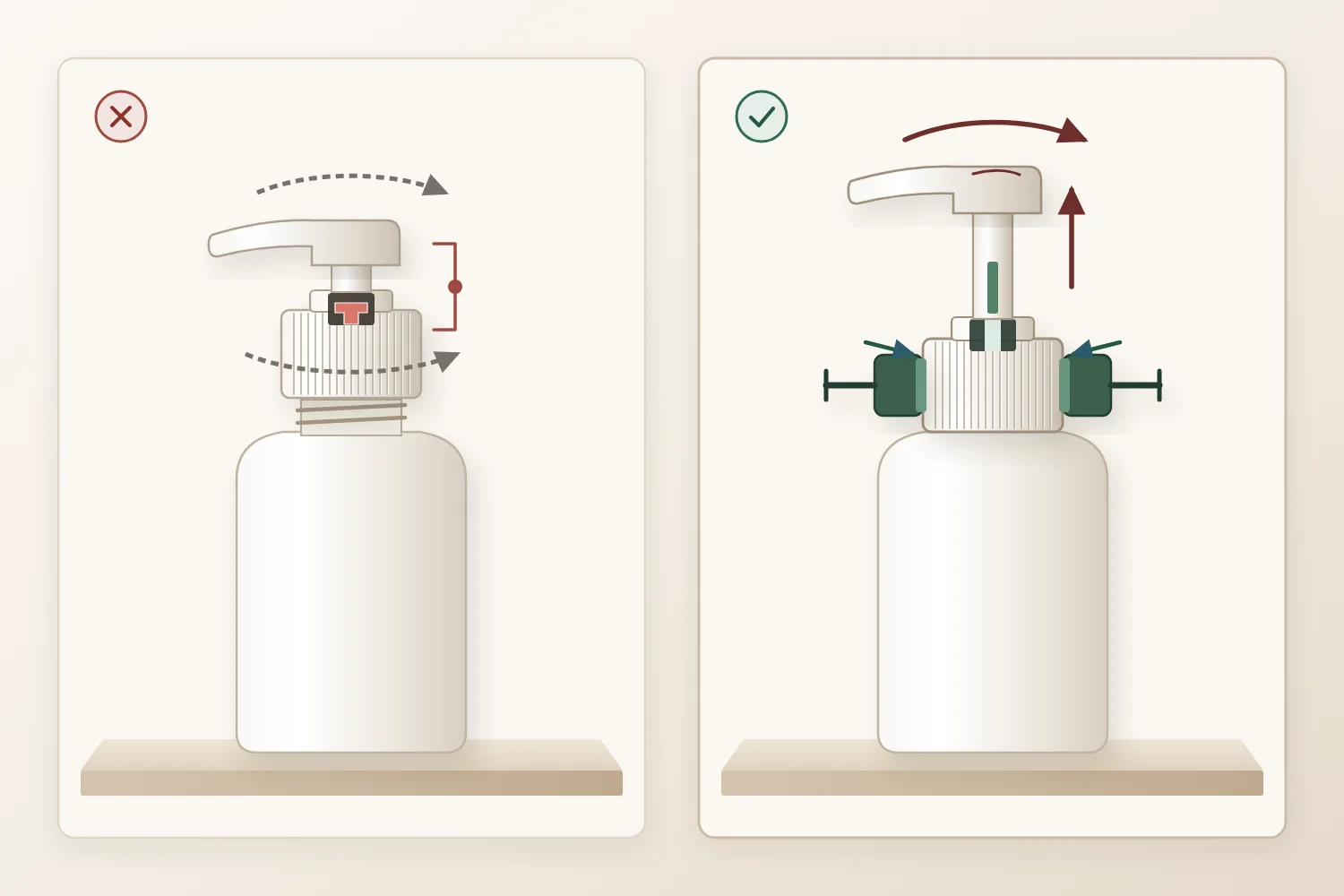
When a pump was tightened hard during production and resists popping open, Palmer’s instructs users to tighten the collar by twisting to the right, hold the collar so it cannot move, and twist the nozzle according to the direction arrow on top of that pump.
Three locks, and no single turn direction
Dispensers do not share a single turn direction across manufacturers. Aptar describes its GS pump as an up-locking system with clockwise and counter-clockwise opening so the pump can be sealed in both the open position and the closed position. Aptar’s GSA pump, built with its spring outside the dosage chamber, likewise uses a locking system with counter-clockwise and clockwise opening that seals open or closed.
A retracted shipping lock works through threads inside the pump body instead. Rieke’s US7168594 describes dispensers in which a reciprocating pump element threads into a housing to stay locked in a retracted position for storage and shipping, and rotationally unthreads to permit reciprocation. In one described figure of US7168594, threading the head counter-clockwise relative to the retaining cap releases the pumping element from the closed end of the plunger plug; that counter-clockwise turn applies to that specific figure rather than every brand.
Other packs block movement with a separate external piece or a rotating cover. Aptar specifies GS and GSA with clips, tamper-evident seals, transport clips, tamper-evident clips, and an e-clip for transit or carried packs. Silgan’s US10870123B2 includes snap beads, locking rings, a slotted tubular band captured between the closure ring and dispensing head to hold an extended head against accidental actuation, and a frangible tear band in that same gap. Berry Global Inc. patent US11453535 describes a selectively openable and lockable closure for creams, lotions, and fluids that rotates relative to the collar from a blocked locked position to an unlocked position where the closure lifts off.
| Lock Architecture | Published Example | How It Releases |
|---|---|---|
| Up-locking actuator | Aptar GS and GSA dispensing pumps | Head opens clockwise or counter-clockwise and seals open or closed |
| Threaded-down plunger | Rieke patent US7168594 | Plunger rotationally unthreads from housing (counter-clockwise in the described figure) |
| External clip or band | Aptar GS/GSA clips; Silgan US10870123B2 bands | Pull off the transport clip, slotted tubular band, or frangible tear band |
| Rotating over-closure | Berry Global patent US11453535 | Rotate closure relative to collar to the unlocked position, then lift off |
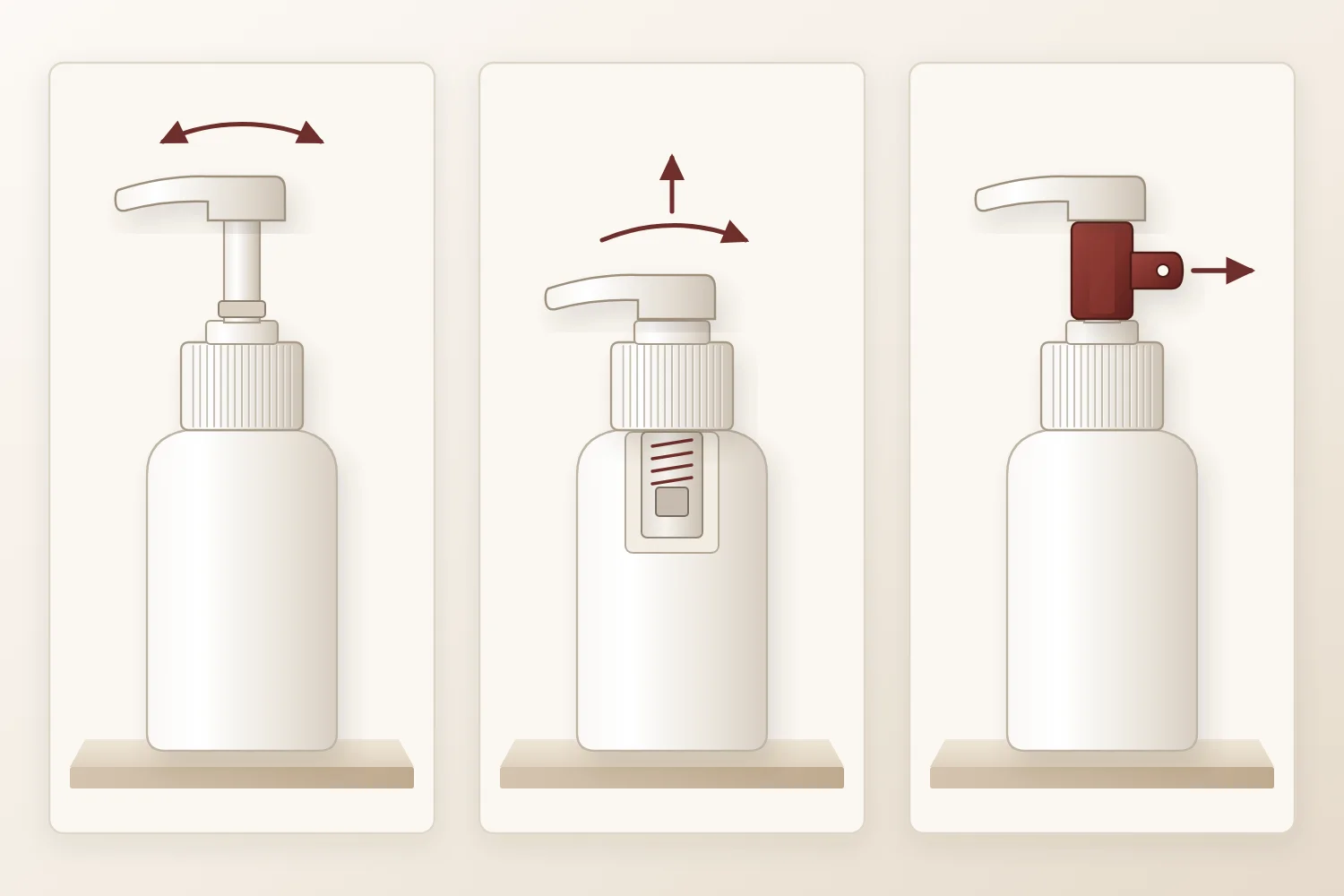
The three-step collar check
Follow these three steps in order when a lotion or soap nozzle stays stuck:
- Name the lock before twisting. Check whether the dispenser uses an up-locking head that opens clockwise or counter-clockwise, a retracted head threaded down into the housing, a separate clip or band between the closure ring and head, or a cover that rotates against the collar and lifts off.
- Immobilize the collar, then turn only the head. By common screw-thread convention, right-handedness is the default for most threaded parts and fasteners, meaning a threaded part seen along its axis moves away from the viewer when turned clockwise and toward the viewer when turned counter-clockwise (University of Florida, Types of Threads). That right-hand thread seats the bottle collar rather than setting the nozzle arrow. If the collar spins, tighten it to the right, hold it still so the head can rotate relative to the closure chaplet or retaining cap, and turn only the head the way the arrow on that pump shows (using counter-clockwise for the Rieke US7168594 figure that specifies it).
- Prime the chamber, and stop if the stem will not rise. Once the head is up, press to fill the housing and press again to dispense. If the collar stays still and the head still does not rise, stop rather than prying the stem. Apply a second motion simultaneously with unthreading only on a child-resistant closure built around two dissimilar opening motions, a category covered for reclosable packages by ISO 8317 and described by the U.S. Consumer Product Safety Commission as a last line of defense rather than child-proof packaging.
Why the first press may not produce liquid
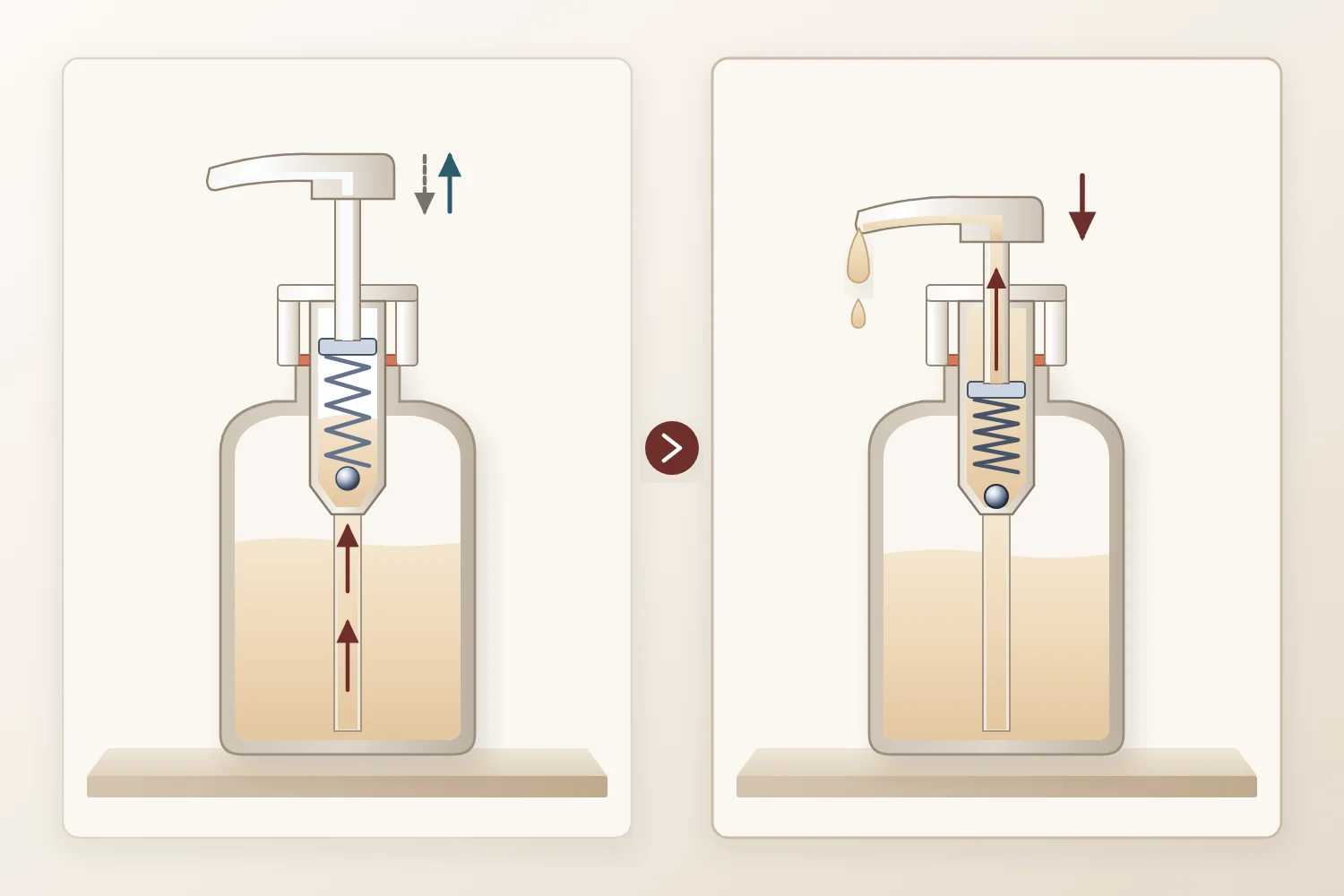
A newly unlocked actuator starts over an empty pump chamber, so liquid does not leave the nozzle on the initial press. When you press down the actuator on a liquid-soap or lotion bottle, the piston compresses the spring and suction draws product up the dip tube from the bottom of the bottle into the housing. Releasing the actuator lets the spring return the piston and actuator upward while the internal ball seats to stop liquid from flowing back into the bottle, a fill stage called priming.
On the next press, liquid already held inside the housing is pushed out through the actuator while fresh product from the bottle refills the housing for subsequent strokes. In dispenser testing, D3890 is the standard test method for the number of strokes to prime a mechanical pump dispenser.
When a spinning collar is a neck-fit problem
When the smooth or ribbed collar itself keeps spinning without tightening on the bottle, the problem lies at the neck threads rather than the actuator lock. Illing explains that a container’s neck finish holds a continuous-thread closure with protruding glass or plastic threads, and the container and closure must have matching finishes, as in a 24/400 bottle that only accepts a 24/400 closure, while the lip land area contacts the inside of the closure or its sealing gasket.
In Illing’s measurement guide, measuring across the outermost threads in millimeters gives the T dimension, a thread passing itself once is a 400 finish (or 405 for glass), 1 and 1/2 turns is a 410 finish (such as a 24 mm T dimension with 1.5 thread turns for 24/410), and a tall neck with two turns is a 415. Aptar’s product sheets reflect those distinct finishes: GS lists Neck Finish 28/400, 24/410, 27 mm Snap On, 24/410 Rachet, 24/415, 28/410, and 28/415, while GSA lists 24/410, 24/410T, 24/415, 27/30 Snap On, 28/400, 28/410, 28/410T, and 28/415. Plastic bottle thread configurations and finish dimensions up to 18.9 L (5 gal) and 305 mm (12 in.) are covered by ASTM D2911/D2911M-16(2023), while skirt-clearance and gasket-compression checks sit in our 410 versus 415 neck finish pump fitment guide.
In packaging engineering, ASTM D2063/D2063M-24 measures torque retention and removal torque of continuous-thread closures on matching finishes under controlled zero-downward-force conditions with a non-automated spring torque-meter or torque wrench, treating SI and inch-pound units separately. Torque-meter calibration and closure application or removal torque checks follow ASTM D3474, whereas ASTM D3198, an older test method that measured loosening during storage or shipment and the force to break hard plastic or strip soft plastic closures, was marked Withdrawn 2016.