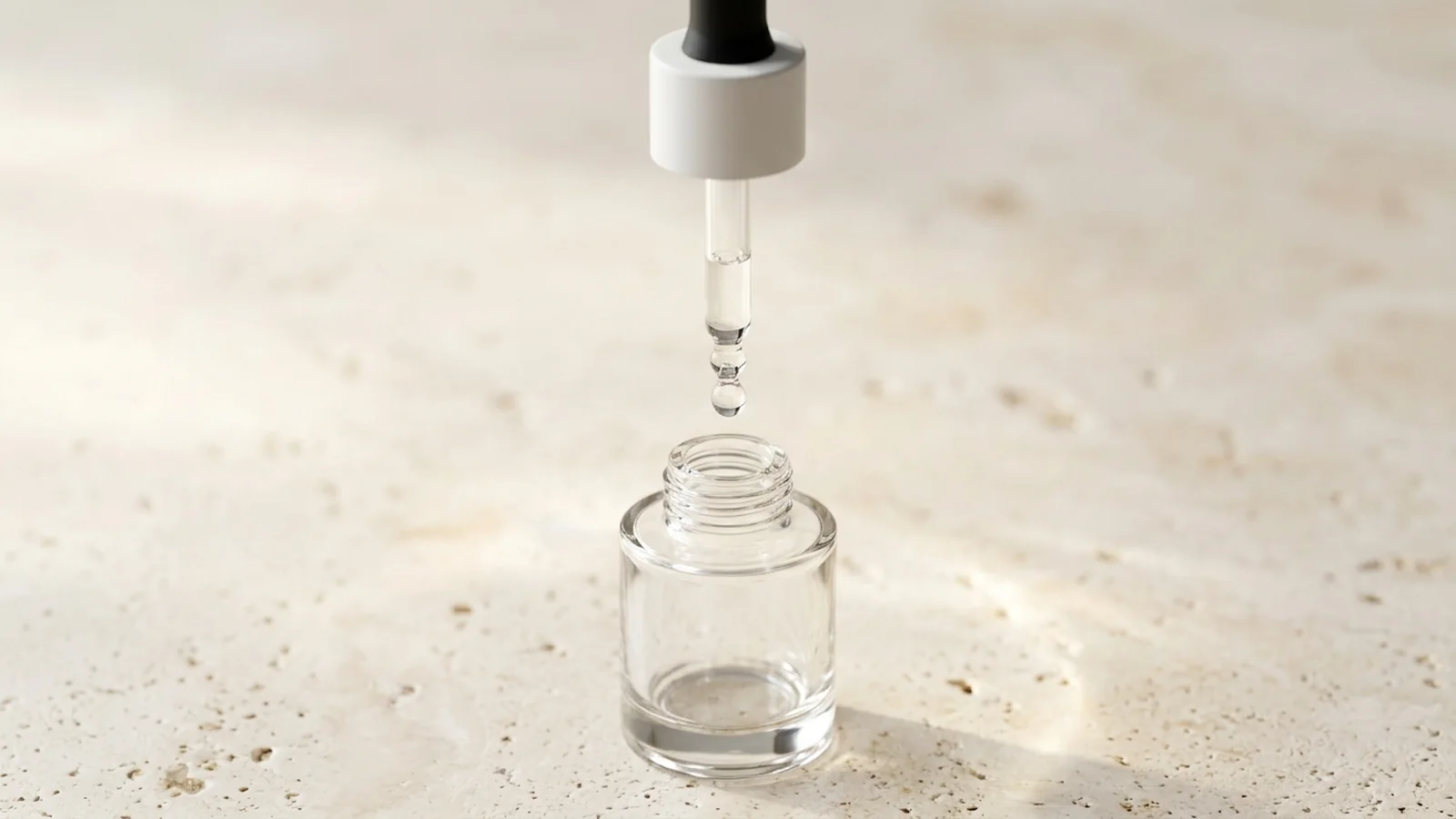
Preventing a serum dropper orifice leak while maintaining consistent dose delivery requires coordinating three mechanical interfaces across the dropper assembly: the delivery tip opening where pendant drops form, the collapsible elastomer bulb that draws liquid up the stem, and the collar-to-neck seal that closes the bottle. Within our personal-care packaging guides, this technical reference examines how liquid surface tension, formulation viscosity, internal neck wipers, and closure torque govern glass pipette dropper performance.
Under USP General Chapter 1101 Medicine Dropper, the delivery end has a round opening with an external diameter of about 3 mm and, when held vertically, delivers water in drops each of which weighs between 45 mg and 55 mg. Most medicinal liquids do not have the same surface tension and viscosity characteristics as water, and therefore the size of drops will vary from one preparation to another. Where dosage accuracy is required, the volume error incurred in measuring any liquid by means of a calibrated dropper should not exceed 15% under normal use conditions.
Engineering a cosmetic dropper system requires joint technical adjustment of pipette length, bulb hardness, neck profile, wiper integration, and formula behaviour. When a high-viscosity emulsion exceeds pipette draw limits, compare alternative mechanical dispensers in our lotion pump dosage and dip-tube sizing guide and review hand-press ergonomics in our note on packaging and ease of use.
Glass Pipette Dropper Orifice Size and Surface-Tension Drop Volume Calculation
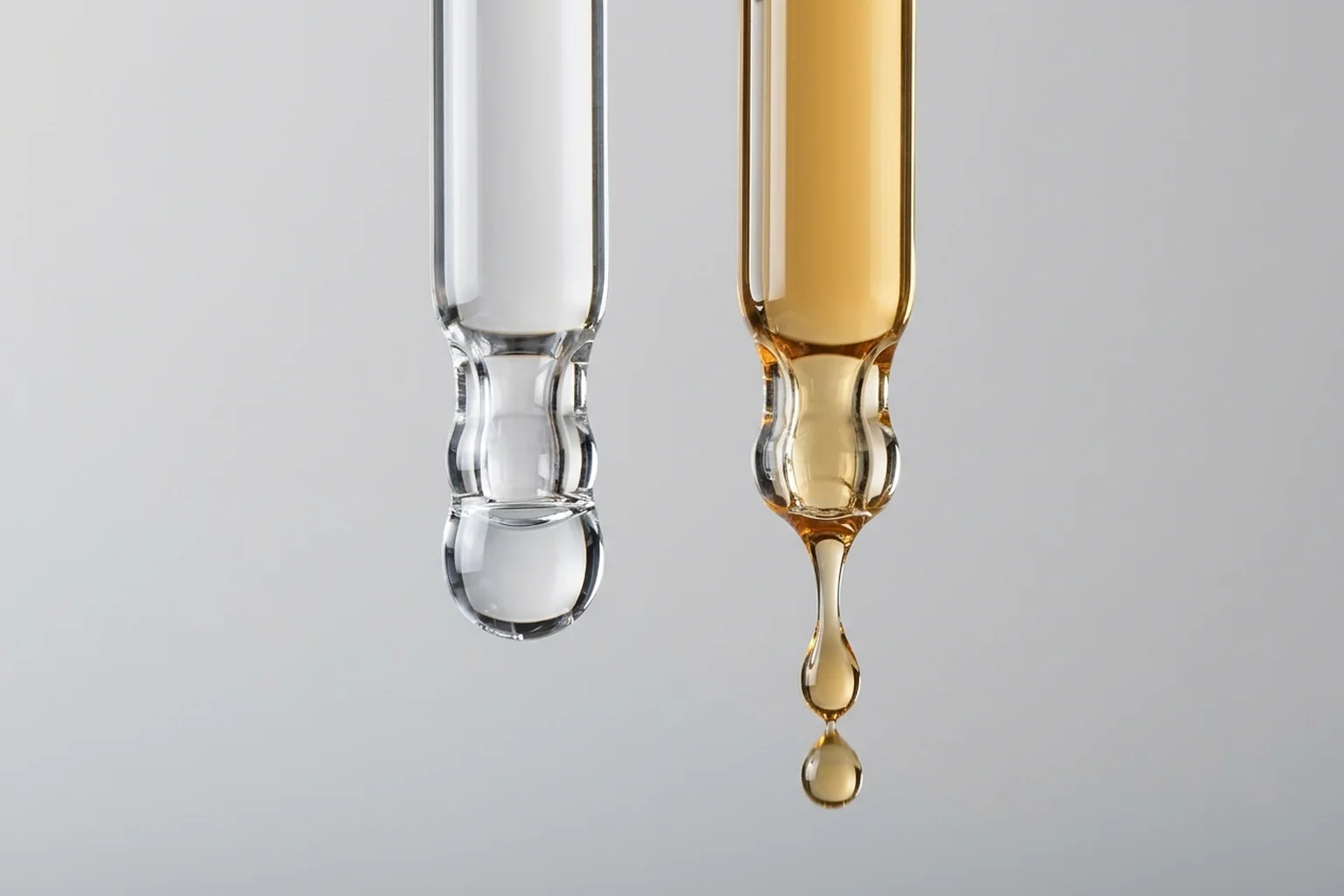
Dispensed drop volume depends on nozzle design and material condition, specifically the inner and outer diameters of the orifice and the surface properties of the container with regard to wettability. A pendant droplet remains in stable equilibrium at the tip of a vertical capillary tube because surface tension pulls upwards at the rim of the tube so strongly that it overcomes the weight of the drop.
Under Tate’s law from 1864 (Tat64), the upward capillary force at the tube rim is maximal for 90 degrees, so that the drop should detach when the mass satisfies equation 5.48: M g0 = 2 pi a alpha. There are corrections to this simple expression, the main correction being that only part of the liquid in a pendant drop actually detaches (YXB05).
In dimensionless units where capillary length Lc = 1, a pendant drop hanging from a capillary with footprint radius a = 0.5 reaches a maximum volume as a function of depth at d = 2.154. The capillary length equals 2.7 mm for the air-water interface at 25 C.
Surface Tension Proportionality and Orifice Narrowing Data
For water at 25 C, the measured surface energy density is 0.072 J m 2, which should be compared to a simple molecular model estimate of 0.126 J m 2. Measured surface tension values at 25 C in millijoule per square meter are 72 for Water, 22 for Methanol, 22 for Ethanol, 41 for Bromine, and 337 for Mercury.
According to Tate (reference 2), in thermodynamic equilibrium between the bulk and the surface, the drop volume is directly proportional to the liquid’s surface tension. In experimental data adapted from Van Santvliet and Ludwig (references 1 and 4), drop weight of ophthalmic solutions as a function of surface tension follows a linear regression with a coefficient of determination R2 of 0.989.
Ophthalmic solutions are available in multidose or single-dose glass and plastic dropper bottles that deliver drops with a volume that ranges from 25 μL to 70 μL, with an average of 40 μL. In a published ophthalmic timolol maleate drop-size study, the authors tried to reduce drop size by increasing the surface active agents in the formulation and by changing the inner diameter of the dropper so that drop size was smaller. In that ophthalmic study, surface tension was determined by using the drop count method and viscosity was determined using the Ostwald viscometer.
Before the capillary tube was inserted in that ophthalmic timolol study, the drop size varied from 31.64 μL (formulation III) to 33.33 μL (formulation I), and for commercial ophthalmic preparations varied from 32.65 μL to 38.68 μL. After inserting the capillary in that ophthalmic study, the drop size varied from 18.82 μL (formulation III) to 22.02 μL (formulation I), and for the commercial preparations varied from 21.73 μL to 22.93 μL.
| Reference Parameter or Liquid | Condition or Method | Reported Value |
|---|---|---|
| Medicine dropper delivery end and water drop weight | Round opening held vertically under USP General Chapter 1101 | External diameter of about 3 mm delivering water in drops weighing between 45 mg and 55 mg each |
| Calibrated dropper volume error limit | Measuring any liquid under normal use conditions in USP General Chapter 1101 | Volume error should not exceed 15% under normal use conditions |
| Pure water surface energy density | Measured value compared with simple molecular model estimate at 25 C | 0.072 J m 2 measured at 25 C compared with 0.126 J m 2 estimate |
| Liquid surface tension values at 25 C | Measured in millijoule per square meter at 25 C | Water 72, Bromine 41, Methanol 22, Ethanol 22, and Mercury 337 |
| Air-water interface capillary length | Air-water interface at 25 C | Capillary length equals 2.7 mm at 25 C |
| Drop weight as a function of surface tension | Linear regression adapted from Van Santvliet and Ludwig (references 1 and 4) | Coefficient of determination R2 for the linear regression is 0.989 |
| Ophthalmic multidose or single-dose glass and plastic dropper bottles | Dispensed drop volume across ophthalmic dropper bottles | Volume ranges from 25 μL to 70 μL (average 40 μL) |
| Dropper tip before inserting capillary tube (ophthalmic timolol study) | Formulations I to III and commercial ophthalmic preparations | 31.64 μL to 33.33 μL (formulations) and 32.65 μL to 38.68 μL (commercial) |
| Dropper tip after inserting capillary tube (ophthalmic timolol study) | Formulations I to III and commercial ophthalmic preparations | 18.82 μL to 22.02 μL (formulations) and 21.73 μL to 22.93 μL (commercial) |
Cosmetic Dropper Bulb Draw Volume, Pipette Geometry, and High-Viscosity Serum Intake
Two of the most common sizes (capacities) for a pipette bulb in the skincare market are 0.7ml and 1ml. Actual liquid volume drawn into a pipette stem on squeezing the bulb depends on the size of the user’s fingers, whether the bulb is completely squeezed, and the liquid being dispensed, as liquids may behave differently depending on how viscous they are.
Virospack produces bulbs in multiple elastomer families (IIR, NBR, TPE) and pipettes in custom lengths and diameters, allowing exact adaptation to formula viscosity. Virospack’s Autofill Bulb Dropper is ideal for cosmetics like serums, oils, lotions, fluid make-up products, as well as higher viscosity formulations, where twisting the cap open automatically charges the correct dose. The Virospack Autofill Bulb Dropper is available with a nitrile or butyl rubber bulb, with a plastic and aluminium exterior and an internal wiper, and is compatible with 20/410 neck bottles in capacities of 15 or 30ml.
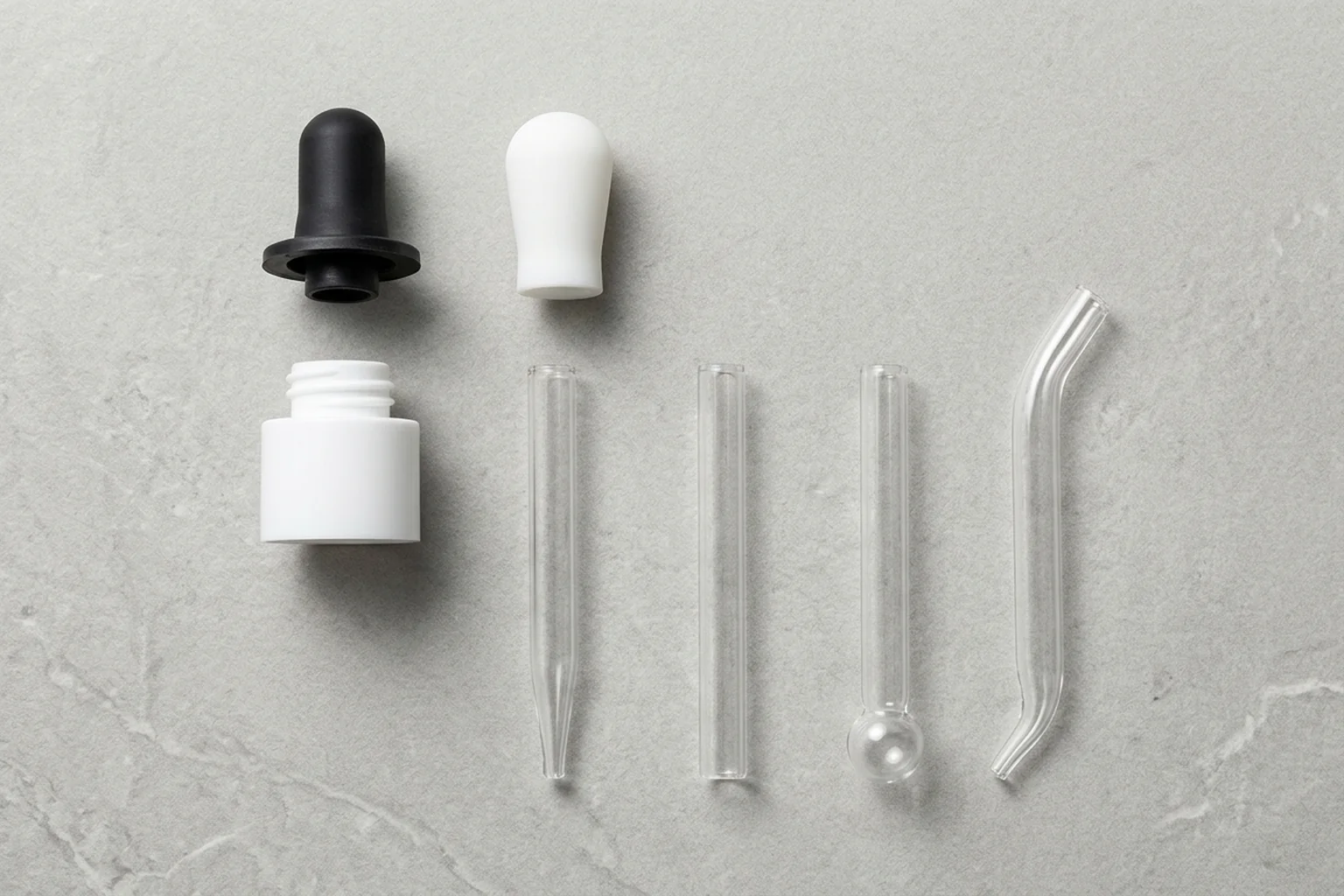
Pipette Stem Materials, Tip Shapes, and Stock Length Series
The most common types of materials used in pipette stem production are glass, either soda lime glass or borosilicate glass, and polypropylene (PP). There are five widely-recognised tip shapes for dropper pipettes, which are Bent Ball (or Bent Spherical), Bent, Blunt, Ball (or Spherical), and Straight.
The pipette tube must be sized long enough to get all of the liquid out of the bottle, but cannot be too long as this could cause it to touch the bottom and possibly break. The U.S. Plastic 18/415 Smooth White Polypropylene Cervino Dropper Cap (Item 92977) pairs a smooth polypropylene collar, a nitrile rubber bulb, and a glass pipette with ball tip in an 83mm dropper length and 4.125“ overall length. Standard 18/415 Cervino ball-tip glass pipette droppers are stocked in discrete glass pipette lengths of 49mm, 52mm, 56mm, 60mm, 62mm, 66mm, 71mm, 79mm, and 83mm.
Bulb Elastomer Chemical Resistance to Oils and Solvents
Among pipette bulb materials, TPE (Thermoplastic Elastomer) loses flexibility with elevated temperatures, Silicone provides very good chemical resistance to most ingredients, and Natural rubber has limited compatibility with solvents and oils. Butyl rubber bulbs may be affected by strong oils and solvents, whereas Nitrile rubber (NBR) bulbs offer very good chemical resistance to most ingredients, including many organic compounds.
| Component or Material | Documented Specification | Functional Behavior and Compatibility |
|---|---|---|
| Skincare pipette bulb sizes | Two of the most common sizes (capacities) in the skincare market | 0.7ml and 1ml pipette bulb capacities |
| TPE, Silicone, and Natural rubber bulbs | Pipette bulb material properties | TPE loses flexibility with elevated temperatures, Silicone provides very good chemical resistance to most ingredients, and Natural rubber has limited compatibility with solvents and oils |
| Butyl rubber and Nitrile rubber (NBR) bulbs | Oil and solvent compatibility | Butyl rubber may be affected by strong oils and solvents, whereas Nitrile rubber (NBR) offers very good chemical resistance to most ingredients, including many organic compounds |
| Virospack Autofill Bulb Dropper | Rubber bulb (either nitrile or butyl) with plastic and aluminium exterior and wiper | Compatible with 20/410 neck bottles in capacities of 15 or 30ml |
| 18/415 Smooth White Polypropylene Cervino Dropper Cap (Item 92977) | Smooth polypropylene collar, nitrile rubber bulb, and glass pipette with ball tip | Dropper length 83mm and overall length 4.125“ |
| 18/415 glass pipette length series | Glass pipette with ball tip stock lengths | 49mm, 52mm, 56mm, 60mm, 62mm, 66mm, 71mm, 79mm, and 83mm |
Preventing Serum Dropper Orifice and Collar Leaks: Bulb Gasket Compression, Neck Wipers, and Closure Torque
In a dropper assembly, the sealing surface is normally the soft underside of the bulb, which creates a soft gasket between the collar and the top of the neck of the glass bottle. Correct tolerances between the collar, bulb/gasket, and bottle neck are required to create the correct amount of compression of the gasket material and ensure the product does not leak when upside-down.
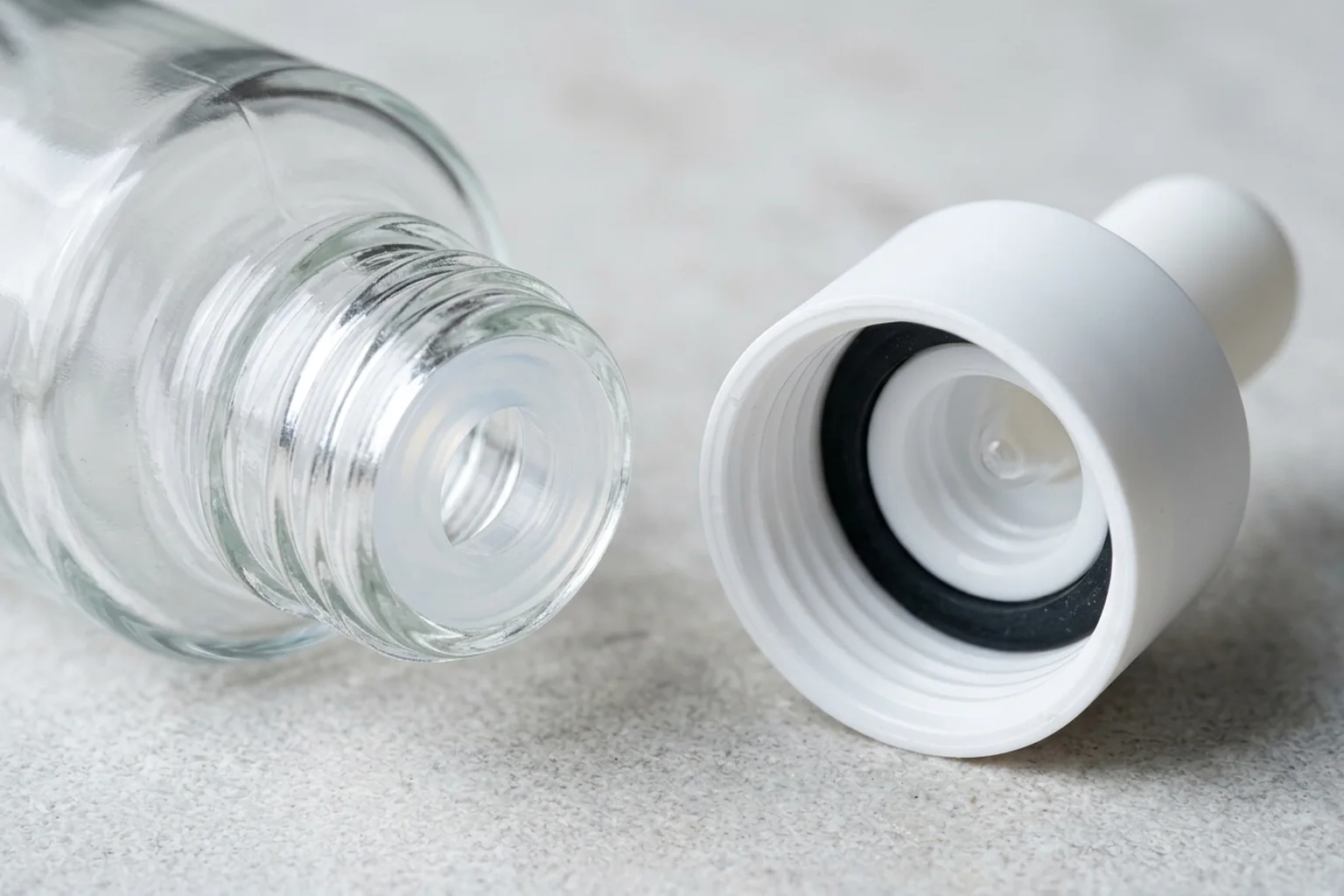
Thread Lubrication Back-Off and the Internal Wiper Seal
Dropper bottles can leak due to closure back-off, a phenomenon in which a pipette collar unscrews of its own accord. The most common cause of collar back-off is that the threads of the bottle have become wet with product, which lubricates them and results in loss of friction, whereas a wiper seal fits inside the neck of the bottle and wipes the surface of the pipette.
A wiper is inserted in the bottle neck to eliminate the excess product on extracting the pipette. Virospack dropper collars in urea, PP/PCR, wood, or metallized finishes complete the visual identity, while the wiper acts as a micrometric internal component that guarantees clean dosage and sealing. The pipette tube needs to be the correct diameter so that it can fit a pipette wiper seal when one is being used.
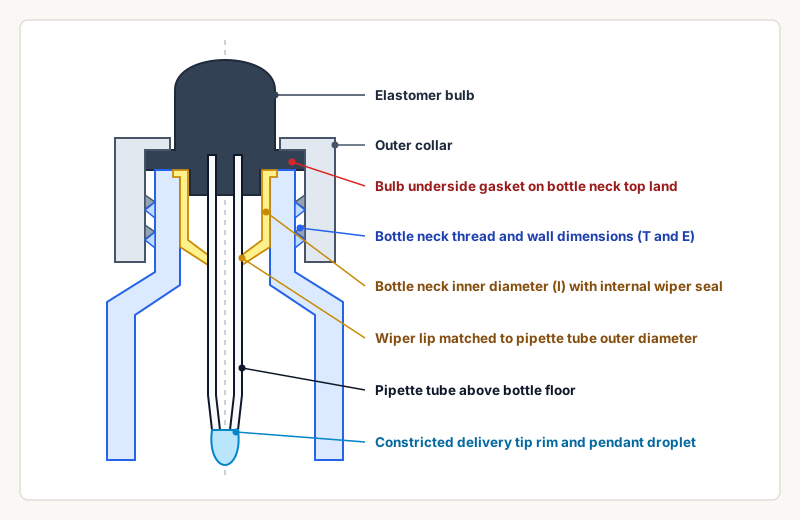
Bottle Neck Finish Dimensions, Closure Torque, and Vacuum Leak Testing
Common bottle neck types for cosmetic droppers include the GL18 (18mm diameter) and the 20/410 (20mm diameter), which have tightly controlled specifications. For a detailed comparison of neck finish heights and skirt clearances across closures, see our guide to neck finish pump fitment.
In bottle neck finish specifications, the I dimension is the inner diameter of the bottle neck, and linerless closures with a plug or land seal and dispensing plugs and fitments require a controlled I dimension for a proper fit. The T dimension is the outside diameter of the thread, the E dimension is the outside diameter of the neck, and the difference between the E and T dimensions divided by two determines the thread depth.
Applying excessive torque can create uneven pressure points on the closure, leading to an improper seal, while under-tightening can prevent the cap from forming a proper seal; as a general guideline, torque is usually about half of the cap’s diameter, expressed in inches per pound. For an 18 mm cap on glass, recommended application and removal torque is 9 and 5 for a Phenolic/Urea cap and 13 and 8 for a PP / PE cap; for a 20 mm cap on glass, recommended application and removal torque is 10 and 5 for a Phenolic/Urea cap and 15 and 9 for a PP / PE cap.
ASTM D4991 covers the testing of empty containers for resistance to leakage under differential pressure conditions such as those which can occur during air transport. The ASTM D4991 test method establishes the point at which leakage commences, with a limit of approximately 95 kPa (13.8 psi) differential. Cosmetic brands also usually conduct physical tests for 12 weeks even when bottle neck and pipette tolerances are tightly specified.
| Neck or Sealing Parameter | Standard Designation or Interface | Dimensional or Torque Specification |
|---|---|---|
| Cosmetic dropper bottle neck types | GL18 and 20/410 bottle neck types | GL18 (18mm diameter) and 20/410 (20mm diameter) with tightly controlled specifications |
| Bottle neck I dimension | Inner diameter of the bottle neck | Linerless closures with a plug or land seal and dispensing plugs and fitments require a controlled I dimension for a proper fit |
| Bottle neck T and E dimensions | Outside diameter of thread T and outside diameter of neck E | The difference between the E and T dimensions divided by two determines the thread depth |
| Recommended torque on glass for 18 mm and 20 mm caps | Phenolic/Urea cap on glass and PP / PE cap on glass | 18 mm cap on glass is 9 / 5 (Phenolic/Urea) and 13 / 8 (PP / PE), and 20 mm cap on glass is 10 / 5 (Phenolic/Urea) and 15 / 9 (PP / PE) |
| ASTM D4991 vacuum leakage test limit | Differential pressure leakage test | Establishes the point at which leakage commences, with a limit of approximately 95 kPa (13.8 psi) differential |
| Physical compatibility and seal testing | Filled dropper assembly verification | Cosmetic brands usually conduct physical tests for 12 weeks even when everything is tightly specified |
Verifiable Serum Dropper Parameter Checklist
Use the verification table below when specifying or auditing a serum dropper assembly across laboratory samples and production lots. For broader container-handling principles across everyday dispensers, browse the personal-care packaging section.
| Inspection Checkpoint | Parameter to Record | Verification Standard or Target |
|---|---|---|
| Delivery tip opening and water drop weight | External tip diameter and vertical water drop mass | External diameter of about 3 mm delivering water drops weighing between 45 mg and 55 mg each under USP General Chapter 1101 |
| Calibrated dropper volume tolerance | Volume error under normal use conditions | Volume error should not exceed 15% under normal use conditions under USP General Chapter 1101 |
| Formulation rheology and drop size (ophthalmic timolol study methods) | Surface tension and viscosity measurement in that ophthalmic study | In that ophthalmic study, surface tension was determined using the drop count method and viscosity was determined using the Ostwald viscometer |
| Skincare pipette bulb capacity | Nominal bulb volume selection | Two of the most common sizes (capacities) in the skincare market are 0.7ml and 1ml |
| Pipette tube and wiper seal fit | Pipette tube outer diameter | The tube needs to be the correct diameter so that it can fit a pipette wiper seal when one is being used |
| Bottle neck I dimension | Inner diameter of the bottle neck | Linerless closures with a plug or land seal and dispensing plugs and fitments require a controlled I dimension for a proper fit |
| Inverted gasket compression | Collar, bulb/gasket, and bottle neck tolerances | Correct tolerances between collar, bulb/gasket, and bottle neck create the compression required so product does not leak when upside-down |
| Vacuum pressure-differential leak test | ASTM D4991 vacuum leakage test | Establishes the point at which leakage commences, with a limit of approximately 95 kPa (13.8 psi) differential |
| Physical compatibility and seal testing | Filled pack test duration | Cosmetic brands usually conduct physical tests for 12 weeks even when everything is tightly specified |
Sources
- United States Pharmacopeia — General Chapter Medicine Dropper
- Weizmann Institute of Science / Benny Lautrup — Physics of Continuous Matter: Surface Tension
- KRÜSS Scientific — Surface Tension as a Basic Parameter for Controlling Drop Dispensing of Ophthalmic Solutions
- PubMed Central (NIH / NLM) — Reduction in Drop Size of Ophthalmic Topical Drop Preparations
- ASTM International — ASTM D4991 Standard Test Method for Leakage Testing of Empty Rigid Containers by Vacuum Method
- Virospack — Exact Dosage Also Suitable for Higher Viscosity Cosmetics
- Virospack — The First Real Autofill Bulb Dropper
- Virospack — Custom Packaging for Cosmetics: Exclusive Glass Bottles and Droppers
- Richmond Containers (Richmond Group) — In Depth: Cosmetic Dropper Pipettes
- U.S. Plastic Corp. — Smooth White Polypropylene Cervino Dropper Cap with Nitrile Bulb and Ball Tip Glass Pipette
- C.L. Smith — Neck Finish Dimensions and Chart (GPI / SPI Standards)
- TricorBraun — Understanding Torque in Closure Applications