
Executing a professional costume design process across live Broadway theatre and motion-picture production requires translating narrative character psychology into verifiable textile, optical, acoustic, and mechanical tolerances: ruling every screenplay page into 1/8th-of-a-page increments (1 page = 8 eighths ≈ 60 seconds, or 7.5 seconds per 1/8th) across independent Story Days (D1, D2, N2), Change Numbers (Chg #1, #2A, #2B), and non-linear Shoot Days; verifying 5 × 8 cm warp-aligned character arc swatches under 3,200 K tungsten, 5,600 K daylight, and narrow-band stage LEDs while screening out ≤1.0 to 2.0 mm micro-weaves that trigger Nyquist moiré aliasing on 4K/8K CMOS sensors and crisp filaments that generate 35 to 55+ dBA of lavalier microphone rustle; separating stage vs screen costume durability (5/8 to 1.0 in. / 16 to 25 mm alteration inlays and 8-show/week gusseted construction versus 14 to 18 SPI close-up tailoring backed by 3 to 6+ identical hero, breakdown, and stunt multiples); re-engineering closures with #3/#4 (13 to 15 mm) snaps or #10 (21 to 25 mm) Whopper Poppers® for 15-to-30-second wing quick changes; and locking 4-angle fitting photographs, 50:50 glycerin/water and Fuller’s earth breakdown recipes, and ISO 9706 archival conservation parameters inside the costume Continuity bible.
Where our parent analysis on how costume design carries a character examines the Victoria and Albert Museum Hollywood Costume (Gallery 39) panel text—establishing why costume begins with the screenplay, why MGM designer Adrian wrote in 1938 that a garment must mirror a definite mood of the play, how Jason Bourne’s camouflage-grey palette conceals him in a crowd, and why Ellen Mirojnick observed that contemporary clothing requires harder design work to disappear into the story—this technical guide within the style section details how a wardrobe department builds, tests, rigs, and tracks those garments on set and backstage. Similarly, while our production table on what the 2012 Broadway revival record lists documents the verified Internet Broadway Database (IBDB) record for A Streetcar Named Desire at the Broadhurst Theatre (23 previews and 105 performances between 3 April and 22 July 2012, set in the French Quarter of New Orleans in 1952), its credited department heads—Costume Designer Paul Tazewell (2012 Tony Award nominee), Associate Costume Designer Sara Jean Tosetti, Assistant Costume Designer Sarah Cubbage, Lighting Designer Edward Pierce, Sound Designer Mark Bennett, and Hair and Wig Designer Charles G. LaPointe—illustrate why costume construction cannot operate in isolation from stage lighting spectra, wireless microphone placement, and cranial/axillary sweat chemistry.
| Workflow Phase | Primary Technical Deliverable | Governing Dimensional or Optical Tolerance | Cross-Departmental Interface | Failure Mode if Omitted |
|---|---|---|---|---|
1. Script Breakdown (1/8th-Page Timing) |
Three-axis breakdown ledger (Story Day, Change #, Shoot Day) in SyncOnSet |
1 page = 8/8ths ≈ 60 s (1/8th ≈ 7.5 s); ≥4/8ths action/rain flags 3 to 6+ multiples |
1st Assistant Director (stripboard), Script Supervisor, Line Producer |
Visual jump-cuts when non-linear Shoot Days 3 and 34 film adjacent Story Day scenes |
| 2. Swatch Card & Camera/Mic Testing | Character Arc Swatch Card (5 × 8 cm warp shell + 2 × 4 cm lining/trim + Pantone TCX/TPG) |
Weave pitch >2.0 to 3.0 mm (zero 4K/8K Nyquist moiré); 0.5–1.0 stop OBA tech-dye; <35 dBA mic rustle |
Director of Photography, Lighting Designer (3,200 K / 5,600 K / LEDs), Sound Mixer |
Rainbow CMOS moiré fringes on 35–50 mm lenses; electric-violet white shirts; 2–8 kHz vocal masking |
| 3. Stage vs. Screen Build Specification | Shop cutting ticket (8 shows/wk stage build vs. 85 mm close-up screen hero + multiples) |
Stage: 16 to 25 mm inlays (38 to 50 mm CB waist), 6 × 10 cm gussets, #5–#8 zippers; Screen: 14 to 18 SPI |
Cutter/Fitter, Stunt Coordinator (25 mm harness slots), Hair/Wig Designer |
Underarm seam blowout during stage combat; visible overlock stitching on 85 mm close-up lenses |
| 4. Backstage Quick-Change Rigging | Rapid-closure conversion (15 to 30 s wing transition window) |
#3/#4 (13–15 mm) snaps or #10 (21–25 mm) Whopper Poppers on 20–25 mm grosgrain; 15–20 mm zip rings |
Deck Wardrobe Dressers, Stage Manager, Sound RF Tech (≥5–8 cm magnet clearance) |
Missed stage entrance (60–90 s standard buttons); 80–90 dBA Velcro rip bleeding into live mics |
5. Principal Fitting (30–45 Min Protocol) |
Base-layer lock, clay-chalk pinning, 180° kinematic test, & 4-angle slate photos |
Neutral 5,000 K CRI ≥95 mirror bay; ±25 mm heel pitch lock; Front, L 90°, R 90°, Back views |
Principal Actor, Costume Designer, Cutter/Fitter, Assistant Designer | Hem break shifts on set when shoe heel changes; jacket collar gaps during seated camera blocking |
| 6. Continuity Bible & Archival Wrap | Digital/binder costume Continuity bible, breakdown recipe log, & ISO 9706 storage |
18 to 21 °C (64–70 °F), 45% to 55% RH (±3%–5%); unbuffered pH 7.0–7.5 (protein) vs. pH 8.0–8.5 (cellulose) tissue |
Set Costumer, Breakdown Artist, Property Master, Studio/Museum Archivist | Mismatched sweat/blood aging across multiples; protein hydrolysis or lignin yellowing in storage |
1. Script Breakdown, 1/8th-of-a-Page Timing, and Character Arc Swatch Testing
As documented in the Academy of Motion Picture Arts and Sciences (AMPAS) Costume Design guide and the V&A Hollywood Costume panel examined in our character and costume design note, the costume design process begins with deconstructing the screenplay before a single sketch is drawn or bolt of cloth is pulled.
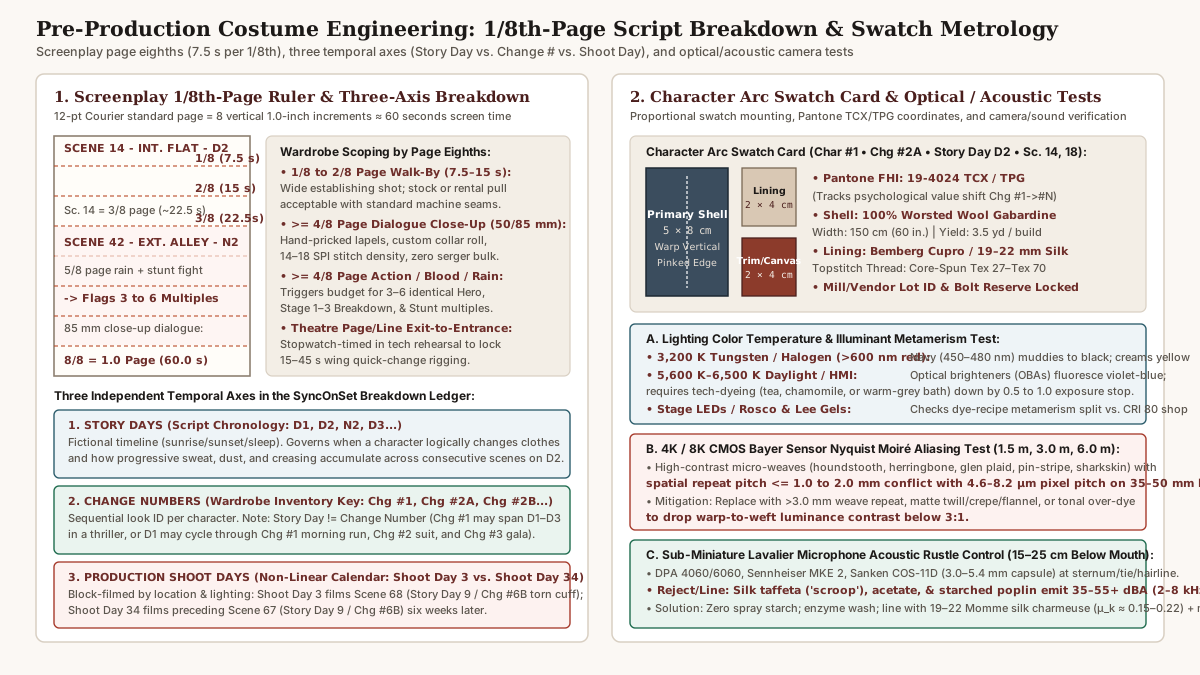
The 1/8th-of-a-Page Screenplay Convention (7.5 Seconds per Eighth)
In standard motion-picture and television formatting (12-point Courier typeface, 1.0-inch top and bottom margins, 1.5-inch left binding margin), one full screenplay page (125 to 135 words) equals approximately 1.0 minute (60 seconds) of screen time. First Assistant Directors (1st ADs) and Costume Supervisors divide every page horizontally into 8 equal vertical increments of 1.0 inch each, termed Eighths of a Page (1/8ths), where each 1/8th represents roughly 7.5 seconds of screen exposure.
Logging scene lengths in eighths (e.g., Scene 14 = 3/8ths of a page ≈ 22.5 seconds versus Scene 42 = 4 and 5/8ths pages ≈ 4 minutes 37 seconds) governs three engineering decisions:
- Lens Scrutiny and Tailoring Grade: A
1/8th-pagewide establishing walk-by (~7.5 s) allows standard retail or rental house stock (rack pulls), whereas a3 and 4/8-pageinterior confrontation filmed on50 mmand85 mmclose-up prime lenses demands hand-pricked lapels, custom-shaped collar rolls, and zero visible machine overlock bulk. - Action and Weather Multiples Budgeting: Any scene exceeding
4/8ths(0.5 page) that combines dialogue with rain towers, stunt wirework, food/beverage spills, or stage blood automatically triggers the budget requirement for3 to 6+identical garment multiples. - Theatrical Page/Line Exit-to-Entrance Timing: In live stage productions—such as the two-act structure of A Streetcar Named Desire at the Broadhurst Theatre—the Costume Supervisor converts script page and line counts between an actor’s Act I Scene 2 exit and Scene 3 entrance into a stopwatch-verified off-stage transition window (
15 to 45 seconds) during technical rehearsals.
Separating Story Days (D1, D2, N2), Change Numbers (Chg #1, #2A), and Shoot Days
To prevent continuity errors during block shooting, the wardrobe department tracks three orthogonal temporal axes inside SyncOnSet:
- Story Days (
Script Chronology: D1, D2, N2, D3...): The internal timeline of the fictional narrative, advancing whenever the sun rises or sets or characters sleep. Story Days dictate when a character logically changes clothes and how progressive perspiration, street dust, or linen wrinkling accumulates across consecutive scenes occurring on the same Story Day (e.g., Scenes 4, 7, 11, and 18 all taking place across a single humid afternoon on Story Day 2). - Change Numbers (
Wardrobe Inventory Key: Chg #1, Chg #2A, Chg #2B...): The sequential inventory identifier assigned to each distinct look a specific character wears across the script (Character #1 / Change #1,Change #2, plus sub-states such asChange #2Awith suit jacket buttoned versusChange #2Bwith jacket removed and sleeves rolled two turns). Crucially, Story Day does not equal Change Number: a protagonist in a survival thriller may wearChange #1across three consecutive Story Days (D1 to D3), while a corporate drama lead may cycle throughChanges #1, #2, and #3within a single Story Day (D1morning run, courtroom suit, evening gala). - Production Shoot Days (
Calendar Shooting Days: Shoot Day 1 of 45...): The real-world calendar sequence in which scenes are filmed, grouped by location availability, set lighting direction, and cast schedules rather than narrative order. On Shoot Day 3, an actor may filmScene 68(Story Day 9 / Change #6B—featuring a torn left cuff, Stage-2 oxidized blood, and damp underarm sweat rings); six weeks later on Shoot Day 34, the production moves to an interior soundstage to filmScene 67(Story Day 9 / Change #6Bimmediately precedingScene 68as the character steps through the doorway). Only strict indexing by Change Number and stage-state prevents a visual jump at the edit point.
Character Arc Swatch Cards and Optical/Acoustic Metrology
Before cutting yardage, Assistant Costume Designers and Swatchers construct physical and digital Character Arc Swatch Cards (Costume Plot Boards) ordered sequentially from Chg #1 to Chg #N. Each card mounts a 5 × 8 cm pinked primary shell swatch cut with the warp grain oriented vertically (so gravity drape and pile nap direction read accurately), alongside proportional 2 × 4 cm secondary swatches for hair-canvas interlining, Bemberg cupro or 19 to 22 Momme silk lining, pocket bag pocketing, topstitching thread (Tex 27 to Tex 70), and buttons—scaled to reflect their visual surface ratio on the finished garment. Header metadata records Character Name, Actor, Scene Numbers, Story Day, Change Number, Mill/Vendor, Bolt Lot ID, Fiber Content (%), Width (cm/in), Yardage Required, and Pantone® Fashion, Home + Interiors (TCX/TPG) coordinates so the designer can track psychological color-value shifts across the script.
Every candidate swatch must pass three pre-production metrology gates with the camera, lighting, and sound departments:
- Spectral Color Temperature (
3,200 Kvs.5,600 K) & Illuminant Metamerism:3,200 KTungsten / Stage Halogen (>600 nmred/orange peak): Deepens warm reds and ambers but causes cool navy blues (450 to 480 nm) to muddy into charcoal black and yellow-undertone creams to appear jaundiced against skin.5,600 K to 6,500 KDaylight / HMI (460 to 500 nmblue peak): Excites synthetic optical brightening agents (OBAs) embedded in commercial white dress shirts and retail laundry detergents, causing modern white cottons to fluoresce an unnatural electric violet-blue and clip digital highlight channels. All on-camera whites are tech-dyed (tea, chamomile, or weak warm-grey tint bath) down by0.5 to 1.0 exposure stopto read as natural white on sensor.- Narrow-Band Stage LEDs & Dichroic Gels (
Illuminant Metamerism): Under stage lighting designs (such as Edward Pierce’s lighting plot on Streetcar or Rosco/Lee gel combinations), two fabrics dyed with different chemical recipes—such as a worsted wool trouser and a polyester-blend waistcoat—can match perfectly under5,000 Kshop fluorescent tubes (CRI 80) yet split into mismatched purple and green-black under narrow-band RGB/amber stage emitters or cinemaTLCI ≥ 95fixtures.
4K/8KCMOS Sensor Nyquist Moiré Aliasing (≤1.0 to 2.0 mmWeave Pitch): As analyzed in Imatest optical metrology documentation on digital sensor moiré, modern digital cinema cameras (ARRI Alexa 35,RED V-Raptor,Sony Venice 2) sample images across a fixedSuper 35orFull FrameBayer-pattern CMOS grid (4.6 to 8.2 µmpixel pitch). When a costume textile features a high-contrast, repetitive geometric weave—specifically fine houndstooth, micro-herringbone, glen plaid, narrow pin-stripes, sharkskin, or tight mesh with a spatial repeat pitch of≤1.0 to 2.0 mm—projected at medium focal lengths (35 to 50 mmat1.5 m,3.0 m, and6.0 mcamera distances), the projected spatial frequency approaches or exceeds the sensor’s Nyquist limit, generating iridescent rainbow interference fringes that cannot be removed cleanly in post-production. Any swatch exhibiting moiré during pan/tilt camera tests is replaced with a larger weave repeat (>3.0 mm), a matte plain/twill weave (gabardine, hopsack, flannel, wool crepe), or tonal over-dyed to drop warp-to-weft luminance contrast below3:1.- Sub-Miniature Lavalier Microphone Acoustic Rustle (
35 to 55+ dBAat2 to 8 kHz): Both Broadway sound designs (referencing Sound Designer Mark Bennett’s credit on Streetcar) and film/TV sets conceal omnidirectional lavalier microphones (DPA 4060/6060,Sennheiser MKE 1/MKE 2,Sanken COS-11D, capsule diameter3.0 to 5.4 mm) inside the costume at the sternum placket, tie knot, corset busk, or hairline (15 to 25 cmbelow the mouth). Crisp filament weaves and stiffened finishes—silk taffeta (scroopstick-slip friction), acetate taffeta linings, heavily starched cotton poplin, and nylon windbreakers—emit35 to 55+ dBAof broadband2 to 8 kHzcrackle during torso rotation or breathing, masking vocal consonants. Wardrobe departments enforce a strict ban on commercial spray starch, enzyme-wash cotton shirting, isolate mic capsules inside brushed moleskin bumpers, and line structured bodices with silent19 to 22 Mommemulberry silk charmeuse (μ_k ≈ 0.15 to 0.22) or Bemberg cupro.
2. Stage vs. Screen Costume Durability and Under-30-Second Quick-Change Rigging
The structural engineering gap governing stage vs screen costume durability stems from operational lifespan versus optical magnification. On Broadway—where the 2012 Broadhurst Theatre revival of A Streetcar Named Desire ran 128 total performances (23 previews + 105 performances) at 8 shows per week (Tuesday through Sunday, with Wednesday and Saturday matinees), and open-ended musicals exceed 400 performances per year—a single custom-built garment must survive continuous athletic choreography, 32 to 38 °C stage deck heat, and 8x/week maintenance while reading clearly from 5 m in the front orchestra to 35+ m in the balcony. Conversely, a feature film or television garment may only be worn for two shoot days, but its collar stitching is magnified across a theater screen by an 85 mm lens positioned 40 cm from the actor’s chin.
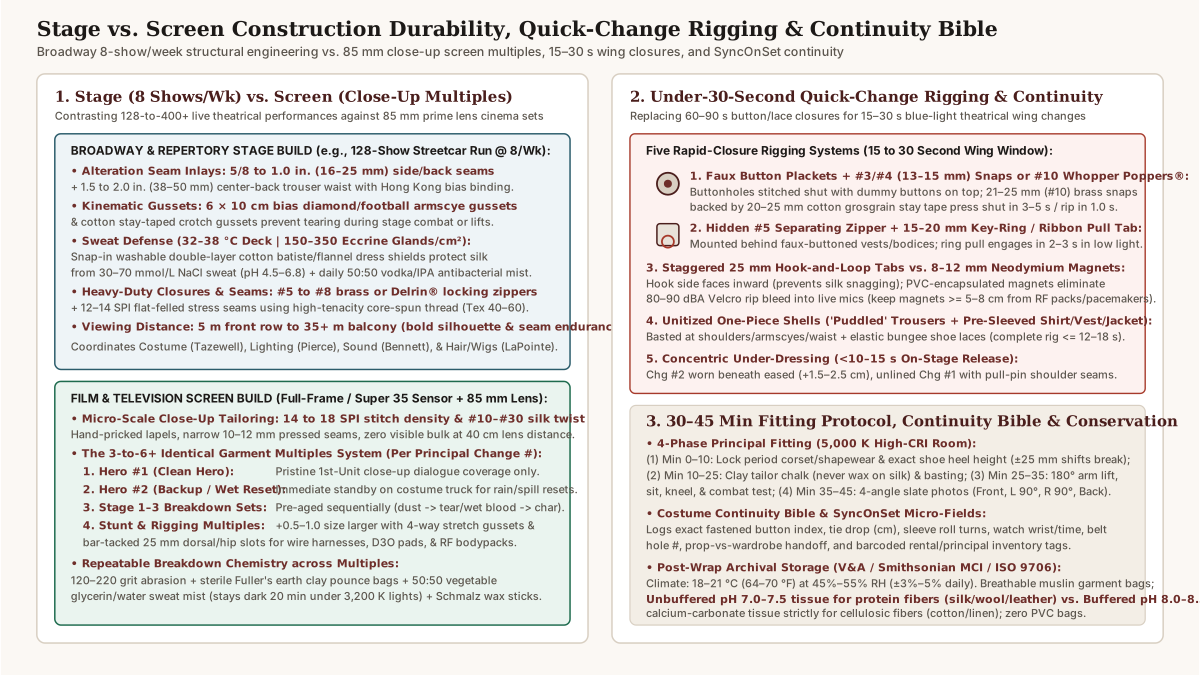
Broadway Stage Durability vs. Screen Multiples (3 to 6+ Sets)
| Engineering Parameter | Broadway & Repertory Stage Build (8 Shows / Week) |
Film & Television Screen Build (4K/8K Close-Up + Multiples) |
|---|---|---|
| Seam Allowances & Alteration Inlays | 5/8 to 1.0 in. (16 to 25 mm) side/back inlays + 1.5 to 2.0 in. (38 to 50 mm) center-back trouser waist let-out, bound with Hong Kong bias or open-pressed overlock for rapid cast-change alterations |
Narrow 3/8 to 1/2 in. (10 to 12 mm) pressed seams to eliminate shadow ridges under sheer or lightweight fabrics in tight close-ups |
Stitch Density (SPI) & Lapel Finish |
12 to 14 SPI flat-felled stress seams using high-tenacity core-spun polyester thread (Tex 40 to Tex 60) built for tensile tear resistance |
14 to 18 SPI micro-stitching using #10 to #30 silk buttonhole twist and hand-pricked lapels invisible at 40 cm lens focus |
| Kinematic Gussets & Harness Access | 6 × 10 cm bias-cut diamond or football armscye gussets + cotton stay-taped diamond crotch gussets allowing 180° arm extension without jacket lift |
Dedicated Stunt/Rigging Multiples (+0.5 to 1.0 size) with 4-way stretch panels and bar-tacked 25 mm dorsal/hip pass-through slots for flying wires, D3O pads, and RF transmitters |
| Sweat Protection & Laundering Cycle | Snap-in washable double-layer cotton batiste/flannel dress shields in armholes + daily 50:50 vodka/isopropyl alcohol (or 70% IPA) antibacterial misting between shows |
Multiples rotation (Clean Hero #1 never wet-washed during shoot; Hero #2 Backup held on truck for immediate spill/rain resets) |
| Primary Closures | Heavy-duty #5 to #8 brass or molded polyacetal (Delrin®) locking zippers + grosgrain-backed #3/#4 snaps or #10 Whopper Poppers |
Authentic period horn/corozo buttons, delicate #2/#3 invisible zippers, or pinned/basted closures locked specifically for camera angles |
In stage workrooms, axillary sweat management is a structural priority. Under 32 to 38 °C stage lighting in a humid 1952 New Orleans drama like Streetcar, human skin (150 to 350 eccrine sweat glands/cm²) secretes 99% water plus 30 to 70 mmol/L sodium chloride (NaCl) and 10 to 30 mmol/L lactic acid at pH 4.5 to 6.8—the same biochemical mechanism that cleaves cortical alpha-keratin hydrogen bonds in our silk press maintenance and humidity reversion guide and requires close coordination with Hair and Wig Designer Charles G. LaPointe’s lace-front wig foundations. Because acidic NaCl perspiration rapidly degrades silk fibroin tensile strength and bleaches natural dyes—while Mulberry Silk’s 11.0% equilibrium moisture regain and cotton’s 8.5% vapor regain (24x to 27x liquid absorption) per ASTM D1909 commercial moisture regain standards govern moisture retention—stage tailors baste or snap detachable double-layer cotton batiste dress shields into every armscye. Deck crew unsnap and wet-wash the cotton shields after each curtain call while keeping the outer silk or wool shell dry.
For motion pictures, rather than building one heavily reinforced garment, the Costume Supervisor budgets 3 to 6+ identical multiples for any principal look facing action or environmental wear:
Hero #1 (Clean Hero): Reserved strictly for 1st-Unit close-up dialogue coverage.Hero #2 (Backup / Wet-Reset Hero): Held ready on the set truck so Takes 1 and 2 of a rain-tower or coffee-spill scene can reset in under5 minutes.Stage 1, Stage 2, and Stage 3 Breakdown Multiples: Pre-weathered in sequential narrative stages (Stage 1: dusty knees; Stage 2: torn left shoulder + wet stage blood; Stage 3: dried oxidized blood + charred hem).Stunt Double & Photo-Double Multiples (1 to 2 sets): Cut0.5 to 1.0size larger to conceal flying harnesses, spine protectors, and wireless audio packs (Lectrosonics SSMorWisycom MTP60) without distorting the outer drape.
Backstage Quick-Change Rigging (15 to 30 Seconds in the Wings)
As detailed in Wenger Corporation performing arts backstage quick-change protocols, fastening a standard 8-button dress shirt, cufflinks, trouser fly, and laced Oxford shoes takes 60 to 90 seconds under full workroom illumination. When a script breakdown locks a 15-to-30-second quick-change window in a dimly lit theatrical wing (blue LED running lights) with perspiring hands, costumers convert standard closures using five mechanical rigging techniques:
- Faux Button Plackets over
#3/#4Snaps or#10Whopper Poppers® (3 to 5 sClose /1.0 sRip): The functional buttonholes on the upper placket overlap are permanently machine-stitched closed, and the exterior buttons are sewn directly through the sealed holes as decorative dummy caps. Beneath the overlap, drapers sew continuous20 to 25 mmcotton grosgrain or twill stay tape (preventing8x/weekrip-open tension from tearing fine shirting) fitted with heavy-duty nickel-plated brass spring snaps:#3or#4(13 to 15 mmdiameter) for shirts and bodices, or quarter-sized#10Whopper Poppers® (21 to 25 mmdiameter) for heavy overcoats, waistbands, and period corsets. - Hidden
#5Separating Zippers with15 to 20 mmKey-Ring Pull Tabs (2 to 3 sPull): On fitted waistcoats, period bodices, or military tunics where point tension between snaps would cause the placket to gap, a#5brass or molded open-ended separating zipper is concealed behind the faux-buttoned lip. Attaching a15 to 20 mmbrass split ring or grosgrain ribbon loop to the slider tab allows a dresser in low light to seat the pin into the box and zip upward in2 to 3 seconds. - Staggered
25 mmHook-and-Loop Tabs vs.8 to 12 mmNeodymium Magnets: While continuous hook-and-loop (Velcro®) strips close cuffs and breakaway seams rapidly, they introduce two severe hazards: an80 to 90 dBAacoustic ripping sound that bleeds into open stage microphones, and exposed hooks that shred adjacent silk and lace in laundry hampers. Costumers sew the hook side facing inward (away from skin and silk), segment tape into staggered25 mmtabs, or replace Velcro on silent breakaway collars and lapels with sew-in PVC-encapsulated neodymium magnet discs (8 to 12 mm diameter × 1.5 mm)—observing a strict5 to 8 cmminimum clearance from wireless bodypack reed switches and cardiac pacemakers, and keeping magnetized garments out of steel-drum dryers. - Unitized One-Piece Shells (
<= 12 to 18 sFull Rig) & Elastic Bungee Footwear: Separate garments that read as distinct layers to the audience—a dress shirt, waistcoat, and suit jacket, or a period chemise, bodice, and overskirt—are basted or zipped together at the shoulder seams, armscyes, and waistline into a single unitized shell. In the quick-change booth, trousers are pre-set puddled around the ankles of boots already laced with color-matched elastic bungee cord or fitted with a hidden medial ankle zipper; the actor steps into the boots, pulls the trousers up in one vertical motion, and thrusts both arms into the pre-sleeved shirt-vest-jacket shell held open by two dressers. - Concentric Under-Dressing (
<10 to 15 sOn-Stage or Wing Shed): For sub-15-second or on-stage transformations, the actor enters wearingChange #2completely dressed underneathChange #1.Change #1is patterned with+1.5 to 2.5 cmextra chest/waist ease, unlined breathable cloth to prevent thermal exhaustion, and pull-pin or Whopper-Popper shoulder/side seams that release cleanly in a single tug.
3. The 30-to-45-Minute Fitting Protocol, Costume Continuity Bible, and Archival Storage
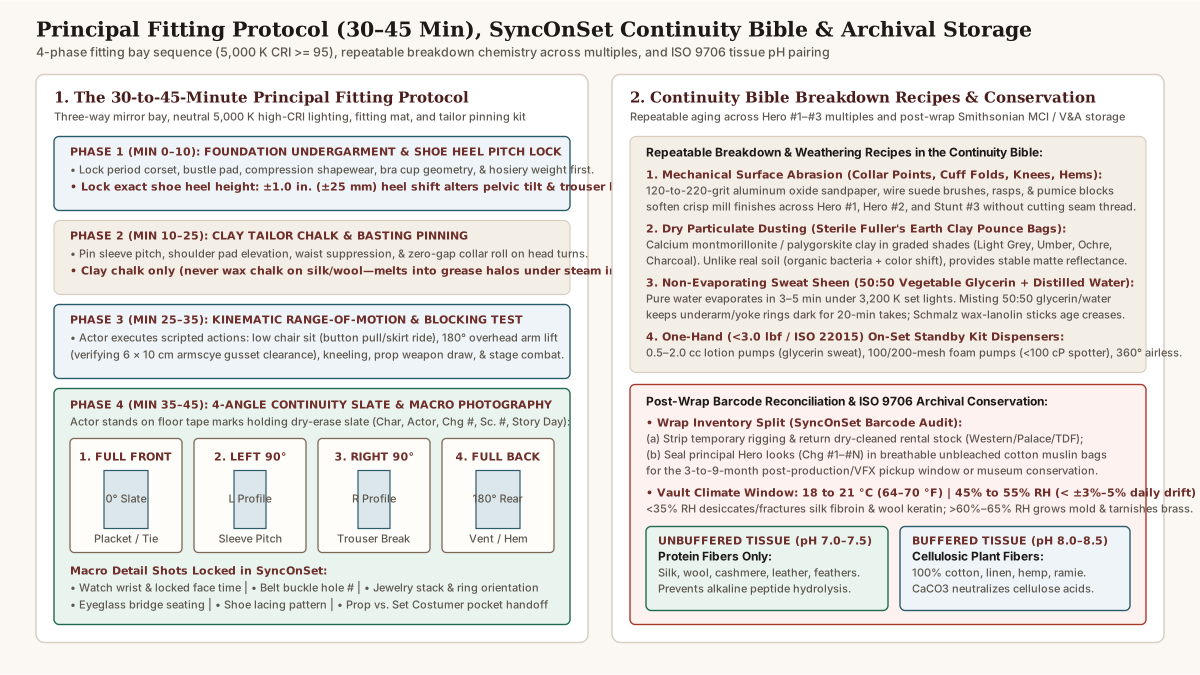
The 4-Phase Principal Fitting Room Protocol (Minutes 0 to 45)
Conducted in a costume shop fitting bay equipped with a three-way full-length mirror, neutral 5,000 K high-CRI (≥95) lighting, a non-slip fitting mat, and a stocked pinning kit, a structured 30-to-45-minute principal fitting unites the Costume Designer, Assistant Costume Designer, Cutter/Fitter, and Wardrobe Supervisor across four timed stages:
- Phase 1: Base Undergarment & Shoe Heel Pitch Lock (
Minutes 0 to 10): Silhouette begins at the foundation layer. Before testing outer garments, the team locks the exact period corset, bustle pad, compression shapewear, brassiere cup geometry, undershirt neckline depth, and exact character shoe heel height—because a1.0 inch(25 mm) shift in heel pitch alters pelvic tilt, trouser break, and floor-length skirt hem clearance across every look. - Phase 2: Clay Tailor Chalk & Basting Pinning (
Minutes 10 to 25): The Cutter/Fitter adjusts sleeve pitch, shoulder pad elevation, waist suppression, and collar hug (zero neck gap during head turns) using clay tailor’s chalk (never wax chalk on silk or fine wool, which melts into permanent grease halos under steam irons) and safety pins, converting all marks to contrasting cotton basting thread before the garment leaves the room. - Phase 3: Kinematic Range-of-Motion & Blocking Verification (
Minutes 25 to 35): Static mirror posture never validates a costume. The designer directs the actor through every physical action flagged in the script breakdown: sitting in a low armchair, raising both arms to180°overhead shoulder flexion (verifying that diamond gussets prevent the jacket collar from riding up the neck), kneeling, drawing a prop, or executing choreography. - Phase 4: Standardized 4-Angle Continuity Reference Photography (
Minutes 35 to 45): Standing on calibrated floor tape marks while holding a dry-erase slate (Character, Actor, Change #, Scene #s, Story Day, Option A/B), the actor is photographed across four mandatory cardinal angles (Full Front,Left Profile 90°,Right Profile 90°,Full Back) plus macro close-ups of watch face time, belt buckle hole number, jewelry stack order, eyeglass bridge seating, and shoe lacing pattern.
The Costume Continuity Bible (SyncOnSet) and Repeatable Breakdown Recipes
Whether compiled in multi-ring truck binders or synchronized across tablets via SyncOnSet’s digital costume continuity and inventory platform, the costume Continuity bible (Continuity Book) serves as the operational contract between the Set Costumer, Key Costumer, Breakdown Artist, Property Master, and Script Supervisor.
- Micro-Styling and Prop-Wardrobe Handshake Fields:
For every scene and Change Number, the costume Continuity bible records exact closure coordinates (
e.g., 2nd shirt button from top fastened; collar button open; tie knot Four-in-Hand loosened 3.5 cm below collar button; sleeves rolled 2 flat turns of 6.0 cm each below the elbow; French tuck with 2.5 cm blousing) and explicitly assigns “working props” vs. “personal wardrobe accessories” (such as whether the Set Costumer or Property Master holds the character’s eyeglasses, wedding ring, watch, and badge between takes). - Repeatable Breakdown, Aging, and Weathering Chemistry (
Hero #1throughStunt #4): To ensureHero #1,Hero #2, andStunt #3match seamlessly across non-linear Shoot Days, Textile Breakdown Artists log exact material formulas inside the Continuity Bible—applying the same single-hand ergonomic dispensing standards (<3.0 lbf/13.3 Nactuation force underISO 22015:2019and the Arthritis Foundation guide) covered in our pump bottle ease-of-use evaluation:- Mechanical Abrasion: Micro-sanding collar peaks, cuff folds, knee fronts, and lower hems with
120-to-220-gritaluminum oxide sandpaper, wire suede brushes, rasps, or pumice blocks to replicate natural friction wear without cutting structural seam threads. - Dry Particulate Dusting (
Fuller's Earth): Puffing sterile, fine-mesh Fuller’s earth (calcium montmorillonite / palygorskite clay powder) from muslin pounce bags in graded mineral shades (Light Grey, Umber, Ochre, Charcoal) onto boot welts, trouser cuffs, and elbows. Unlike real topsoil (which harbors organic microbes and shifts hue as moisture evaporates), Fuller’s earth delivers uniform matte optical reflectance and brushes or vacuums out cleanly. - Non-Evaporating Sweat Sheen (
50:50Glycerin/Water), Spot Foams, andSchmalzGrease: Pure water sprayed onto a shirt evaporates within3 to 5 minutesunder3,200 Kstudio lights, destroying continuity mid-scene. Set costumers mist a50:50vegetable glycerin + distilled water solution (or light mineral oil) onto underarms and chest yokes so damp sweat rings remain dark across a20-minutetake cycle, paired with Schmalz (wax-and-lanolin grease sticks in black, brown, and grey) worked into collar creases and leather seams. In the on-set standby kit, viscous glycerin/mineral-oil sweat lotions are metered through0.5 to 2.0 cclotion pump bottles with FBOG dip tubes,<100 cPaqueous micellar stain spotters are dispensed as dry micro-bubbles (10:1air-to-liquid ratio) using100/200-meshfoam pump bottles so spot cleaning does not leave water rings on dry-clean-only wool, and oxygen-sensitive theatrical adhesives or barrier creams are carried in360°dip-tube-free airless pump bottles for one-handed inverted use in cramped wings.
- Mechanical Abrasion: Micro-sanding collar peaks, cuff folds, knee fronts, and lower hems with
Wrap Reconciliation and Archival Conservation (18 to 21 °C, 45% to 55% RH, ISO 9706)
When principal photography wraps or a Broadway production closes, the Costume Supervisor reconciles every barcoded garment tag in SyncOnSet: stripping temporary basting and returning cleaned rental stock (Western Costume, Palace Costume, TDF Costume Collection) while sealing principal character hero wardrobes (Change #1 through #N) in breathable unbleached cotton muslin garment bags for the 3-to-9-month post-production pickup window or permanent museum/studio archiving.
As specified by the Smithsonian Museum Conservation Institute (MCI) textile storage guidelines, long-term archival preservation requires two strict environmental and chemical controls:
- Climate Window (
18 to 21 °Cand45% to 55% RH): Maintain vault temperature at18 to 21 °C(64 to 70 °F) and relative humidity at45% to 55% RH(with daily drift< ±3% to 5% RH). Below35% RH, protein fibers (silk fibroin, wool keratin) desiccate and fracture under fold stress; above60% to 65% RH, mold spores germinate and brass snaps or metallic bullion threads corrode. - Unbuffered (
pH 7.0–7.5) vs. Buffered (pH 8.0–8.5) Acid-Free Tissue Interleaving (ISO 9706): Never store costumes in acidic corrugated cardboard (pH 4.5 to 5.5, which migrates lignin peroxides and yellows textiles) or sealed PVC dry-cleaning bags (which trap moisture and off-gas hydrochloric acid). Pad shoulders, sleeves, and horizontal folds with crumpled “sausages” of unbuffered, lignin-free neutral tissue paper (pH 7.0 to 7.5) for all animal protein fibers (silk, wool, cashmere, leather, feathers)—because alkaline calcium carbonate buffers (pH 8.5) catalyze alkaline hydrolysis of protein peptide chains—and reserve calcium-carbonate buffered acid-free tissue (pH 8.0 to 8.5) strictly for plant-derived cellulosic fibers (100% cotton, linen, hemp).